Revisiting the Desert

In Lent this year, it seemed more appropriate than ever to explore the rich traditions of spirituality associated with the early desert monastic life, not least because the pioneers of that way of life had a lot of interesting things to say about isolation and patience, about simplicity of life and prayer stripped down to its essentials. I have just read an excellent summary of the insights of the desert tradition in fewer than 8 pages. The Dominican Simon Tugwell’s book, Ways of Imperfection, is a survey of Christian spirituality from its earliest decades with a focus on the many ways in which these traditions steer us away from spiritual elitism towards a more ‘ordinary’ or ‘unspectacular’ way of seeing things which takes account of our human realities.

Ways of Imperfection An exploration of Christian spirituality ...

It is beautifully written – clear, concise and with some nice turns of phrase – and it draws on a careful and broad reading of traditional texts (and not always the best known ones). It was published in 1984 and I’ve only just got round to reading it now.

Here are one or two of his nuggets about the Desert tradition:

The most important way to show fraternal charity was to refrain from interfering with other people, and especially to refrain from criticising them.

It was, however, ’eminently proper to allow other people to interfere with you’. By this, he means that we should gently find ways to give way to the other. There was also a proper ignorance before the truth:

If someone asks you what a verse of scripture means, the proper answer is ‘I don’t know’. If someone says something you do not agree with, you should not argue with him but simply say, ‘You know best’.

The Apophthegmata Patrum is full of such wisdom, which seems to run counter to a culture which gives absolute primacy to one’s own opinion and is intolerant of agnosticism.

That is our business, then. Higher things can look after themselves; we must try to cope with all the disorder there is in our own souls.

The whole teaching of the desert might be summarised in the phrase: ‘pay attention to yourself’. This is not solipsism, but a recognition that there is one part of this vast universe for which we have a particular responsibility; this walking, breathing, opining, observing, interacting piece of squishy matter that is our own body.

‘If you have a heart,’ said Abba Pambo, ‘you can be saved.’ This is the essential thing. It does not matter so much what we do; what matters is that there should be a real human being there to do it. Salvation is offered to real people, not to fictitious saints.

Sermon for Easter 3

File:Rembrandt Christ with two disciples.jpg

In the early decades and centuries of the Christian story, there was a tussle between competing claims to represent authentic Christianity. One of the major threats from a range of groupings finally judged to be heretical was dangerous not because it represented a lax approach to the demands of the faith but for precisely the opposite reason. It was the view of such groups that Christians were called to a perfect life in which there was no room for second chances. The so-called Apostolic Fathers – people like Ignatius of Anticoch, Hermas and Clement – warned against the perfectionism of these groups, were suspicious of their certainties and cautioned against the excitement and ‘big talk’ of their leaders. You see, Christianity is not founded on perfection, but imperfection, and is more concerned with how we deal with disappointment than how to provide unshakable clarity. The Christian life is a matter of patient cultivation rather than constant exhilaration.

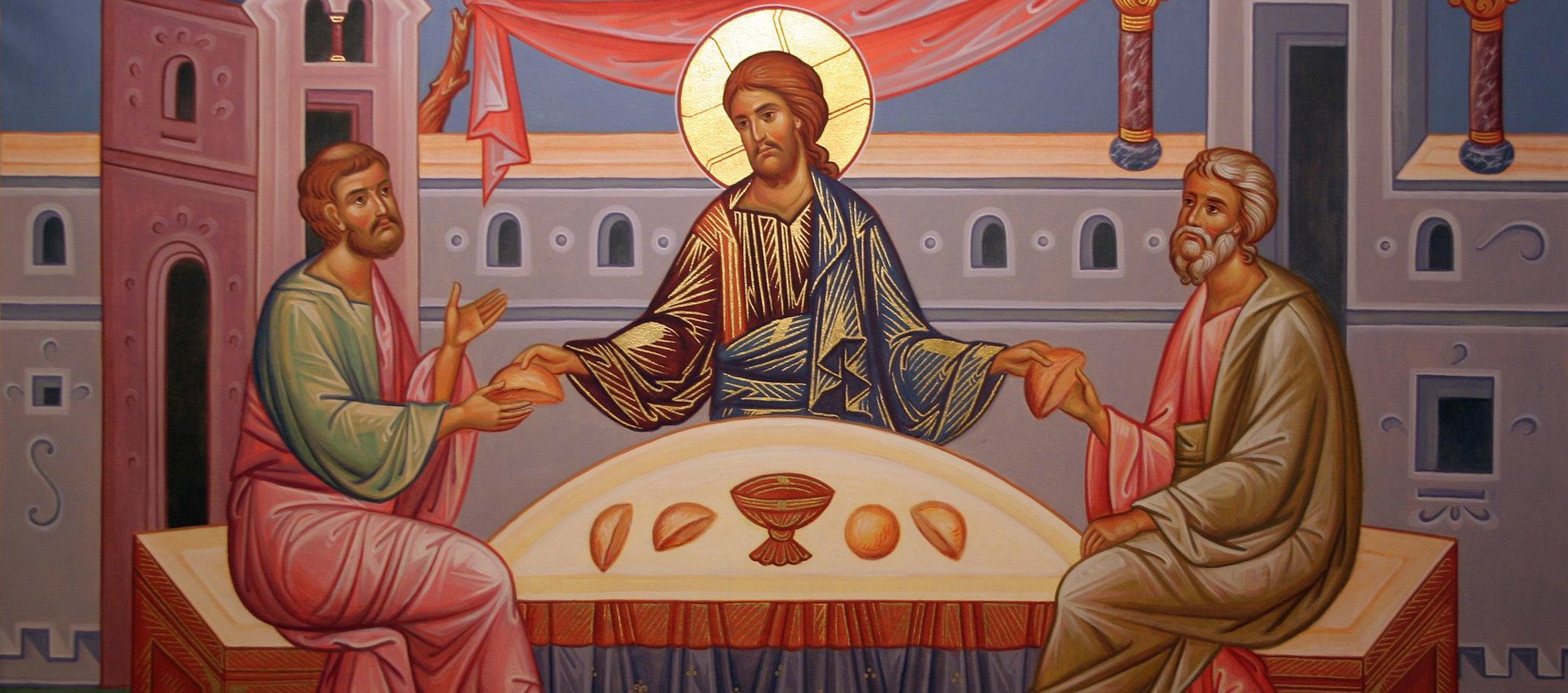
This much should be clear from today’s Gospel. Yes, there is a sense of loss in the voices of the two on the way to Emmaus, but it’s the note of disappointment that comes through most strongly: ‘we had thought that he would be the one…’. No decisive victory that they could discern, no political revolution and no kind of resolution, just a pitiful and ignominious death. Even the first intimations of resurrection sound to them like an aggravating puzzle, not a source of hope.

What Jesus does with these two men is remarkable. He takes them to task for their inability to see what anyone who truly read the prophets would know, which is that there is no messiah who does not suffer, there is no glory that is not born in brokenness. But still they don’t see. It’s not until he does something powerfully visual and symbolic that their eyes are opened. What he does is to break open their perception by tearing apart a loaf of bread. Then they get it. It is only through a broken body that life will come, only through the generous giving of open, wounded hands that true nourishment will come, only in the response to do this in remembrance of him that the true kingdom will continue to grow.

There is always a fracture at the heart of Christian faith, a broken middle that remains broken so that it is not closed off from the world. Those early heretics would have none of this. Christianity was to be kept pure from the world, confident in its perfection. What the Emmaus road offers us, however, is far from perfection. It is a call to live tentatively yet faithfully with the intuition that our wounds and disappointments are not to be kept well away from the life of faith because they are, in fact, the sacraments of our healing. They are what allow us to enter into the life of the other with compassion and with the reassurance that incompleteness is a fundamental part of the human condition.

To accept that we live with imperfection in this way is, I think, profoundly liberating. We are freed from the temptation to dress up our fallibility in the disguising robes we so often wear: the ones that say ‘I’m doing fine thanks’ to close down further inquiry; the ones that say that we’ll only be accepted if we’re perfect; the ones that say that success is all that matters. These are the garments that keep us separate from everyone else.

As Christians, we are formed in a way of living that undermines this message. As our Emmaus story underlines, it is a Eucharistic way of living. It begins with a joyful willingness to confess our shortcomings because that’s the way we learn mercy. It continues with an exercise in listening – an open ear, an open mind, an open heart. It then leads on to an act of offering not a spotless lamb but bread and wine from the field and the table. And it concludes with a fraction, a rupture. Bread is fragmented so as to unite what is scattered through a deep act of sharing, of participation. In the Byzantine Rite, the gifts are offered upon an image of the broken, entombed body of Christ. This reminds that we are always nourished by the wounded yet risen Christ. We follow him not in the crisply defined path of perfection, but in the path of joy-filled imperfection, boundlessly open to others and to the renewed life which is God’s gift to us.

In Praise of Passivity

This week, I’m taking a bit of time off, mostly to make some headway on the final stages of some research I’m undertaking. That means that I’m picking up lots of interesting books and finding lots of interesting things to share here, not all of them closely related to the research (I think the technical word for this is ‘distraction’). Today’s little nugget comes from an excellent theologian who deserves to be better known, the English Jesuit Michael Barnes. His specialism is inter-faith encounter and comparative theology but he also writes with a keen eye for the spiritual life: he writes theology as someone who cares about what it does to us (or, to be more accurate, what God does for us through the process of reflecting on our experience of God).

I came across these thoughtful words in his book, Theology and the Dialogue of Religions:

A measure of passivity or patience is intrinsic to Christian personhood. Or, to put it the other way round, a properly Christian response to the God who speaks requires time and discernment.

It has long been my experience that discerning the voice of God in any given circumstance is a work of patient waiting, for that voice is not always clear, not always obvious. And that discernment precedes the further process to which Barnes refers of making a suitable response to that voice. I’ve always felt a little suspicious of claims that these processes are simple and immediate – we hear, we understand, we respond obediently – for the simple reason that I have not found it to be so. I don’t at all reject the possibility that some people do indeed hear the divine voice lucidly but I suspect it’s not true for most of us most of the time. And one of the reasons for that is that life itself is hard to understand.

Take the current crisis as an example. None of us can tell with any degree of confidence what life will be like for us in two months’ time, or even two weeks’ time. Even those with considerable expertise in this field urge caution in suggesting simple solutions or alternatives to our current arrangements. Beyond that, many people are beginning to ask; ‘how will this change us?’, or ‘what will this mean for how we do things in the future?’. We simply don’t know. And that is where Michael Barnes’ insight comes in. Christians have long experience of developing the skills of patient waiting and careful discernment. They are skills that belong to the work of each day and can be honed with the use of a powerful tool like the Ignatian prayer of examen.

This is a simple technique that, over time, allows us to spot patterns of behaviour in ourselves, to refine our awareness of the movements of God’s Spirit in our lives and to learn how to respond faithfully. It is a process of slowing down our assessment of things and overcoming our tendency to make swift judgements about them. One of the things revealed to us in this practice is that some experiences simply take a long time to reveal their significance. What we might at first have thought of as a negative experience might also turn out to have been a moment of deeper learning or greater awareness.

This time of isolation invites us to develop our skills of patient discernment – may we learn how to wait well.

A Light Burden

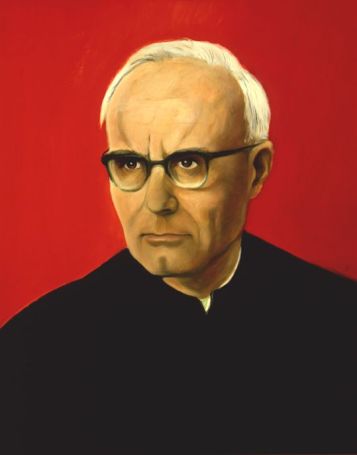
Karl_Rahner_by_Letizia_Mancino_Cremer

I recently came across this lovely passage from Rahner’s book, The Practice of Faith:

The cross and resurrection belong together in any authentic faith in Jesus. The cross means the no longer obscured requirement that human beings must surrender completely before the mystery of existence, which human beings can no longer bring under their control because they are finite and sinful. The resurrection means the content of the absolute hope that in this surrender there takes place the forgiving and blissful and final acceptance of a human being by this mystery, that when we let go completely we do not fall.

and again:

Christianity … embodies the single totality of existence, plunges this totality calmly and hopefully with the dying Jesus into God’s incomprehensibility and leaves all the details of life to us as they are, but without giving us a formula.

Needless to say, such a simplicity is not easy, leaving with us the full responsibility of living such a life. But I am moved by Rahner’s image of finding that ‘when we let go completely we do not fall.’ The letting go includes a letting go of any notion of God’s comprehensibility, of our competence, of theories of reality, of religious tidiness, of the magnificent yet fragile certainties of systems of thought (theistic or atheistic). What we take with us into this self-forgetting plunge is nothing less than the totality of all that we are. Ultimately, it is a plunge into death with the dying Jesus. And yet we do not fall. That is why it is a light burden.


quotations are from pp.10,11 The Practice of Faith, Crossroads, New York, 1992

Resurrection and Enlightenment

What Vision Do We Have for the Deep Sea? | Science | News

There is a Zen koan that is not to be found in any of the classic collections but first came to my attention through Bill Johnston’s writing on it. It goes like this:

In the Sea of Ise, ten thousand feet down, lies a Stone.
I wish to pick up that stone without wetting my hands.
On the stone a name is inscribed. What is the name? On one side of the name it reads, “Cannot get wet.” On the other side of the name it reads, “Cannot get dry.”

The koan is found in the collection of Miscellaneous Koans used by the Sanbo Kyodan lineage and you can find a version of it in Sr Elaine McIness’s book, The Flowing Bridge (p.72) and a lovely interpretation of it in Ruben Habito’s Living Zen, Loving God (p.107). Johnston’s reference to it is in Letters to Contemplatives (p.72).

This koan speaks to me in Eastertide as an expression of the risen life of the one who has descended to the depths. As Christ descended to the deepest darkness and yet was not defeated by death (‘cannot get wet’), and ascended to risen life of wounded, compassionate presence filling all things (‘cannot get dry’), so the one who dies with him is raised with him. What one dies to is a limited self; what one is raised to is an empty-fullness. As the wound-bearing Christ showed, this risen life is not something disembodied and yet it is boundless. It is of great comfort to know the boundlessness of compassion in a time of isolation.

The resurrection is not comprehensible in biological terms, but it is ‘graspable’ in spiritual practice. The ‘descent’ is known to any who enter stillness without thought or theory, and the rising is known by any who are awakened to a compassionate life free from clinging (noli me tangere). Of course, these two movements are not straightforwardly chronological but form a constant and single flow. We enter into that flow in contemplation and we live it in every moment.

Sermon for Easter 2

https://iconreader.files.wordpress.com/2011/04/altar-of-the-church-of-st-john-the-baptist-chesmenskaya.jpg

Touch. Simple, warm, human contact. Reassurance, comfort, strength. This is the thing that so many are missing right now as we live with the restrictions necessary to keep us all safe and well. All through our lives it is the simple act of touching that communicates so much of what it means to be alive and to love. It is the loving security we give to a baby, the healing warmth we give to an injured child, the expression of intimacy we give to a lover, the encouragement we give to a friend facing difficult times, the reassurance we give to one who is uncertain of us, the expression of communion and forgiveness we share at the Liturgy, the love we share with the dying. And all these experiences are the reasons we find it so hard to be distanced from one another at a time that we most strongly want to be in touch.

Today is the Sunday of Thomas, the day where we remember that disciple whose questions and whose faith are so compelling to those of us ‘who have not seen and yet believe.’ The traditional depiction of this Gospel in iconography carries an interesting title. Rather than ‘doubting’ Thomas, we are presented with ‘touching’ Thomas. He stretches out his hand to make contact with the wounded yet glorified flesh of Jesus at his invitation. Of course, the text doesn’t tell us whether or not Thomas did what Jesus invited – to put his fingers, his hands, on the scars so recently made. But it makes perfect sense to us that Thomas did just that. His touch is not the confirmation sought by a suspicious mind but contact desired by one who loved him. It’s not proof he’s looking for but intimacy. Belief for Thomas is not a matter of evidence but of embodied knowing, physically mediated truth.

For that is how we always know. We know with our bodies. We know what our senses open up for us. We know that food is good through smell, taste and sensation. We know that love is real through caresses and tones of voice. We know loss in the pit of our stomach, fear in the depths of our loins, joy in the lightness of our hearts, contentment in the restfulness of our breath. We learn skills through the training of our muscles in repeated movements and music through the refinement of our listening. And we pray through the bending low of our bodies and the lifting up of our hands, through the tracing of the cross upon our torso and taste of sweet wine on our lips, in the gaze of our eyes upon the face of Christ and the inhalation of aromatic incense. Prayer is in our knees and our hands as much as it is in our minds and memories.

So Thomas had it right when he expressed his desire to see and to touch, to feel the presence of Christ rather than simply to imagine it. The other name for the icon of Thomas’s meeting with Christ is the ‘assurance’ of Thomas. Faith is brought to life through contact.

So how does that work for us? In normal times, we get this through the rich physicality of our worship and I hope that some of that is possible for us even in this constrained online format. But we also continue to find faith in very physical experiences. When we take a deep and nourishing breath; when we feel the warmth of the sun on our skin; when we savour a mouthful of food and give thanks for the many labours that brought it to us; when our feet make contact with the firm earth that supports us; when we feel the warm hand of a loved one. All of these are sacraments that draw us close to one another and to the very source of life itself.

And for those who suffer in this present pandemic, the healing hands of carers, physicians, nurses, chaplains and friends bring an immeasurably powerful reassurance. For those of us at home, we still have the healing touch of a familiar voice to offer to others and the power of our prayerful breathing to share. Our breath connects us with all that lives so it is not surprising that the risen Jesus breathes on his disciples send their attention far beyond their limited horizons and to share with them the forgiving and healing love that first drew them to him.

So in this time of isolation, we may still find space to pray with our bodies and our breath, to savour the goodness of life in the food and fresh air that sustains it and to make contact with one another in whatever ways we can. In doing these simple things, we open ourselves to One who will come among us and say ‘peace be with you’ and to whom we respond, ‘My Lord and my God.’

An Empty Tomb

I’ve always found Ken Currie’s paintings compelling, even if occasionally disturbing. I think it’s the way he paints his figures with a combination of radiant light and intense fleshliness. At times the seem ghostly, but never anything less than human. Often vulnerable, but also luminous. In a pair of rare non-human images, he offers something more symbolic using the same palate. Here are Life Story I and II (badly reproduced from a book – sorry!):

KC LifeStoryI (2)KC LifeStoryII (2)

Even if one were to avoid making too simplistic an identification with the discarded graveclothes and empty tomb of Jesus, these powerful images would speak to me of the fertile emptiness that Easter opens up to us. There is a waiting and a receptivity that characterises Eastertide as much as it might be thought to characterise Advent, for Easter is a time to be opened up to life. Timothy Radcliffe quotes Tomas Halik:

Hardly anything points towards God and calls as urgently for God as the experience of his absence.

The empty tomb is an experience of God’s absence, but it is one that invites us to wait for the life that will fill the space we make.


Haec Dies

Haec dies | Me, senescent

Following on from yesterday’s thought, I love the way that the texts for Easter Week from the Roman Missal emphasise the unity of this week. It’s as if to say that the light of Easter Day is too bright to remain within the confines of 24 hours: we need a whole week of Sundays and a whole week of weeks to even begin to express the enormity of the transformation initiated by events of the early dawn of that first ‘eighth day’.

One of the repeated texts in the Missal is the Gradual: ‘This day was made by the Lord: we rejoice and are glad.’ (Psalm 117/118:24) The Hebrew could equally be translated, ‘this day, God has acted’ and I like the multiple meanings allowed by this simple phrase. Each day is at the same time a fresh gift and an opportunity to recognise the ‘action’ of God in raising Christ.

It feels to me like a similar insight as the one we find in the Prologue to St Benedict’s Rule, which invites us to to attend to the ‘today’ in the Venite, Ps 94/95:8 – ‘O that today you would listen to his voice’ – as an opportunity to wake up each day, be enlightened, be open to the world around us, be open to one another, be attentive to the voice of the Living One. In Anglican tradition, we a further thought to that one during Eastertide as we sing the Easter Anthems in place of the Venite, which invite us to ‘see ourselves as alive to God’ (from Rom. 6:9).

Here again, the tradition offers us a simple daily practice of being awake to Life. Each day offers a new opportunity, whatever lies ahead of us and whatever yesterday brought, to be alive rather than simply exist.

Everyday Resurrection

Emmaus icon - Crossroads Initiative

It seems to me that we, in the church, are pretty good at filling our Lent with lots of things to do, books to read, fasts to keep, lives of prayer to shape. I greatly appreciate this annual period of focused and intensified prayer. But I wouldn’t want to neglect the period of Eastertide as time for a different flavour of focused spiritual practice, so here are just a few brief suggestions for ways in which we might make each day of this bright season an opportunity for deepening our joyful faith. They are deliberately simple things because, although Pascha is a great mystery and the Feast of Feasts, it is also about our daily encounter with the new life that we embrace as a gift for now and a promise for the future.

  • Every dawn a Pascha. Each sunrise is a reminder of the Risen One and the opening of a new day. ‘In the tender compassion of our God, the dawn from on high shall break upon us.’ Even if we are not awake to see it, the sun’s return each day offers a moment for thanks and even a few words from Mattins at the outset of the day can serve to mark our thanks for God’s bounty.
  • Every meal a feast of the resurrection. Grilled fish by the shore and broken bread at Emmaus are paradigms not only of the Eucharist, the supreme Paschal feast, but also an invitation to see each and every meal as a sacred moment and a foretaste of the Kingdom. Every meal is an opportunity for nourishment, community – even if taken alone as no meal comes to us without the labour of many others – and sacrifice, in the sense of an act of gratitude and service. every particle of bread, every sip of water or wine is an occasion for contemplation of the one who is the Living Bread, the True Vine, the Living Water.
  • Every breath a gift of the Spirit. Each time we breathe, we taste the freshness and wonder of life; we savour the giftedness of life itself. we don’t ‘hold our breaths’ until Pentecost but recognise that the gift of the Spirit of the Risen Jesus is breathed into us every day, inspiring and renewing us. At this time of virus pandemic,we recognise even more acutely the preciousness of the breath that flows through our body and connects us to all that is. Taking time to breathe prayerfully is another daily opportunity for Eastertide.

Even in the absence of ‘normal’ church life, these simple practices offer ways of living a daily Pascha. I’d be delighted to hear of more suggestions!

Stations of the Cross

These reflections on some of the Stations of the Cross are by priests of Old St Paul’s.

First Station: Jesus Before Pilate
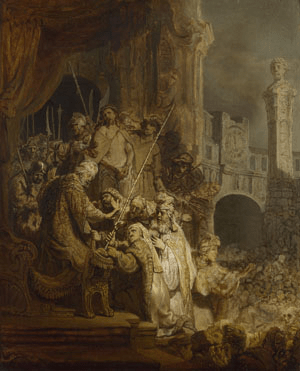
Rembrandt Jesus before Pilate

PILATE

Cool water over my fingers flowing.

The upstart

Had ruined a night and a morning for me.
I thrust that stone face from my door.

I was told later he measured his length
Between the cupid and the rose bush.
The gardener told me that later, laughing.
And that a woman hung about him like a fountain.

Another woman stood between him and the sun,
A tree, sifting light and shadow across his face.

Outside the tavern
It was down with him once more, knees and elbows,
Four holes in the dust.

More women then, a gale of them,
His face like a scald
And they moving about him, a tumult of shadows and breezes.

He hung close to the curve of the world.

The king had gone out in a purple coat.
Now the king
Wore only rags of flesh about the bone.

(I examined cornstalks in the store at Joppa
And discovered a black kernel.

Of the seven vats shipped from Rhodes
Two had leaked in the hold,
One fell from the sling and was broken.)

And tell this Arimathean
He can do what he likes with the less-than-shadow.

No more today. That business is over. Pass the seal.

George Mackay Brown, from his Stations of the Cross


Pilate’s callous dismissal of Jesus and his casual mockery of his sufferings comes from a place of expedience and business-like ruthlessness. The body of Jesus, so pitifully evoked here – ‘four holes in the ground’, ‘rags of flesh about the bone’ – is, by contrast, guarded and shielded by the women, treasured. Pilate is more concerned about his precious grain consignment than this broken body. Before Pilate, Jesus seems utterly defenceless. And yet, ‘He hung close to the curve of the world’. For me, this depicts not only his falls under the weight of the cross but his choice to remain close to the earth, close to the poorest and weakest, close to those regarded as dispensable or acceptable collateral damage. It is, I think, not by accident that the characteristically laconic GMB hints at resurrection by mentioning grain. Jesus is the grain of seed that falls into the ground, the ground he abides close to, and dies so that it may bear much fruit. Against such fragility, the ‘seal’ Pilate affixes to the tomb will prove insubstantial, less than a shadow. What abides is this risen, broken body.

Station 2: Jesus Takes up the Cross
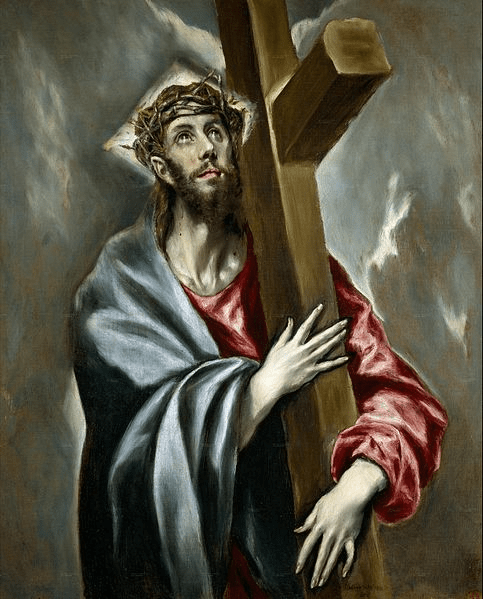
el greco jesus cross

‘Lord, it is time. Take our yoke
And sunwards turn.’

George Mackay Brown’s sequence, Stations of the Cross, begins with fourteen beautifully concise mini-poems, one for each station. For this one, he manages to hint at several scriptural allusions in two short sentences. ‘It is time’ evokes St John’s ‘the hour has come for the Son of Man to be glorified’ (Jn 12.23), a turning point in the narrative that points to the cross and leads immediately into his words about the grain of wheat falling into the ground. This long reflection then concludes in chapter 17 with Jesus’ prayer, ‘Father, the hour has come; glorify thy Son’ (Jn 17.1) and, ultimately, with ‘It is finished’ (Jn 19.30). This is not chronological time but the consummation of all time in the One who makes all things new.

‘Taking the yoke’ evokes a different scriptural tradition. Matthew 11.29 speaks of a light burden, an easy yoke. Surely the cross is no light burden! And it is light for us only because it has been borne by another. Nevertheless, El Greco’s painting of Jesus bearing the cross does have light about it, albeit light from a stormy sky. His face is not contorted with pain but at peace, trusting, tender. The cross is not merely carried but embraced, as if it were something to give life, as if it were a tree planted in the primordial garden, as if it were a sign of hope.

‘And sunwards turn.’ Face the rising sun. Face the dawn. Face Jerusalem’s empty tomb and find warmth, light and hope.

Station 3: Jesus falls for the first time
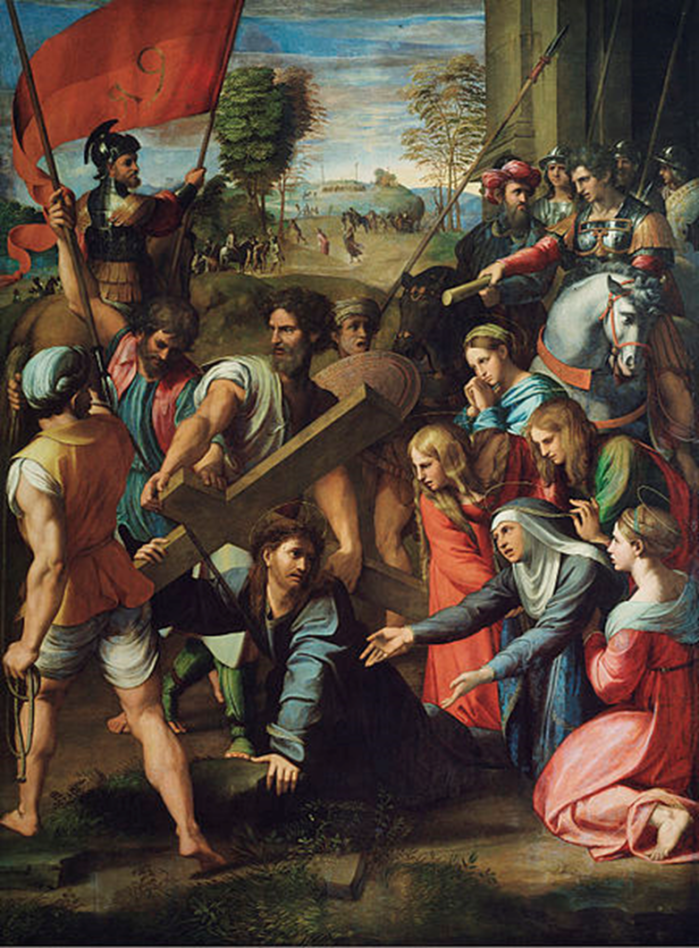
rapahael Jesus falls

Raphael’s painting of c.1514-16 both depicts the current scene of the sequence – the first fall of Jesus – and sets up the next two by including both Mary and Simon of Cyrene. In the far distance are crosses already erected with crowds surrounding one – this is no exceptional moment for the ruthless machine of imperial control but just one more example to be made to hammer home the supremacy of might. Spears, armour, horses, banners, batons; military strength is arrayed above Jesus as if to show just how much he is subjected to it. But Simon stands strong and faces it down, suggesting that it is not absolute, for beneath the cross he shows to us that there is another story. Here, by contrast, is tenderness, love, devotion and pain. Here is the face of Christ which shows, in the face of brute force, only mercy, only pity. ‘Those who live by the sword die by the sword’. ‘But I say to you, love your enemies.’ And Mary’s face shows the same pained tenderness:

Illos tuos misericordes oculos ad nos converte

Turn those merciful eyes towards us.

Station 6: The face of Jesus is wiped by Veronica
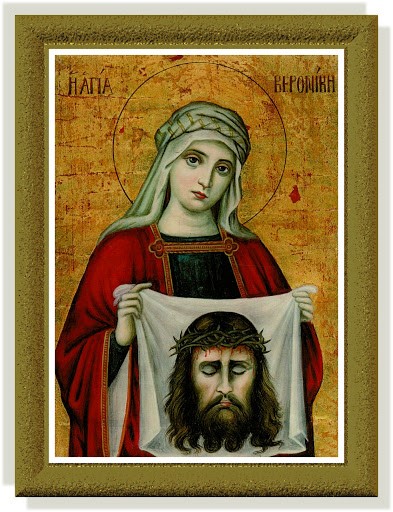
veronica

Who walked between the violet and the violet
Who walked between
The various ranks of varied green
Going in white and blue, in Mary’s colour,
Talking of trivial things
In ignorance and knowledge of eternal dolour
Who moved among the others as they walked,
Who then made strong the fountains and made fresh the springs

Made cool the dry rock and made firm the sand
In blue of larkspur, blue of Mary’s colour,
Sovegna vos

Here are the years that walk between, bearing
Away the fiddles and the flutes, restoring
One who moves in the time between sleep and waking, wearing

White light folded, sheathing about her, folded.
The new years walk, restoring
Through a bright cloud of tears, the years, restoring
With a new verse the ancient rhyme. Redeem
The time. Redeem
The unread vision in the higher dream
While jewelled unicorns draw by the gilded hearse.

The silent sister veiled in white and blue
Between the yews, behind the garden god,
Whose flute is breathless, bent her head and signed but spoke
no word

But the fountain sprang up and the bird sang down
Redeem the time, redeem the dream
The token of the word unheard, unspoken

Till the wind shake a thousand whispers from the yew

And after this our exile

T. S. Eliot ‘Ash Wednesday’

An anonymous woman is watching as Jesus is led out to the place of crucifixion and, moved by this young man burdened by the instrument of his execution, pushes her way through the gawping crowd, and taking out a cloth, possibly the head scarf she was wearing, wipes the sweat from his face. Why does she do this? Is this a statement? Does she recognise the Son of God? Is she simply protesting against the barbarity of this penalty? Or is this the response of a human heart to the suffering of another? Whatever her motive her act of compassion has earned her a place in the history of our redemption. She is an example to us how we are to respond to suffering wherever we find it. “In that you did it to the least of these you did it to me’” says Jesus and here we see this acted out on the way of the Cross. We can see the actions of Veronica all around us in the response to COVID-19, in the heroic act of our front line workers in the NHS, support services, and in the kindness of strangers in making deliveries and telephone calls.

Fr Paul Burrows

Station 8: Jesus meets the women of Jerusalem Luke 23.27 – 31
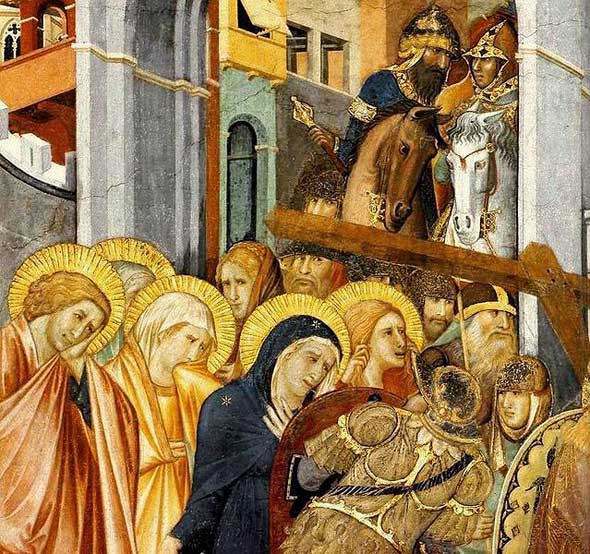
VIII-Jesus-women-Pietro-Lorenzetti-Assisi

Here, in the longest utterance by Jesus in any of the gospel accounts of his passion, he addresses a group of women among the crowd following him.
Who are these women of Jerusalem? Given the many women disciples Luke features in his version of the Jesus story, it’s highly likely they are among his followers, perhaps quite recent ones. The response of Jesus to them could seem unnecessarily harsh. But that is perhaps to misunderstand Luke’s point here; in line with his focus on Jesus’ prophetic ministry, Jesus is responding to their pain and sorrow with words of prophetic warning. Thus the focus shifts from Jesus, and what is about to befall him, to events lying in the future, to the Jewish/Roman wars and the destruction of the temple and city of Jerusalem.
Where does this take us? I cannot help thinking of the increasingly urgent warnings about climate change and its likely impact on all of us, especially on poorer countries around the world – and of the apparent ignoring of those warnings by so many. But in this present time of pandemic, Jesus’ words also bring sharply to mind how unprepared our developed societies have been for something that many scientists in the field of virology have been warning about for some years.
Jesus’ prophetic words, like the Hebrew prophets of old, were meant to call the people to ‘repentance’, that is ‘to return to the ways of justice and compassion’. So, as we offer prayer for all who are suffering from the virus, let us also pray that leaders and people of every nation will work for the common good and for all that builds human community.
Lord Jesus, the women of Jerusalem wept for you: move us to tears at the plight of the broken in our world, especially all those currently suffering with the coronavirus. Teach us the ways of justice and compassion, and give us a heart to love our neighbour at this time, whether near or far away. Amen.

Fr Tony Bryer

Station 10: Jesus is stripped of his clothes
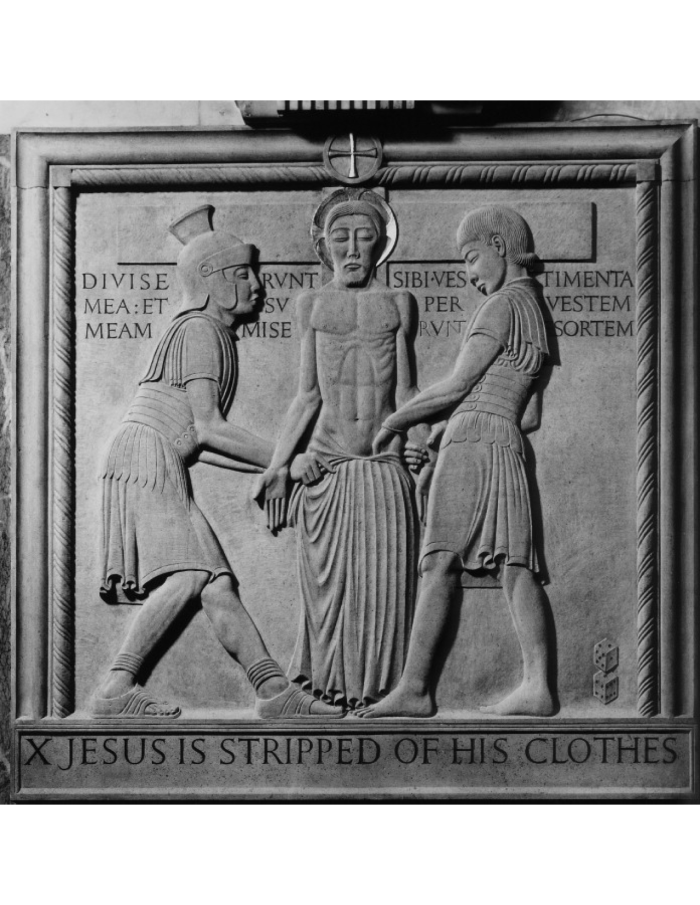
gil station 11

At least since the stories of Genesis, nakedness has been a symbol of shame and humiliation. Tormenters know that, and history is replete with ritual humiliations or degradations involving forcibly stripping clothes from captives. Enslaved people were stripped and displayed as merchandise in both antiquity and in more recent times. Concentration camps developed elaborate systems of stripping people that combined terrifying demonstrations of power and the dispassionate redistribution of seized possessions.

And so it is at this Station of the Cross: Jesus is violated by stripping his garments in actions meant to dehumanize him, to terrorize him, and to provide an economic prize for his captors.

An extraordinary depiction of this is found in Eric Gill’s 1914 carving for Westminster Cathedral, where the sculptor captures the leering privilege of mercenaries given complete control of a prisoner.  The violation they intend is menacingly ambiguous, while their anticipated reward is foretold in their chiseled hands and eyes, as well as in the waiting dice.  The inscription behind them connects this violation with prophecy. This station is about the apparent triumph of power intent on objectifying and commodifying the Human One.

It didn’t succeed; even such absolute, humiliating, violating power succeeded only in dehumanizing itself, and a portent of Jesus’ exquisite endurance and eventual triumph can be seen in Gill’s portrayal of Jesus’ face. Eyes closed in defiance, Jesus embodies the truth that nothing is so powerful that it can separate us from the dignity born with each of us.

Forces of power may try to strip us of our dignity or even our humanity, but it cannot succeed: our identity was forged in the love of God, and nothing can separate us from that love, or from the One who made us in the Divine image.

For I am persuaded,
that neither death,
nor life, nor angels,
nor principalities,
nor powers, nor things
present, nor things to come,

Nor height, nor depth,
nor any other creature,
shall be able to separate us
from the love of God,
which is in Christ Jesus our Lord.

(Romans 8:38-39, Authorised Version)

Fr Michael Barlowe

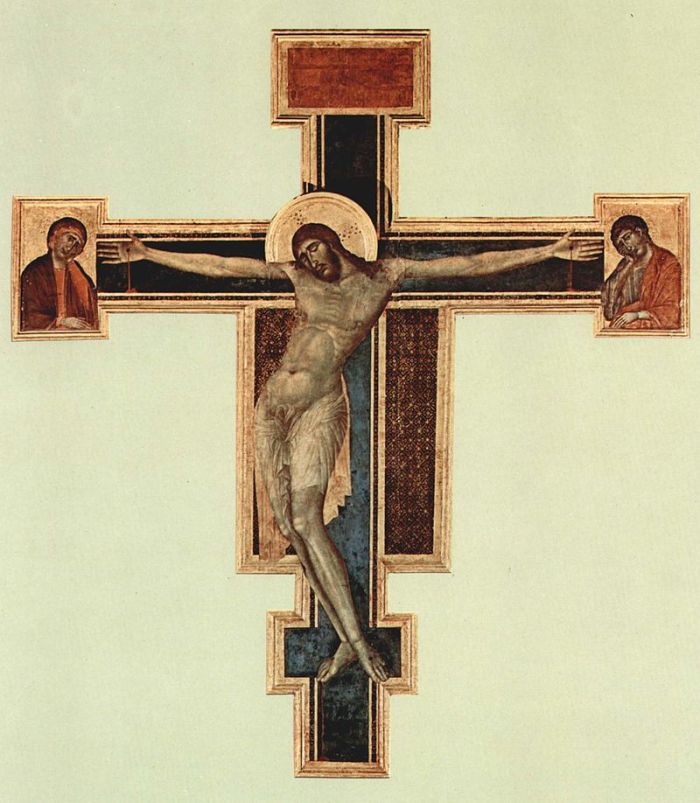
Station 12: Jesus Dies upon the Cross

Cimabue Crucifix

The Killing

That was the day they killed the Son of God
On a squat hill-top by Jerusalem.
Zion was bare, her children from their maze
Sucked by the dream of curiosity
Clean through the gates. The very halt and blind
Had somehow got themselves up to the hill.
After the ceremonial preparation,
The scourging, nailing, nailing against the wood,
Erection of the main-trees with their burden,
While from the hill rose an orchestral wailing,
They were there at last, high up in the soft spring day.
We watched the writhings, heard the moanings, saw
The three heads turning on their separate axles
Like broken wheels left spinning. Round his head
Was loosely bound a crown of plaited thorn
That hurt at random, stinging temple and brow
As the pain swung into its envious circle.
In front the wreath was gathered in a knot
That as he gazed looked like the last stump left
Of a death-wounded deer’s great antlers. Some
Who came to stare grew silent as they looked,
Indignant or sorry. But the hardened old
And the hard-hearted young, although at odds
From the first morning, cursed him with one curse,
Having prayed for a Rabbi or an armed Messiah
And found the Son of God. What use to them
Was a God or a Son of God? Of what avail
For purposes such as theirs? Beside the cross-foot,
Alone, four women stood and did not move
All day. The sun revolved, the shadows wheeled,
The evening fell. His head lay on his breast,
But in his breast they watched his heart move on
By itself alone, accomplishing its journey.
Their taunts grew louder, sharpened by the knowledge
That he was walking in the park of death,
Far from their rage. Yet all grew stale at last,
Spite, curiosity, envy, hate itself.
They waited only for death and death was slow
And came so quietly they scarce could mark it.
They were angry then with death and death’s deceit.

I was a stranger, could not read these people
Or this outlandish deity. Did a God
Indeed in dying cross my life that day
By chance, he on his road and I on mine?

Edwin Muir

Fr Malcolm Richardson