Conversion to the Earth

I was drawn to a reflection on Laudato Si’ by Eric Jensen, a Jesuit, who calls on some interesting Ignatian insights to talk about the invitation to a conversion that lies at the heart of the encyclical. He suggests that one may have either a religious or a moral conversion that leads to a renewed relationship with the earth. Beginning with a religious conversion, we are drawn to an awareness of a loving creator who cares passionately about all created life and from there to a change of heart about how we then relate to (rather than use) the other parts of God’s creation. Beginning from a moral conversion, which may be the norm for most people in this part of the world, it is also possible that a care for – a love for – the earth may move us to a desire for the Source of life, the source of beauty.

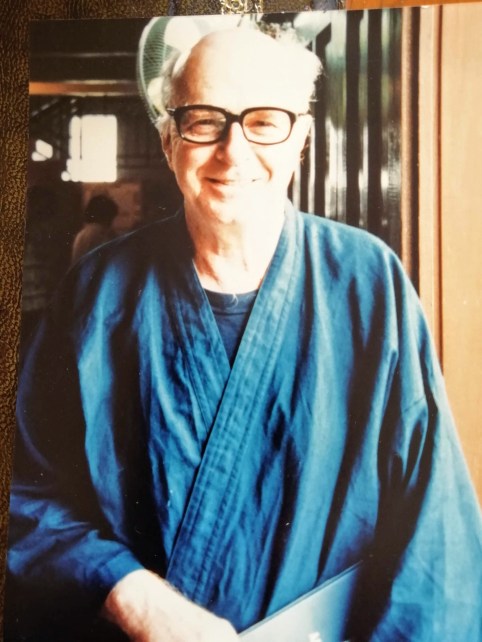
Of course, Jesuits are well-versed in the movements of heart that are involved in a conversion. The Spiritual Exercises are, above all, a path of conversion. They begin with a ‘diagnosis’ of our situation, which is precisely what the Jesuit Pope does in Laudato Si’, for clear discernment of what is true is the necessary precondition for a change of heart. In naming the specific challenges of our ecological crisis, the skills and insights of science are indispensable. I am struck by how much of this thinking is present in the writing of William Johnston SJ, whose work I am researching.

dav

In one of his last books,Arise, My Love…’ Johnston also saw the need for many conversions in our current context: a conversion to the body to overcome mind-body dualism that continues to plague so much Western thought; a conversion to the poor in imitation of the Jesus who emptied himself; a conversion to the ‘other’ through dialogue; a conversion of Christians to welcome the insights of all who are passionate for truth through the attentive work of scientific research. All of these changes of heart are bound up in the call to conversion in Laudato Si’: our embodied nature as part of an interdependent creation; our embrace of the way of simplicity and our option for the poor as an essential realisation of the true impact of climate change; a deep solidarity with all who share a concern for truth and for the renewal of humanity through faith, compassion and contemplation. The path of conversion is not a discrete religious activity but is a way of life, a way for life.

Laudato Si’ Week

Pope Francis has invited people to take this week as an opportunity to reflect on his encyclical, Laudato Si’. For an excellent overview of the document, try this piece by the now Provincial for the Jesuits in Britain, Damian Howard. I thought I’d offer some responses to this remarkable text in the course of the week.

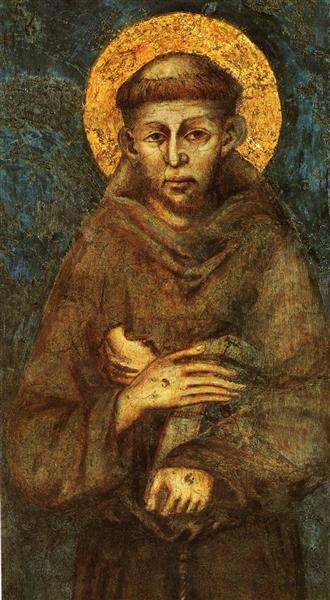
Saint Francis of Assisi (detail) - Cimabue - WikiArt.org

First of all, I think it is essential to recognise the basis of Francis’ approach in a spirituality that is deeply rooted in Christian tradition. It is a spirituality that is expressed most powerfully in St Francis’ Canticle of the Creatures, from whose opening line the encyclical takes its name. The Canticle directly addresses elements of the created world as brothers and sisters and with which Francis was united by ‘bonds of affection.’ This aspect of fraternal love for all creatures is vital. Our attempts to restore balance with the rest of creation is not best motivated by duty but by love. Pope Francis adds another Franciscan element to his holistic and ecological spirituality, which is a love of poverty and a love of the poor. He sees no distinction between love for our fellow human beings – especially those who are poor – and love for the wider creation. And the sense in which poverty itself can be loved is the sense in which it is a love of simplicity and restraint, spiritually detached from possessions. This, in turn, requires ‘being at peace with oneself’ and an attitude of ‘serene attentiveness’ which overcomes the anxiety that we feed with our greedy consumerism. In a practical vein, the spirituality that motivates Laudato Si’ encourages a life lived with ‘daily gestures which break the logic of violence, exploitation and selfishness.’ And finally, the mystical insight at the heart of the encyclical is that ‘the universe unfolds in God, who fills it completely’ – God is present in each of the ‘sublime realities’ of life. For this latter insight, Francis calls on St John of the Cross, whose Spiritual Canticle speaks of the vast, graceful, bright and fragrant mountains’, and dares to say that ‘These mountains are what my Beloved is to me’.

I think many in the wider environmental movement recognise that a conversion of our world towards a more sustainable future will not be accomplished without an underlying spirituality. Pope Francis has proposed this very thing and has invited us all to join in the conversation.

Hid Divinity

The author of The Cloud of Unknowing used this endearing phrase in his free rendering of Pseudo-Dionysius’ Mystical Theology. In his more famous work, the author advised that ‘no one can fully comprehend the uncreated God with his knowledge; but each one, in a different way, can grasp him fully through love’ (ch. 4, Bill Johnston’s translation). He invited us to be at home in the darkness of the cloud that seems to exist between our mind and God, feeling nothing but a ‘naked intent towards God’. It is, of course, the central paradox of mystical theology that so many words are used in the attempt to describe our reaching out towards the unknowable God who first reaches out towards us. Even the great ‘doctor de la nada’, St John of the Cross, indulged in a great many complex and technical words in his account of the ascent of a mountain whose way and end is nothing, nothing, nothing. Surely, the wise course would simply be to say nothing about the One of whom nothing can be said.

Cloud of Unknowing and The Book of Privy Counseling: William ...

Appealing as this may seem to weary theologians and exhausted preachers, I think it simply won’t do. This is not because we can ever fully grasp with our minds that which may only be grasped through love (here meaning self-transcending ‘naked intent’) but because it is a very real temptation to say wrong or unhelpful things about God, even if we must retain a certain hesitation about saying anything at all. More than that, it seems to me to be a very noble thing to seek to understand that which is most important in life, humbly admitting at the outset that there are limitations to such an enterprise. Of course, the work of theology will always be something of a vertiginous looking into the abyss of the unknown, but should we fear to do so, once we have admitted our proper sense of hesitation?

Unsurprisingly, it is often the theology that is expressed without such hesitation that is the most dangerous – theology that confidently claims God for our own causes or that sets out a simple formula whose reliable output is salvation. The response to this, surely, is not to abandon the project altogether but to do it better, more carefully, more generously, more mystically. Mysticism is not an excuse not to think but an invitation to think the unthinkable as far as one can before falling back into the silence from which the exploration sprang. It is quite appropriate to recognise the absurdity of trying to say anything about God, but let’s not give up trying.

Christianity and Other Faiths Part II

My post yesterday was a kind of theological prelude to the main act, an act which continually re-forms the sort of tentative position I began to outline there. The main act in the dramatic interplay of the glorious diversity of religions is dialogue and I want to offer only a very few preliminary words about this today. Let me say first of all that I do not regard dialogue as some kind of hobby activity for people who are into religion, but a fundamental matter of human flourishing and peacemaking. Dialogue is a path of conversion, in that it seeks to move me from one place to another in my understanding of myself and my own faith, of my neighbours and their faith and, ultimately, of God himself. Any act of dialogue that is not begun with the expectation of one’s own conversion is bound to be insufficient.

Dialogue is encounter with the other at a profound level which leads to new understanding. It is a kind of ‘passing over’ into the life of the other in order to see things from a new standpoint. As that great pioneer of Christian-Muslim dialogue, Louis Massignon, put it:

To understand something is not to annex it, it is to transfer it by decentring oneself to the heart of the other.

Louis Massignon (FranceArchives)

I guess this is what it means to love one’s neighbour ‘as oneself’ or, ‘as one who is like you’ – another subject, not an object, whether of fascination or revulsion. On one level, it is impossible fully to inhabit the mindset, worldview and culture of another person without having lived the life they have lived and without inheriting the patterns of thought and metaphors by which every one of us sees the world, consciously or not. So alongside the vital work of deep listening, there are other means of ‘decentring oneself’ in order to draw closer to the heart of the other. Religions involve much, much more than just ideas, so some level of engagement in the patterns of religious life and prayer of the other is also vital to dialogue. More than that, some level of love for these patterns is also essential. Here I don’t mean something sentimental or idealised, but committed and patient, affective and intellectual, respectful and also passionate. If we are to love our neighbours, we must also love the lives they lead.

Such holistic dialogue seems ever more vital in a world that is under constant threat of fragmentation into self-interested and homogeneous entities. Mostly, I think the common experience of facing a threatening pandemic has brought out the best in us – active compassion and genuine sorrow at the suffering of others – but we do need to heed the counter-current of xenophobia and ‘my nation first’ thinking that has also raised its head. Perhaps this current global situation underlines more urgently than ever the need for mutual understanding, for without it, we are left with only the limited resources of our own perspective to draw on. Perhaps our neighbours of other faiths and worldviews have insights into this situation that we could not have found from our own standpoint, insights into the nature of disease and wellbeing, insights into the balance between communal and individual lives, insights into the presence of God in such a challenging situation. So far, I have seen many impressive and thoughtful reflections on the pandemic from within my own tradition but perhaps its time to widen my perspective. We need each other in this time.

Christianity and Other Faiths

I raised a question in my sermon yesterday which I didn’t then address (you can only do so much in one sermon!). I used an example of religious exclusivism to ask a question about the nature of truth, suggesting that, for Jesus, truth was not so much a system of thought as his own embodied way of living. Truth is found in living as he lived – by dying to self. The question I left hanging was whether Christians consider that those of other faiths could ‘come to the Father’ while remaining within their own faith tradition. To put it in traditional terms, is there salvation outside the church?

This is a far more complex question than it seems, hence my decision to leave it alone in a sermon that was really about other questions! For a start, we would need to ask whether a Christian notion of salvation would even make any sense to people who belong to that other faith. Many religions see that there is a problem at the heart of being human, but may diagnose that problem differently and, therefore, propose a different remedy. If, as a Buddhist, you see the problem in terms of suffering caused by our cravings and a false view of the world, then release from suffering comes from an awakening to our true nature, not through forgiveness of sins. Even this example is complex when you begin to explore how these two approaches, Christian and Buddhist, may in fact offer different angles on a similar problem, and how, even within Buddhism, there are many accounts of how this operates (through disciplined effort? through invocation of the Buddha Amida? through sudden awakening?).

Of course, some people do not see any kind of problem here at all: live and let live, each religion is truthful on its own terms (an approach often called ‘pluralist’). The problem is that Christianity does make claims that are universal in their scope – ‘In Christ, God was reconciling the world [kosmos] to himself’ (2 Cor 5:19) etc. To take a pluralist line would require a significant modification of this kind of claim, so the exclusivist approach does at least have the merit of consistency. What it lacks, however, is the sense that God and God’s truth may be somewhat bigger than our capacity to grasp them, or the sense that God may be free to use other means to draw people to himself.

One kind of approach that seeks to honour both the universal claims of Christianity and its humility in the face of religious diversity is often called ‘inclusivist’, though these terms, like all attempts at taxonomy in complex realms, have their limitations. One way of describing an inclusivist approach would be to say that God’s action in Christ is far greater than our ability to describe it and that, in God’s own economy, God is able to ‘save’ Muslims as Muslims, Hindus as Hindus through the cosmically significant work of incarnation and redemption in Christ. The risk here, of course, is the suggestion that good Muslims are just good Christians without knowing it. A more nuanced approach might be to say that, for Christians, we see the pattern of God’s salvific activity in Christ (the pattern of self-transcending love) and that this pattern may well be present in other faiths and expressed in very different ways. Additionally, if we think that those of other faiths may be ‘saved’ through the exercise of that faith, then, as Christians, we must believe that it is God who is doing the saving and, as Christians, we can only describe God in trinitarian terms and, therefore, Christ and the Spirit must be active in that saving activity. This approach could only ever be a Christian account of the theology of how God might work through other faiths and any respectful dialogue would be open to hear that faith’s own account of how human beings reach their ultimate fulfillment. In other words, an inclusivist theology of religions is an internal discourse for Christians but, in a subtle form, might be capable of opening Christians up to the possibility of divine action through the exercise of another religion.

What about pluralism? Surely this is a more satisfactory approach which respects the equality and distinctiveness of religions without trying to see one through the lens of another? I think it has much to commend it but is also not without its challenges. Is truth only ever relative? Are there no categories for discerning the truthfulness or otherwise of any religious claim, whether within or outwith our own faith? Might it also limit our understanding of God, making him only ever a ‘tribal’ rather than universal deity? I do think it is possible to describe a more subtle pluralist approach that, again, expresses humility in the face of what we cannot know and assumes that divine activity transcends our categories (but would we then say that God is active even in those who are not theists? Is that not back to an inclusivist approach?). And there are certainly pluralists who are willing to work at some means of discerning both good and harmfulness in religions, thus refusing a lazily relative account of truthfulness.

All of this is a work-in-progress for me, but as a Christian, I think I find myself drawn to an account of other faiths that fully respects them on their own terms, yet admits the possibility that our Christian account of God’s saving action in Christ is partial, and that there is, indeed, a cosmic truth revealed in the shape of divine self-giving love as seen in Christ which transcends religion. To approach dialogue in this way makes it possible that, among other things, we might learn more about Christ from those who are not Christians. It would not be for me to speculate what the non-Christian partners in that dialogue might take from it. If that makes me an ‘inclusivist’, rather than a ‘pluralist’, then so be it, but I’m not too concerned about labels!

Sermon for Easter 5

pantokrator-2011-2.jpg | キリスト, イエスキリスト

When I worked as a hospital chaplain, there was a period of a couple of weeks when the prayer room used by Muslim patients and staff was out of action while it was being renovated. During that time, we agreed that space would be made at the back of the chapel, which was just next door, for Muslims to use for prayer, with an appropriate indication of the direction of prayer. This arrangement went pretty smoothly and I must say that I felt that there was something very precious in celebrating mass at the altar in the chapel while Muslim colleagues prayed in the same space. Each group was directing its prayer towards God in its accustomed way, side-by-side, respectfully making space for each other.

The one objection I saw to this arrangement came in a fairly low-key, yet pointed form. Someone had left an open bible next to the area set aside for Muslim prayers and it was open at today’s Gospel passage, indicating the words; ‘I am the way, the truth and life; no one comes to the Father, but by me.’ The objector had, presumably, read this text in a way it has often been read – as a claim to Christian exclusivity, a monopoly on truth possessed by those who sign up to its propositions. In its more generous form, this kind of exclusive claim might be made with a degree of humility, but it often comes with a kind of self-satisfaction in having backed the winning side. This kind of thinking depends on an understanding of truth as a static body of thought, a coherent and immutable system requiring our assent. Those who withhold assent are outside the system and therefore do not gain its prize – access to the Father.

I recognise that I have put this position rather starkly and don’t mean to belittle those who hold to it. As I said, many who hold an exclusivist position on Christianity’s place in relation to other religious paths do so with humility and with a genuine desire for the wellbeing and eternal salvation of those who differ from them. But I fear that this position does not represent well what Jesus was saying. I fear that it diminishes something rather central to Jesus’ teaching.

Last week, we heard Jesus describing himself as the door to the sheepfold and I suggested that we might see this image in terms of thresholds where a life-giving encounter takes place. And in this chapter of John’s gospel, we have a similar kind of image. The first of Jesus’ words to describe himself is as a ‘way’, a path, and I think the next two rather depend on how we understand this. In speaking of himself in this way, Jesus says that the life-giving truth he embodies is personal, and that it is dynamic. His way to true life does not reside in a system of thought, but is embodied in himself, in the way he lived his life, in the way he approached his death, in the way his death was no defeat but a pathway to fuller life. The way he lived his life was to empty himself of all but love – a dying to self that is the only route to full life. And it is dynamic because it is a way that is only revealed by walking it. Truth unfolds as we go along. The Christian life, I think, is not so much something that we adopt as a metaphysical lens through which we then interpret the world, but nothing other than the very living of our lives in the pattern of Jesus’ life – in his way. Don’t get me wrong – I’m quite partial to a bit of metaphysics, but the Christian life is so much more than that.

There’s a wonderful Spanish pilgrim’s palindrome that goes ‘la ruta nos aporto otro paso natural’ – the path provides the natural next step. So if Christ offers himself as a way and calls us to walk in it, then the first, last and constant thing we must do is go. The resurrection accounts are full of this: go to the tomb, go to Galilee, go on the road to Emmaus and go back again, go out into the lake. Encounters with the renewed life of the risen Christ only happen when we get up and go, and that going will always entail a going to a place we don’t yet know. Jesus is met on the way. You see how far this is from seeing Christ as a static body of truth over which we might gain some mastery? The Christian life always entails a fairly substantial helping of not knowing. The other word for that is faith.

We are living through a time when everyone wants to know what’s next for us – when will the lockdown end; when will we have a vaccine; when will we get back to church? And there’s no shortage of people happy to speculate answers. People are also asking important and difficult questions about the future of our economic and political life, the future shape of our church life, the future of our relationship with the planet. However, anxious speculation can have a paralysing effect on us. Jesus said; ‘let not your hearts be troubled.’ We cannot know the future but we can choose to live the future we would want to see right now. It seems to me that Jesus invites us to live life without certainty, but to live it anyway, and to do so in the way that he did; generously, selflessly, gratefully, trustingly.

Images of Resurrection Part 2

Well, just when I asked a question about why there are so few images of the resurrection in churches I received a stunning answer in the book I’m currently reading by Tomas Halik, Patience with God. I think Halik is one of the most creative theological voices I’ve heard in a long time in the way he responds to the situation of Christian faith in contemporary Europe, writing, as he does, from one of the least religiously observant countries in our continent. But he writes as a sympathetic fellow-traveller, not a strident critic of his contemporaries.

His take on the absence of images of the resurrection is subtle. First, he insists that there can be no meaningful talk of resurrection without a serious understanding of the cross and all it entails in terms of Jesus’ abandonment and suffering. Such a resurrection would simply be a find of triumphalism. Then he suggests that the resurrection is not depicted because it is an event that must take place in us. It is a profound mystery which, if it does not decisively shape the way we live our lives is nothing more than ‘just another event’ to whose veracity we assent passively:

What distinguishes it from the other historical facts is that it is ‘visible’ only with the eyes of faith – and because in the here and now even faith sees all the things of God only partially and as in a mirror, it must be supported in the darkness of our lives by patience and the perseverance of hope.

and

Belief in the Resurrection means accepting that ‘strength that showed itself in ‘weakness’, the strength of Christ’s sacrifice – His sacrificial love as a living reality. Not to believe in Christ’s Resurrection is to live as if the cross were the final end.

Seen with the eyes of faith, the resurrection becomes a total commitment to the way of self-giving love, trusting that this way is ultimately life-giving. In the midst of history, the resurrection ‘should be present through the testimony of those who make known that Christ is not a finished chapter.’

Images of Resurrection

I often complain about the relative scarcity of images of the resurrection in our churches. We don’t seem to have any shortage of images of the crucifixion and many churches are surrounded by the Stations of the Cross. Neither do we lack images of the infant Christ with his Mother. But even in a church like Old St Paul’s, which is not short of religious images, you would struggle to find one of the resurrection. Every Orthodox church will have an icon of the Anastasis so why are Western churches so hesitant to depict what ought to be one of the central images of our faith?

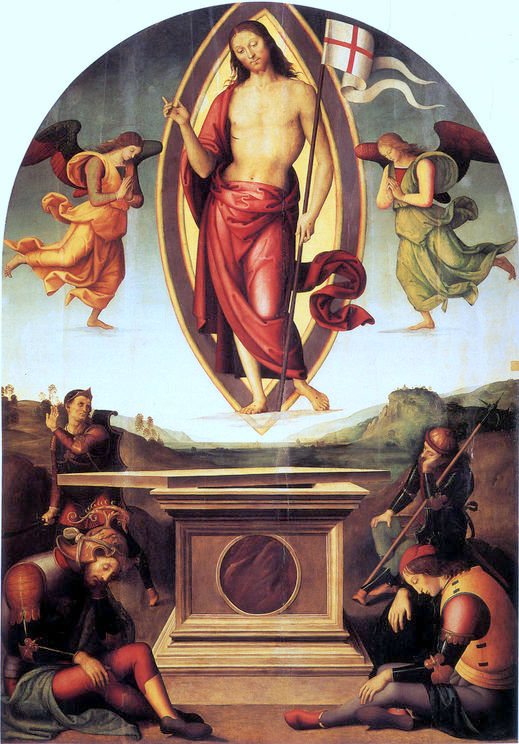
I was delighted, therefore, when I watched Pope Francis’ most recent Regina Caeli address, to see an image of the risen Christ behind him in the library of the Apostolic Palace (the one he doesn’t live in!). It’s a well-known image by Perugino and was originally in the church of San Francesco al Prato in Perugia (no longer active – the building suffered a lot over the centuries and only the shell remains).

Resurrection-of-christ-3929-mid.jpg

It dates from the very end of the 15th century and depicts a fairly typical scene in the Western tradition, with Christ rising above an opened sarcophagus surrounded by sleeping soldiers. He carries the banner of the resurrection and, in this version is flanked by angels. He is also surrounded by a mandorla, a device common in Eastern iconography to indicate a theological truth rather than a naturalistic depiction. I rather like the touch of having Christ and the angels standing on little clouds as if they would look silly just floating around! This is a spiritual image in the sense that it seeks to reveal the inner truth of the resurrection: this is new life as a risen and exalted reality, a life free from constraint and from the torpor of mundane existence. It is awakened life in contrast to the dulled and introspective life depicted in the soldiers.

All of this stands in stark contrast to a much better known painting from only a few decades earlier and only a few dozen kilometres away in Sansepolcro.

Resurrection.JPG

If Perugino’s painting is of a heavenly character, Piero della Francesca’s fresco is very much of the earth. No floating, no angels, no mandorla, this Christ has his feet firmly planted on the solid marble of the sarcophagus. The soft fluidity of Christ’s body in Perugino’s image is contrasted by the stately, muscular body of Piero’s Christ. In Piero, new life is shown in nature – green trees springing to life on the right of the scene, bare branches on the left. Christ’s penetrating, arresting gaze is contrasted by Perugino’s Christ whose eyes are cast down, reflective.

I don’t really have any kind of theological preference between these images and I think they complement each other rather well. Although substantially using the same iconographic format, they propose very different angles on the resurrection. Their different emphases underline the elusive and complex mystery of the risen Christ who brings an inner renewal as well as the call to a transformation of life in its earthly realities.

Sermon for Easter 4

I’ve been thinking quite a lot about doors recently. Each morning, I open up the door to the Calvary Stair from Jeffrey Street and then lock it behind me as I prepare to pray Morning Prayer and the Mass, not alone, but in the company of many who join online and very many more who pray where and whenever they can, conscious that they are part of something bigger. The ‘something bigger’ is not just the scattered community of Old St Paul’s, though I think we’ve all realised even more deeply how much we value that these last few weeks, but the scattered community of all those who long for something more, who have a sense that life is not purposeless, not disposable, but truly valuable, truly meant.

Images of the Good Shepherd : Icons or not? | A Russian Orthodox ...

So on one level, it feels wrong that I have to come down those stairs again some time later and once more lock the door. We are used to our precious temple being a little island of peace in our city that welcomes any who seek solace, peace, meaning, rest, quiet – a place where all questions are welcome, all longings treasured as signs of the beyond, indications of the incomplete nature of life that nonetheless suggest a deep intuition that all is not meaningless.

But I wonder if this time of locks and closed doors might be inviting us to think afresh about what the thresholds are between a patterned, committed religious life and the lives of those who may not feel comfortable joining us, and yet are asking the kind of serious if unresolved questions that we all recognise. Let me put it more starkly: does this time of locked doors not open to us the possibility that the threshold between ‘in’ and ‘out’ is something much more dynamic than we had supposed? Where is our doorstep? Where is the half-opened door where the most vital conversations happen? Who is inside and who is outside, and do these categories really make sense anymore?

We are used to thinking of doors and thresholds as devices necessary for containment. I think there is a real risk in the current crisis to harden that kind of thinking. We’ve heard it already from some political leaders who see this pandemic as an opportunity to draw more sharply the line between in and out, us and them. Those of us inside have been assaulted from without by some alien invader. This thinking is profoundly wrong and extremely dangerous for it fails to see that we are all in this together, irrespective of borders, and the only wise response is one that works from a very wide sense of what ‘us’ means. We need each other now more than ever.

And for the church too, this is a time to consider again what we mean by ‘us’. Who are those on ‘this’ side of the door and who are those beyond? Today’s Gospel might easily be read as a manifesto for those who want to make a clear division between the insiders and the outsiders. The good shepherd knows his own and protects them from the nasty invaders who threaten them. Keep together, shut the door, close ranks against the big bad world outside. But I hear the story in today’s Gospel very differently. Jesus does not seem to be interested in the identity of the sheep that are of his own particular flock. He is concerned with the gift of abundant life to anyone who hears a voice that speaks their name, anyone who ‘goes in and out and finds pasture’. The thing is, the door is Jesus, and the door is open. The door is not a separating barrier but a threshold where encounters happen and it is everywhere.

We might then say, ‘why speak of doors at all? There is no difference, no separation, no sacred and profane, no us and them.’ I think I want to keep hold of the image of the doorway because all of us recognise that, in life, there are thresholds. There are times when we realise something new, times when we break through to a new insight, times when we move from a place of hesitant inaction to a place of dynamic, if still hesitant openness.

I wonder if this time of closed doors might be a time to rediscover the thresholds where encounters happen, thresholds where people are expressing their deepest longings for meaning, love, nourishment, hope. I wonder if this is a time when we discover once again that the church is a doorway that always lies open to the world, open to this city of ours, open to the questioning, the seeking, the hesitant. How might we find new ways to linger in that doorway, wherever it is?

And I wonder if this is a time when we discover afresh the encounter that happens for ourselves, on our own thresholds between us and one whose voice we recognise. This voice says ‘come on in’. It says ‘come and go and come again with your news about where you have found good pasture’. It says ‘look out for the sheep that are not of this fold’. It says ‘you are a flock without number, without limit.’ The voice says ‘you are alive when you see that the door lies open because the door is me, and I am not here. I am out and about, seeking to save that which is lost. Come with me.’

The Joy of the Gospel

The first exhortation from Pope Francis – the title of this post – called the church to a conversion from a concern for self-preservation to a missionary outlook, sharing the gospel of life. Among the many wonderful insights in this document is the reminder that there is a ‘hierarchy of truth’ in Christian thinking – some things are more important than others. And in this time of challenge and crisis, it’s right that we should be giving a lot of thought to exactly what it is that matters most.

Pope Francis (@Pontifex) | Twitter

Pope Francis would probably say that the answer to this is rather simple. Indeed, it’s vital that the essence of the Gospel is not obscured by an undifferentiated mass of complex ideas, customs and language. The simple answer Francis gave at the outset of his exhortation was that one is set free by an encounter with Jesus. Everything else flows from this. Yes, the church is important in its institutional or communal form – we do not believe in a disembodied ideal – but it is important because it is a realm of encounter with the Risen Jesus. Everything else – community, ethics, structures – flows from this.

In describing the freedom found in an encounter with Jesus, Pope Francis specifies a number of ‘diseases’ from which we are liberated: sin, sorrow, inner emptiness and loneliness. The freedom is renewed each day when one is open to the possibility of a fresh encounter with the Risen One each and every day. No one is excluded from this offer and ‘no one can strip us of the dignity bestowed upon us by this boundless and unfailing love.’ (EG 3)

But how does one encounter the living Jesus? Mostly, we do so when we encounter someone who has already encountered him and has been transformed by his tender mercy, but also through the proclamation of the Gospel and the celebration of the paschal mystery, primarily in the Eucharist. Francis talks of a ‘gift of beauty’ as a primary mode of encounter. By this he does not mean a narrow aesthetic, but the beauty of a transformed life, transformed by joy, gratitude and self-forgetfulness. The constant challenge to the church is to ensure that every decision is made so as to facilitate such encounters. To do this requires spiritual discernment, not programmes, slogans or political manoeuvring. In practice, I see in Pope Francis a commitment to discernment that does not exclude and is based on both-and thinking rather than either-or thinking. This is because the very manner of our encounters with each other must also reflect the tenderness and the mercy of Christ.