Franciscan Zen – Practising Poverty

giotto francis renunciation

One of the biblical texts that appears again and again in Buddhist-Christian dialogue is the well-known hymn in Philippians 2:5-11 in which the writer speaks of a Christ who emptied himself. This idea of kenosis is appealing to those who are exploring how Christian understandings of Jesus can interact with Buddhist experience of sunyata (emptiness or void) and it is not unusual for Christian thinkers to see this experience of ‘void’ as closely akin to the experience of God. This depends, in part, on an understanding of kenosis that goes beyond a simple expression of humility in the act of incarnation and sees self-emptying as a fundamental expression of the divine. God is not ‘a being’ but being itself, empty of all form and beyond all description or intellectual apprehension. God is sheer simplicity, complete unity, without beginning or end. The distinctively Christian aspect of this would be to see this divine self-emptying as ‘for us’, an act of transforming love, but an act so complete as to be empty of duality or over-againstness. This is a complete identification with us.

But there is an aspect of this discussion that is of particular interest to Franciscans, and that is the suggestion of the language of poverty in the Philippians hymn (humility, the nature of a slave). Franciscan poverty is akin to Buddhist sunyata in that it is not only a kind of ascesis, and not only a compassionate identification with the poor, but is a mystical state of identification with Christ in his emptiness. It is a letting go of contingent things, a refusal to put one’s trust in objects, status or even ideas. All of these things are fleeting, what abides is loving emptiness. For Franciscans, the life of chosen poverty is not a concept but a practice that involves renunciation both in material terms and in spiritual ones. I think this means that the distinctive character of Franciscan contemplation is a practised renunciation of conceptual thought and the adoption of a posture of complete openness. Openness and emptiness are, I think, the same thing in relation to contemplative or meditative practice.

This is an area where I think Franciscans can take a lesson from Zen Buddhists, particularly those of the Soto tradition that is content merely to sit in a thinking-beyond-thinking. The practicalities of this practice – following the breath, adopting a stable, alert posture, letting go of thoughts as they arise – are all there to help one embody the simplicity of emptiness. In Christian terms, they are there to train us in ‘having the same mind that was in Christ Jesus’ (Phil.2:5). Zen helps me to realise that having such a mind is not a question of thinking and ideas, not even a question of doctrines, but of living a life of spiritual poverty.

When were you saved?

The film, Wild, which is based on Cheryl Strayed’s memoire, is a deeply moving reflection on one woman’s pilgrimage along the Pacific Crest Trail in the wake of her mother’s untimely death and the personal trials that follow it. The pilgrimage reveals what all true pilgrimages do, which is that it is only in going on a journey that we discover afresh the place in the universe that we already inhabited. It is rarely a question of discovering something new, something that we did not already possess, and more often a question of learning to see afresh. Enlightenment always has that quality – the discovery of our original face, the realisation of our true nature.

But is the Christian story of redemption not something different? Is it not a case of receiving something we did not already have, like forgiveness, or reconciliation, or grace? Is the Christian narrative not one of rescue rather than realisation? At the end of the film, Strayed says something like (and please forgive this paraphrase, this is how I remember what I heard!) ‘When was I redeemed? I always was.’ This seems to be a novel use of a word that might usually be thought of as denoting precisely a kind of rescue, an intervention from ‘outside’ that sorts us out and gives us what it was that we lacked. But its use here is much more in the territory of enlightenment or realisation. Strayed discovered in her long walk the woman her mother had always raised her to be – it was a question of learning to become what she already was.

I think this is a lovely way of talking about the Christian story of ‘redemption’. When were you saved? Well, there are many ways of answering that question. You could say, ‘Early in the morning, on the first day of the week, when the gardener uttered my name.’ You could say, ‘I was always saved. It was always in the way of God to create life, always in God’s heart to bring that life to the full realisation of the beauty of being alive. It was always true that each created being found its fullness in being truly awake.’

In this account, the death and resurrection of Jesus reveal what has always been true about human life. It is only in giving ourselves over to self-transcending love that we wake up to the truth of who we are. But that ‘giving over’ might be a demanding journey. Like Strayed, it might be a bruising trek through desert heat which confronts us with things we had strived to put out of mind. Like Jesus, it might be that fourteen-stationed crossbar haul through a city’s streets to a hill that demanded everything and then gave it back, shining like the sun.

The Chariot and the Desert

The world needs contemplatives. The world needs those who have the courage and the imagination to see beyond the superficial, to see through self-interest and to see that life in all its fullness is possible. The world needs contemplatives because we are all too easily seduced into thinking that all that matters is our own productivity, our own security, our own success. It needs contemplatives who refuse to discard any single person as nothing more than an instrument (or impediment) towards my own fulfilment. There is no tolerance of collateral damage in the contemplative life.

the-monk

So what does it mean to be a contemplative of this sort? In a hastily written letter to a Cistercian Abbot of a monastery near Rome, and in response to a request of Pope Paul VI for a message of contemplatives to the world, Thomas Merton offered some powerful suggestions. The fact that he took so little time over it accounts for its directness, spoken straight from the heart of one committed to the contemplative life, one who was also well aware that his thoughts were incomplete. Here is one long, but magnificent, sentence that sums things up rather well:

“O my brother, the contemplative is not the one who has fiery visions of the cherubim carrying God on their imagined chariot, but simply the one who has risked his mind in the desert beyond language and beyond ideas where God is encountered in the nakedness of pure trust, that is to say in the surrender of our own poverty and incompleteness in order no longer to clench our minds in a cramp upon themselves, as if thinking made us exist.” (The Monastic Journey p.173)

This, I think, is a useful corrective to some of the more banal accounts of meditation as a soothing escape from the trials of life. More importantly, it is an account of the contemplative life that underlines the fundamental truth that it is not a matter of self-absorption but self-forgetting, not a turning in but an expansive, outward movement, albeit one that is fostered in fearless ‘interior’ struggle. There really is nothing more important than this calling.

The Nonviolent Shepherd

Yesterday’s gospel text from John 10 talked about Jesus the good shepherd, who lays down his life for the sheep. This would appear to be a strange thing for a shepherd to do – surely a sheep is ultimately nothing but a disposable commodity, eventually destined for the dinner table anyway. But I wonder whether this tension is not, in fact, the whole point of the story. Perhaps we are being led to think about our own sense of the ‘disposability’ of lives in our own calculations of what costs we are prepared to absorb in order to reach our intended goal.

good shepherd

Jesus, as good shepherd. is the one who demonstrates the extent to which he is prepared to go in order that ‘they have life, and have it abundantly’. He is prepared to go to the extent of laying down his life. Indeed, there is no way to life other than the way of self-giving: no ‘taking up’ without ‘laying down’. There is no way to life if we take the route of self-preservation. There is no way to life as long as we regard any life as disposable. This self-giving, which is a kind of self-forgetting, is a basic recognition of the unity of all that lives (one flock). Existence is not matter of the sum of individual egos but a fundamental unity, so we only serve life if we let go of a commitment to the primacy of my individual ego. This is something more profound than ‘we’ over ‘me’: it is the recognition of the artificiality of these categories.

John’s meditation on Jesus as good shepherd is also, then, the basis for a spirituality and a theology of nonviolence. Violence is founded on the commodification or utilitarian view of life. Other lives are expendable in the name of preserving my values and ‘liberties’. Nonviolence is founded on the essential unity of life – no life flourishes if any life is denied. But, paradoxically, the way of life that enhances life is a way of laying down one’s life. What can this mean? I think it means precisely the refusal to define life in terms of self-interest. My fate and that of my enemy are bound up together, and this radical position is at the heart of Jesus’ revolutionary teaching.

So the good shepherd is much more than the paternalistic dispenser of benevolence beloved of Victorian stained glass artists. He is the exemplar of nonviolence, a revolutionary who bids us realise what is already true – that we are all of one flock and that none must be lost to the violence and exclusion that we imagine to guarantee our security.

Only One Such Tree

Thomas Merton wrote comparatively little about the events of Holy Week or, indeed, about the Cross. His spirituality was of a more ‘cosmic’ nature, though firmly rooted in human experience as well as in traditional Christian theological categories. But here is one little reflection that mentions the Cross in his characteristic style. It comes from his extended meditation, Day of a Stranger, which describes a ‘typical’ day in his hermitage:

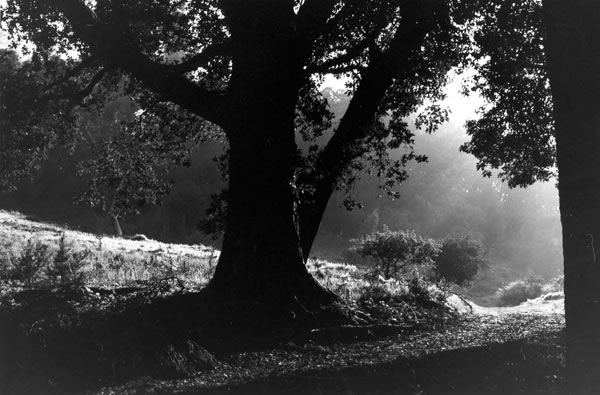
One might say I had decided to marry the silence of the forest. The sweet dark warmth of the whole world will have to be my wife. Out of the heart of that dark warmth comes the secret that is heard only in silence, but it is the root of all the secrets that are whispered be all the lovers in their beds all over the world. So perhaps I have an obligation to preserve the stillness, the silence, the poverty, the virginal point of pure nothingness which is at the center of all other loves. I attempt to cultivate this plant without comment in the middle of the night and water it with psalms and prophecies in silence. It becomes the most rare of all the trees in the garden, at once the primordial paradise tree, the axis mundi, the cosmic axle, and the Cross. Nulla silva talem profert. There is only one such tree. It cannot be multiplied. It is not interesting.

treephotobythomasmerton

The Latin quotation in the piece is from Fortunatus’ hymn, Pange Lingua, which hails the wood of the cross as being without compare. The contemplative depth of Merton’s reflection here is extraordinary and needs a little unpacking. I think it reflects his engagement with Buddhism in his suggestion that the ‘point of pure nothingness’ is one – that is, something akin to the Buddha-consciousness or to sunyata – and that it is ‘uninteresting’ – that is, not an object for speculation or analysis but a pure simplicity of being. It is also profoundly Christian in its presentation of the Cross as a cosmic reality. He draws on that ancient tradition of the tree of the garden of Eden being the tree from which the wood of the cross would be taken – paradise is restored in the self-giving of the Christ. And he is clear that our way to engage with this reality is to enter silence in love. This is no retreat from the world, as all the world is contained in this apprehension of reality, and Merton’s engagement with the wider world, its peace, its creativity, its contradictions is highly visible in this essay.

Merton may not dwell much on the drama of Holy Week in his writings, but his contemplative consciousness would be unthinkable if it had not been formed in the shadow of this one tree.

Beautifully Limited

The poet Alice Oswald once described her medium as ‘beautifully limited’ and, in this, she was likening it to music. In the same interview, she talked about her sense of what it was to be a poet and used phrases like; ‘it’s a question of paying attention’ and ‘you get drawn into the big human questions: how to live’. I respond very strongly to these descriptions and they strike me as deeply spiritual. In the spiritual life, the ‘methods’ at our disposal are also beautifully limited. Our practices, our historic texts, our liturgies are all abundantly rich in meaning and offer the most profound encounters, and yet we know them to be limited. They are beautiful forms, but they are just that. They should not regarded as of ultimate value, only of proximate value.

The spiritual life is, like poetry, a matter of paying attention. It is nothing more and nothing less than our response to the invitation to see clearly and a simple discipline of attentive, concentrated silence, of radical openness to what is in front of us, of seeing the connections. And it is, above all, concerned with the question of how to live. The spiritual life can never be reduced to theory (though I wish more theologians took seriously the task of considering spirituality in an analytical, conceptual and contextual way…) and is always a matter of vital seriousness (though one of its hallmarks is self-forgetting humour).

So if poetry and the spiritual life have so much in common, I wonder if we might not gain rather a lot by applying Alice Oswald’s thoughts to our primary spiritual texts – what we call sacred scripture. If we read these texts as ‘beautifully limited’ expressions of faith, then we might see their succinct and incomplete character as strengths rather than weaknesses. The Bible is not all we have to say about faith, but a way to open us up to encounter with the Absolute. Not definitions but invitations. And if reading the Bible is a matter of paying attention, then our encounter with it is a school for contemplative consciousness. And if we come to it with the question of how to live, seeking not instructions but a mirror to be held up to our most challenging experiences, then we will find hope, honesty, love, betrayal, fear, wisdom reflected back at us in new clarity.

Maybe that’s a good way for us to read the accounts of Christ’s Passion this week. I’ll give it a try!

A Friendship With An Unpromising Start

“Intense, one-sided, humorless, propagandist, morally indignant” – not a promising description of someone you will later describe as a ‘firm friend’, yet these are the words written by the English Benedictine monk Dom Aelred Graham in Atlantic Monthly about Thomas Merton and his earliest religious writings, most notably his famous autobiography, The Seven Storey Mountain. Graham found Merton to be narrow-minded and ascetical and his critique of such a notable religious figure caught the attention of Time magazine in 1953. The criticisms stung Merton, but if we fast-forward a decade, we find Merton writing in the warmest terms about Graham’s book, Zen Catholicism, in the journal America. What happened in between to change the atmosphere between the two monks?

Aelred Graham wrote a fascinating set of autobiographical reflections a couple of years after Merton’s death in 1968. In The End of Religion, he recalls that earlier spat with Merton and is regretful of the language he used in his critique, though not of his view of the sometimes harsh narrowness of the early Merton. He recalls how he invited himself to Merton’s abbey after the publication of his essay in order to engage face to face with the man he had so publicly criticised. He remembers long conversations and a gradual warming of their relationship into a friendship that would last until Merton’s death. As an example of how far they travelled, in his journal for March 10 1964,  Merton writes: “Good talks with Dom Aelred on Sunday. He is very open and sympathetic and one of the most pleasant, understanding people I have ever run into. A lot has gone under the bridge since the Atlantic article (which in any case was not so far wrong!). This is something to be grateful for and a real manifestation of the life of the Church in us.’

This friendship was to bear fruit in one most significant way. It was Graham who made the introductions and provided the contacts for Merton’s Asian journey in 1968. Graham was an early pioneer of Christian inter-faith exploration and had travelled in India and Thailand. He was able to supply Merton with a range of contacts who would introduce him to the living Buddhism he longed to encounter. In his Asian Journal, Merton also notes that he was, at that time, reading Graham’s new book, Conversations: Christian and Buddhist, a collection of transcripts of conversations Graham had had with Buddhists in Japan. This book is significant in the development of Merton’s awareness of Japanese Buddhism as it represented a widening of his sources which had, for a long time, been dominated by the rather partial views of D.T. Suzuki. It is a great pity that Merton never made it as far as Japan on his journey. His intended visit there would have brought him face to face with Japanese Zen practitioners in their own context as well as the three Jesuits of Sophia University – Dumoulin, Lassalle and Johnston – whose writings have done so much to further understanding between Christians and Zen Buddhists.

Aelred Graham’s own contribution, however, should not be forgotten. He was a true pioneer and a man of gentle yet probing spiritual insight. He may not have the lasting fame of his friend Thomas Merton, but I think he deserves a place in our growing appreciation of the spiritual revolution that took place in the Christian church in the second half of the 20th century, a revolution whose work is not yet complete and whose fruit continues to ripen.

Meaning and Meaninglessness


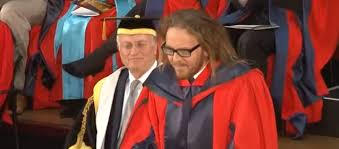
It is a truism that human beings are meaning-making mammals, which I take to mean that we have a propensity to see patterns in things and, more than that, to see such patterns as having significance or value. But I was made to think again about how Christianity talks about meaning by two unconnected thoughts from yesterday. One was a highly amusing and thought-provoking speech given to graduands at the University of Western Australia by one its alumni, the comedian and singer-songwriter, Tim Minchin. The two things that stood out for me were his statements that life has no meaning (and that we should just get on and live it) and that it was foolish to make grand plans (it’s better to be fully focussed on what we are doing now). I find myself largely agreeing with him, though knowing his antipathy towards religion, he might be surprised to hear me say this.minch

Indeed, I think his insights speak of a deep spirituality. To take the second point first, the kind of focus Minchin was describing is powerfully represented in religious traditions as ‘watchfulness’ or ‘mindfulness’. Just think of the desert Fathers and Mothers with their clear focus on the simple spiritual disciplines of each day, or the prologue to St Benedict’s Rule for Monks which speaks of the urgency of ‘today’ as being the time in which we are called to live lives that are full of divine light and wisdom. The practices of meditation in many religious traditions also speak of this kind of full presence in the present.

The first piece of advice regarding meaning may seem more problematic for Christians. Surely it is without question that our faith presents a view of life that shows it to have meaning. Well, I think it rather depends what we mean by ‘meaning’. If we mean that our lives fit into some larger scheme or that every thing that happens to us happens in order to bring about some pre-planned outcome, I am not sure that this fits into my notion of ‘meaning’ in the Christian sense. Indeed, I think it is highly problematic to see every event in life as having a ‘meaning’ that is just waiting to be discovered: it is not always possible to make sense of senseless acts or events and it can give us serious problems if we try to do so. ‘Meaning’ in this sense can be seen as the notion that every thing that happens refers to something else – this means that – whereas the focus on present things I mentioned above is more about this means this. In other words, the insight that comes from wisdom allows us to see more clearly what is there. This is entirely consistent with Christian theology and practice.

I think I would rather speak in terms of ‘value’ or ‘worth’ that ‘meaning or ‘sense’. I think it is a profoundly Christian insight to say that life has value, that lives have value. Those humanists who do not come from a religious perspective are content to let that statement stand on its own self-evident merits. Christian humanists are more likely to offer theological or spiritual weight to this statement by talking of the giftedness of life and its fundamental orientation towards joy, praise, wonder and love. So life has meaning or purpose in the sense that it has direction – outward, towards fullness, towards goodness, towards compassion, towards creativity.

The second thought reinforced much of what Tim Minchin had to say. It was an article the Blackwell Companion to Christian Spirituality by the priest and academic, David Perrin OMI in his article on mysticism. He rejects a focus on a totalising system (‘meaning’) and urges instead a gathering of life-giving fragments ‘that do not necessarily need to be connected to a common ontological foundation’ ‘such that our love relationship with God and our world is constantly renewed.’ I think this all offers us some interesting common ground for religious and non-religious people to start talking!

Visual Literacy and Theology

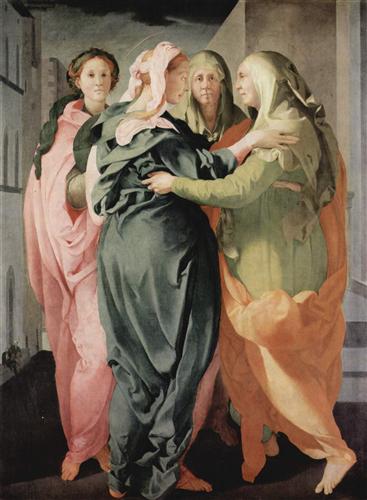
I have just attended an excellent seminar by Dr Chloe Reddaway from the National Gallery in London where she presented a stunning overview of the representations in art of the Visitation of Mary to Elizabeth. Her main aim was to focus on a significant aspect of the theology portrayed in images of that encounter – the New Creation that is brought to birth in Christ and the active part played by these two women in that act of (re)creation. A survey of some couple of dozen pictures brought more theological insight than most exegeses of that biblical text I have ever heard or read. From explorations of liminal spaces depicting thresholds of new life to depictions of the primal void of creation, she showed how art can draw the viewer into an expanding community of those who embrace the already-and-not-yet new creation through their recognition of the creating presence of God within, between and among us.

pontormo2

But I was also fascinated by a side-comment about the carelessness with which most theologians treat our visual expressions of theology. We would never, she said, consign our biblical texts to ‘cultural history’, so why do we do so with our visual canon? She suggested that we should take seriously the challenge to read these works as carefully and as creatively as we read our scriptures. There is, indeed, a growing number of theologians and spiritual writers who draw on our visual canon but it is still not seen as a mainstream activity. This is a great pity, given the potent role of visual art in human expression and in the spiritual quest. Indeed, humanity’s first religious expressions were in cave art, which predates writing.

When I was training to be a priest, I was taught how to read biblical texts in their original languages, how to interpret theologians who wrote about these texts, I was even taught how to sing them! But I was never taught the value of looking at a painting or given the conceptual and analytical tools to interpret it. I have tried to pick some of these up along the way because I like to look at great art – it moves me and draws me into contemplative modes of seeing – but it would be wonderful if we gave more people more confidence in looking at a work of art and seeing it as a primary piece of theological expression and exploration.

I hope the kind of vibrant and creative theological work done by people like Chloe Reddaway is the beginning of a new and mainstream focus on the visual means at our disposal to encounter the Word made flesh.

God and Equality

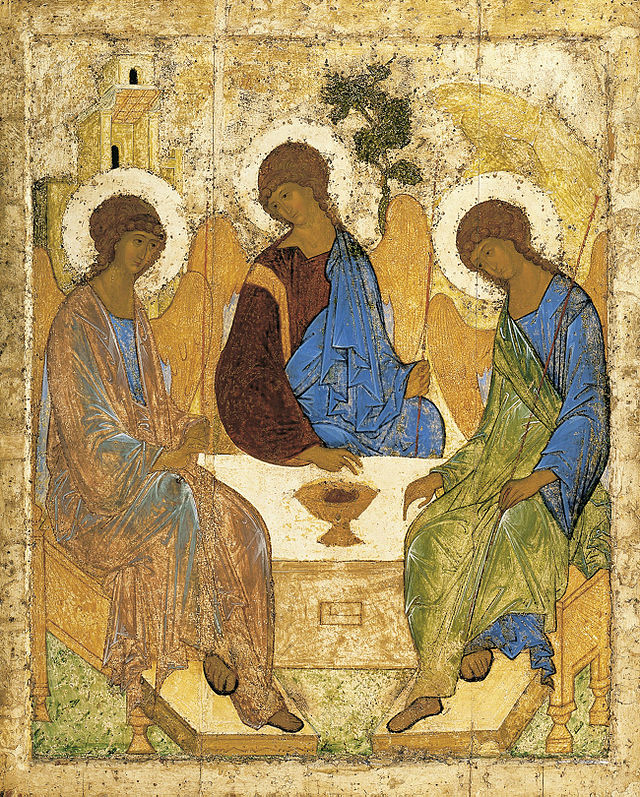
I have been puzzling about the church’s struggles to express the equality of all when we know that the equality of persons in the Trinity looks something like this:

Rublev Trinity