The Contemplative’s Crucifix

In the Christian West, our most central devotional image, that of the crucified Christ, usually carries two major resonances. One is theological: it represents the salvation of the world through the loving self-offering of the Saviour in his victory over death. The other, more devotional resonance is of the suffering of Jesus and most representations of the crucifix have this character – the suffering of Jesus is shown powerfully and graphically as he bears in his own tortured body the suffering of the world. However, this emphasis is surprisingly late in Christian art. It is really only from the 13th century or so that we see Christ depicted more consciously in his suffering. Until then, his image was not one of pain but of victory, even to the extent of showing him crucified as a king.

Perhaps the most famous example of this earlier form is the crucifix before which St Francis heard his call to rebuild the church, which hung in the church of San Damiano. This powerful image can still be seen in the Basilica of St Clare in Assisi.

https://upload.wikimedia.org/wikipedia/commons/3/31/Kruis_san_damiano.gif

It is surprisingly large, almost 2 metres tall, and is rich in symbolism and narrative. The art shows strong influences from the Christian East and shows how close the iconographic traditions of the churches were at that time. Incidentally, this tradition has been revived in the icon painting of the ecumenical community at Bose in Italy. But I don’t want to get distracted into art history because my purpose in sharing this profound image is a spiritual one.

I have often felt that it is a pity that Christian art does not have an equivalent of the Buddhist iconography of the Buddha Shakyamuni in meditation. Jesus is shown teaching, healing, at supper with his disciples, on the cross, risen, but only very rarely at prayer. Given how often the Gospels refer to his withdrawal by himself to pray, this is surprising. But in revisiting this image, which has held a very important place in my own spiritual journey for about three decades, I has struck me with a great force that this is the supreme image of Jesus in meditation! The Jesus who emptied himself and took the form of a slave is here depicted in that boundless and loving emptiness. Stripped of all outward embellishment, he stands erect, open-eyed, open-armed, serene, united with the Father and with all of life, not in suffering but transcending suffering. This is Jesus-Sunyata: having let go of all things, even life itself, he fills all things with his boundlessness. This is the-one-who-does-not-cling (Phil 2:6) and is therefore open to all in unbounded compassion. This is how he saves – not through some legal-theological process, but by the utter poverty of self-emptying love. Suffering and violence are transcended by the complete renunciation of the savage system of blame and revenge that can sometimes pass for justice, and peace is realised through the courage to enter the unknowable void of egolessness.

The Seed has fallen into the ground and has died. It has let go of life that Life might flower.

Bede Griffiths and Godly Paradox

I think it is fair to say that Bede Griffiths was one of the 20th century’s most notable religious pioneers, a true adventurer in the deepest realms of human existence. The experimental monastic community in Tamil Nadu he inherited from his spiritual forebears, Jules Monchanin and Abhishiktananda, combined the life of a Hindu Ashram with Benedictine monasticism but this was not only an experiment in the external aspects of inculturation. What Bede sought to embody was the true coming together of religions in his own person. His goal was the reconciliation of opposites in advaita, non-dualism, a profound level of unity in which all things are held together. In part, he was motivated by what he saw as an excessive reliance in the West on rational processes and their resulting technologies. Ever since an early experiment in simple communal living with two friends in the 1930s, Bede shunned many of the products of industrial activity. Indeed, when he entered Prinknash Monastery shortly after that experiment, he was appalled by the comforts of a monastic life that was considered by many to be exacting! He felt deeply that Westerners, Christians included, had lost touch with the fullness of human life, losing confidence in the darker and intuitive aspects of the human psyche in favour of control and reason.

Bede went to India to find ‘the other half of his soul’ and this journey, a life’s journey, was one of unifying feminine and masculine, ordered and spontaneous, light and dark, intimate and self-contained aspects of his person. In religious terms, he insisted on using texts and symbols from other religions in the Ashram’s liturgies. One of the most potent of these symbols was the cross outside the Temple at Shantivanam:

The use of the sacred syllable, Om, in the middle of a Christian cross aroused anger from conservative Hindus and Christians. And, despite Bede’s unstinting commitment to welcome all who came, some found this desire to embrace all religions as fundamentally expressing one great Truth to be completely unacceptable. Bede dealt with considerable levels of conflict in his life and I suppose this is inevitable for those who try to hold ‘opposites’ together in their own person. For those whose faith is ‘this and this only – never that‘, Bede’s insistence on true faith as always residing in ‘this-with-that’ poses a deeply uncomfortable threat.

For Christians in particular, Bede’s exploration of non-dualism asks hard questions of traditional Christian polarities such as evil-good, law-gospel, dark-light, human-divine, death-life, creator-creature. Do these melt away into an indistinct singularity? I think Bede’s answer would be that distinctions remain, but in constant relationship, in ultimate unity and sometimes in painful tension. To use a phrase from Teilhard, ‘union differentiates’. All the same, the truest reality, the reality we call God, is one. This means that human fulfillment is found in the unity of opposites, the reconciliation of contradictions and the fearless of embrace of paradox.

On Giving up Prayer for Lent

https://c2.staticflickr.com/8/7265/7586726888_a17ba4e9c6_b.jpg

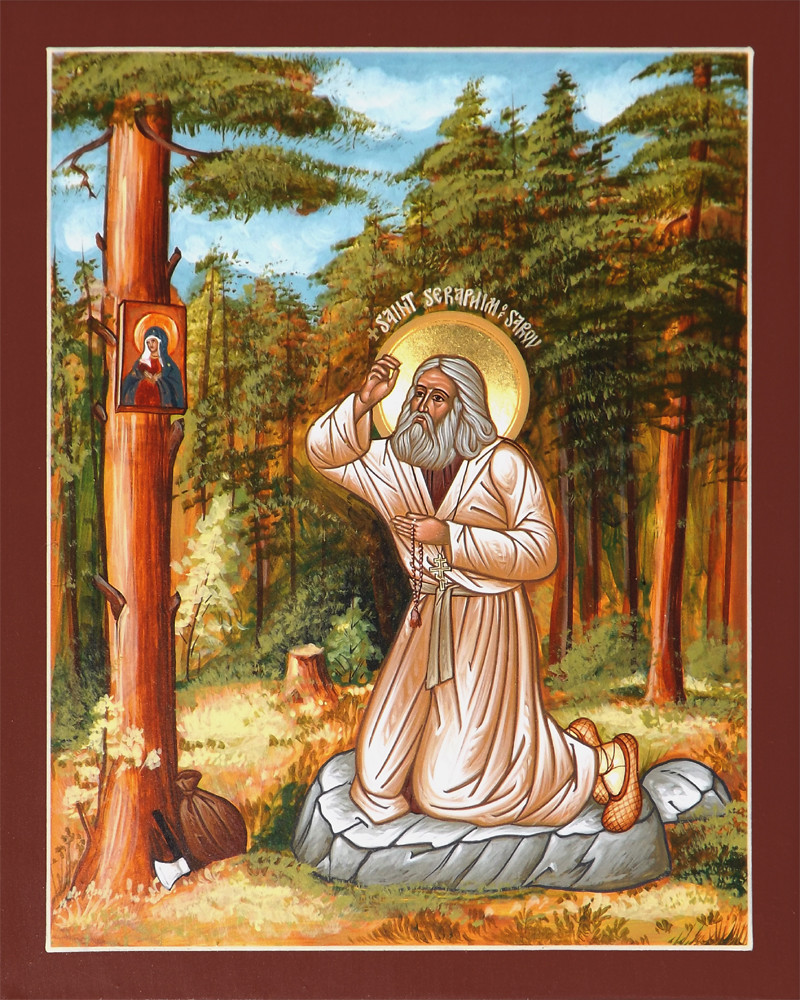
One of the most extraordinary testimonies of spiritual encounter in the Eastern Christian tradition is Nicholas Motovilov’s meeting with St Seraphim in the forest near Sarov in November 1831. Famously, this dialogue between the staretz and his disciple culminates in an experience of divine light, radiating from both men as they are filled with warmth, peace and calm. But in the course of their conversation, Motovilov records some remarkable words from Seraphim about the practice of prayer. In speaking about the mystical gift of stillness, he says:

Many explain that this stillness refers only to worldly matters; in other words, that during prayerful converse with God you must ‘be still’ with regard to worldly affairs. But I will tell yo in the name of God that not only is it necessary to be dead to them at prayer, but when by the omnipotent power of faith and prayer our Lord God the Holy Spirit condescends to visit us, and comes to us in the plenitude of His unutterable goodness, we must be dead to prayer too.

This last phrase is one of the most startling expressions of apophatic theology in Christian tradition, but it is entirely in keeping with the experience of many that it is only in letting  go of what we think of as prayer that we truly enter the fullness of divine reality. No words, no images, no thoughts, no intent of gain, no technique, no activity, only complete stillness of body and mind and a radical emptiness or openness.

It is very hard indeed for us to ‘do nothing’ in prayer. We want to be in control, to have an outcome and to feel that we have accomplished something. And surely when the world is in a big mess, the impulse to ‘do something’ is even greater. Paradoxically, however, the act of radical letting go that is true prayer is the only way to turn our own hearts from the dangerous notion of an isolated self and to realise the fundamental connectedness of all things. We let go of the idea that I am here, you are there, God is somewhere else and prayer is some kind of negotiation between these separate loci. Without such a metanoia, we remain the realm of oppositions, a realm that too easily becomes a power struggle. In prayer – in giving up prayer – we let go of all such notions of power over-against another and open ourselves to compassion. Christ Jesus, ‘who emptied himself, taking the form of a slave’ showed us the way and invites us to do the same. One simple way to train ourselves in such a demanding way of life is to give up our notions of prayer in order truly to pray in the utter stillness of compassion and trust.


On Duelling and Dualism

Why do we love to see things in terms of either-or rather than both-and? It seems that we have a bias towards oppositional understandings and I struggle to know to what extent this is coloured by cultural norms and to what extent psychological ones, as if it were possible to separate these things out! In any case, Western thinking, including Western religious thinking, often seems to opt for a binary model of reality. There are winners and losers and no one wins unless and until another loses. This kind of zero-sum-game is played out in so many different contexts that it’s hard to choose only one as an example. Our British political culture, of course, sets out this binary model in graphic terms with an ‘opposition’ whose job, over-against that of the government, is to contradict those sitting on the other side. The symbolism of our House of Commons is unmistakable. This is a kind of ‘social darwinism’ of the worst sort.

In religious terms, to pick up a theme from a previous post, we resist pluralism on the grounds of a perceived ‘incompatibility’ between faiths and imagine that it is only in exclusive claims of univocal truth that we thrive over against those of other faiths. I cannot be ‘right’ unless there is someone else out there whom I know to be ‘wrong’.

Of course, this kind of thinking almost inevitably leads to conflict or even to violence. So is there another way? Beginning at that most extreme end of the spectrum, where there is division that has led to a high level of conflict, Jesus introduced his most revolutionary religious idea: love of enemy. There can be no peace that is not also good for my enemy, no solution that does not include my enemy. And our love for enemy is founded on a fundamental challenge to the notion of our complete separation from our enemy. Our ‘enemy’ is our neighbour, whom we are to love ‘as one who is like ourselves’ (a better translation, I think, of the Hebrew, k’mocha). I am not separate from my enemy because I, too, am an ‘enemy’. Put more positively, I am not separate from my enemy because I share their fears, their hopes, their very nature. We are of the same stuff as those we hate.

Buddhism is, I think, correct in diagnosing our problems as being rooted in a wrong view of our understanding of reality. We imagine our ‘selves’ to be separately existing entities when, in fact, all of life exists in a fundamental flow of connectedness. We project our hates and fears onto others as if they are the cause and source of our hates and fears. They are not: these things come from our own distorted perceptions. So the solution is to change our perceptions or, to use a more loaded Christian word, to repent. We simply have to change our minds and we do that by letting go of our mind as a separated, protected thing. There can be no compassion without a radical openness to the ‘other’ that is able to see that there is, in fact, no ‘other’ at all!

Deny Your Self

As Lent begins, I find myself once more blessing the congregation with these words: ‘Christ give you grace to grow in holiness, to deny yourself, take up your cross and follow him’. It seems to modern ears that the very worst thing one could ever do is to deny oneself! Surely it’s all we have, the most precious, indeed, the only thing that we truly have. Our contemporary spiritual instinct is to deny such denial and counter it with another injunction: ‘be yourself’!

I can full understand why people react against this apparent call to meek submissiveness, sounding, as it does, like an invitation to be at the mercy of some greater authority, conforming to external norms and expectations, rejecting all individuality and freedom. And I am sure that religious authorities have sometimes been as guilty of such an interpretation as other human institutions have. But I feel more and more convinced that the call to deny oneself is right at the heart of the spiritual life and I have been helped by some Buddhist insight into what this truly means.

In Buddhist thought, there is no separate self to deny: to deny oneself is deny that there is such a thing as a separate self to deny! Buddhism does not posit a self-existent ‘soul’ with some sort of existence that is, to some degree, independent of the body. Indeed, orthodox Christianity also denies such an anthropology! The Buddhist no-self is a recognition that there is no separate ‘thing’ that is ‘me’. We are always in movement, in process, in becoming and not some kind of solid entity with firmly defined boundaries. Of course, Buddhism does not deny that there are ‘selves’ – that would be counter to the simple observation of the diversity of human forms – but it insists that these ‘selves’ are also ’empty’ of substance. But to say they have no separate substantial identity is not to say that they are unimportant or of no value. On the contrary, this awareness opens us up to the fundamental truth of our connectedness with all other things. All ‘selves’ share this boundless, expansive, creative openness, this ‘void’ that is at the heart of all life.

So in denying that there is a separate self, we are denying the self-importance, self-obsession and aggressive self-protection that can lie at the heart of so much of our human misery. To let go of such a self is to find freedom. And I think that when Jesus said  that we must ‘deny ourselves’ in order to find ourselves, I think he something like this in mind: ‘deny your separation, your isolation; do not cling to such things and you will find life’.

I belong to you (two)

I apologise that this post is nothing like as racy as the menage-a-trois sounding title might imply. It’s really a reflection on a phenomenon that has been occupying my thoughts and studies rather a lot recently, and it is the notion of ‘dual belonging’ in religious life. I part, this stems from my research into the writings of the Irish Jesuit William Johnston, whose own interaction with Zen Buddhism was complex and did not lead him to the position where he could in any way embrace a multiplicity of religious identities. For him, the reason was not polemical or judgmental – he simply couldn’t see a way to let go of his primary calling to a spiritual path that was Christian, formed by many centuries of contemplative experience, an experience which he sought deeply in his own life. He felt the same kind of loyalty to one path in his Zen Buddhist friends, for whom loyalty to a teacher, as well as more primary loyalties to the Buddha, the Dharma and the Sangha, was fundamental. Nonetheless, his Christianity was deeply shaped by his ongoing dialogue with Buddhism to the extent that he regarded such dialogue as utterly essential.

But many of Johnston’s friends and followers took a different path, one that wholeheartedly, if not always straightforwardly, embraced the practices and insights of Christianity and Buddhism. Robert Kennedy, another Jesuit, writes powerfully of this blending of insights in his books, of which ‘Zen Gifts to Christians‘ is an excellent example. He describes there how Johnston led him round many Zen temples in Japan in search of wisdom and spiritual rejuvenation.

Looking to another exemplar, Paul Knitter is more reflective on the nature of this dual belonging. Knitter was a Catholic priest and has spent his life teaching theology. He also practises Dzogchen Buddhism and has written extensively on inter-religious matters. He used to describe himself as a Buddhist Christian, but now finds it impossible to separate these identities or give one of them priority. He talks of how some ‘dual belongers’ are Christian for one half of the week and Buddhist for the other, some clearly identify a primary belonging, some are simply uncertain about how these two streams interact. Knitter has a particularly interesting way of describing how it is for him (at least, it’s interesting to theology nerds like me…). He uses the Chalcedonian language about the two natures of Christ to talk about how his own ‘two natures’ interact – constantly influencing each other, constantly moving, but completely united. For him, there can be no division, no dualism between the ‘wisdom’ emphasis of Buddhism and the ‘love’ emphasis of Christianity. On a practical level, this means that he also participates both in Christian liturgy and prayer, and Buddhist ritual and meditation, though he brings all of his experience to each. So he hears Christian sermons through Buddhist ears and meditates as a Buddhist conscious of the divine presence. He describes quite movingly how, for him, ‘Buddhism provides the ontology and Christianity provides the particularity. Buddha makes clear what is going on. Christ shows how it goes on.’

For many Christians, this poses severe problems as it challenges both Christianity’s claim to exclusive truth and the believer’s secure place among the elect. Is this ‘dual belonging’ not simply a loss of nerve in the face of declining Christian influence in the West? Is it simply a giving in to the lure of the mystic East, not recongising the treasures of one’s own tradition in the area of mystical wisdom and loving contemplation? I don’t think so. I see this phenomenon as being a genuine fruit of encounter between faiths and I would not want to dismiss it any more than I would want to dismiss Johnston’s choice to adhere to his one Christian way. These dual belongers offer a particular kind of challenge to religious people to see beyond their tribal loyalties and place the faithful practice of spiritual awakening at the heart of all that they do. They embody the urgency of dialogue in their own person and urge us all to see beyond limited horizons. Their approach also embodies a deep spiritual truth, which is that there is no spiritual growth without loosening our grip on the things we imagine to be essential or, as Jesus put it, no gaining of life without the willingness to lose it.

A Manifesto for a Meditative Christianity

William Johnston’s little book, ‘Letters to Contemplatives’, is a wonderfully accessible introduction to his teaching. It is addressed to a range of ordinary people seeking to live a faithful life in a complex world and, although he admitted that the characters in the book are really facets of his own character, there is much there that will appeal to any religious person seeking an authentic expression of Christian spirituality in a pluralist world. I have a modest ambition to make Bill Johnston’s work better known and this book is as good a place to start as any.

In the first of these letters, Johnston sets out a vision for what he boldly calls a new school of Christian mysticism. It draws on the insights of the past but finds new expression in close and careful dialogue with Eastern religions and with the contemporary world. He cites people like Thomas Merton and Bede Griffiths as pioneers of this approach and sets out this compelling description of the characteristics of this new school:

  1. This new mysticism is for everyone, not just religious professionals.
  2. It adopts a new language, drawing on insights from psychotherapy, science and other religious traditions, with a rich vocabulary with which to talk about consciousness and about energy.
  3. It strongly emphasises posture and breathing as essential spiritual ways.
  4. It emphasises faith – pure, naked, dark faith beyond reason. It is the prayer of the ‘void’.
  5. It talks also of enlightenment – a glimpse of the divine beauty, of transcendental wisdom, of holiness, of the vision of the God of love.

Johnston always rooted his teaching in the gospels, the Eucharist, the mystical writings of the saints, especially John of the Cross. He never flinched from the demanding nature of the life of faith and refused to separate the life of prayer from the life of active engagement with the world of pain and suffering. Above all, Johnston’s new mysticism is compelling because it is practical. By this I mean that he sees no separation between insight and practice. Christian spirituality is not a theory to be put into practice, but a practice from which we learn insight.

Is Christianity a ‘Toxic Brand’?

Shirley du Boulay’s autobiography is called ‘A Silent Melody’ and I suspect the title is influenced to some extent by that of William Johnston’s book, Silent Music. Du Boulay refers to that book in a number of places as having a particular influence on her when she read it in the mid ’70s. Both books talk a lot about meditation and it is the practice of meditation that has remained with du Boulay as she has travelled first deeper into the Christian church and then further away from it until she finds herself saying – not without pain – that she can no longer call herself a Christian.

Shirley du Boulay has been influential in the religious life of these islands for many years, first as a producer of religious programmes for the BBC and then as the biographer of Cicely Saunders, Desmond Tutu, Theresa of Avila, Bede Griffiths and Abhishiktananda. So her autobiography is a fascinating survey of contemporary spiritual life as it is experienced by increasing numbers of people. Drawn first of all by the teachings of the Maharishi Mahesh Yogi, then becoming a Roman Catholic and finally practising Zen Buddhism for over 20 years, she has travelled a long way from her conventional Anglican origins. She writes eloquently and with humility about the complexity of describing a fixed religious identity and talks about how this is true for many people through history. The notion of ‘dual belonging’ or even multiple belonging is not a new one and it is unlikely that the early Jewish-Christians were the first hyphenated believers! Du Boulay makes a strong case for the fluidity of our religious belonging and, in a world where unshakable certainty about religious purity leads to such violence and exclusion, I find it hard to disagree.

But why is it that, given this willingness to embrace plurality of religious identity, she no longer wishes to identify with the Christian church? It is not that she has ‘lost her faith’ or that she does not wish to see the churches flourish, but there are two major factors in her coming to the place where she now finds it impossible to claim that belonging. The first is that the church has failed to meet her spiritual needs. Bill Johnston frequently said that the church must be mystical if it is to make sense to modern people. If the churches do not offer an experience of spiritual depth and a practical approach to exploring such depths, then spiritual seekers will find it cold, doctrinaire and dislocated from their spiritual longings. The second is that the churches have tolerated the abuse perpetrated by members of their own clergy while strongly condemning the loving, committed relationships of their gay members. The commitment of many Christians to justice and peace and to the practice of compassion and inclusion has not been sufficient for people like Shirley du Boulay to find a way past this clear and appalling contradiction. For many people, yes, Christianity has become a toxic brand.

What is the way out? I think that nothing less than a death and resurrection will suffice. A death to the old ways of privilege, exclusion and judgementalism. A death of self-interest and introspection giving way to a new life of humility, service, spiritual depth, openness and joyfully embraced pluralism may be what is needed to present this profound tradition of spiritual truth afresh for our generation.

Light, Mirror, Poverty – the Contemplative Wisdom of St Clare

Clare - Simone Martini

It is St Clare’s feast day tomorrow and, therefore, another opportunity to remember what an exceptional mystical theologian she was. Too often, she is overshadowed by Francis in the consciousness of most church people, but it would be a mistake to see her only as a follower of her better known contemporary. Although she responded to the same call that drew Francis to a life of radical simplicity, her mystical exploration of Holy Poverty is of a different order from his – more subtle, more contemplative, more carefully developed – though it is no less radical in terms of the life she led. Clare’s letters to Blessed Agnes of Prague are classics of medieval Christian mysticism and explore poverty as a profound expression of self-forgetting, an utter humility in which the true self is realised. Among the many images in these letters, the image of the mirror in the third letter stands out. She is by no means the first to use it and, in the letter, is quoting directly from the book of Wisdom. The image is also known in other faith traditions as a picture of the true mind, clarified of all distortions, simple and pure, seeing all and having no separate identity. In Clare’s writing, the mirror into which we gaze is Christ, poor, humble and loving. In that mirror, we see our own face, and when we see it clearly, we see that it has the same character of the mirror itself – poor, humble, loving. In other words, our own face is seen also as a mirror, also as Christ.

With Clare, though, this is no theory. It is the lived experience of the contemplative who practices a life of spiritual and material poverty. Poverty is not an add-on for her but a lived expression of one’s true nature. Her example brings to mind another exemplar of holy poverty, the Zen monk Ryokan. When a thief came to his simple hut, Ryokan was happy to let him take what meagre possessions he had. As the thief left, Ryokan sighed sadly and said, ‘I wish I could have given him the moon as well.’ The lesson being, of course, that if the thief learns true poverty, he can have the moon as well! Ryokan also wrote on the practice of begging for food, takuhatsu:

The cloud-covered sky
is all open.
The heart of takuhatsu
as it is –
a gift from heaven.

This was Clare’s experience of poverty too, a divine simplicity in which we learn complete openness. This complete openness is shown ultimately in self-giving love. For Clare, this self-giving love is the Mirror that hangs on a wooden gallows. Looking into it with the same openness, our love is inflamed until we cry out:

‘Draw me after you!
I will run and not tire
until your hand will embrace me happily
and you will kiss me with the happiest kiss.’

[Third Letter to Agnes, paragraphs 30ff]

Just Let Go

The spiritual life is a path of letting go. People often talk of religion as if it were ‘adding something’ to people’s lives but I like to think of it more in terms of subtraction than addition! Faith, to me, is not a question of adopting new ideas, beginning new kinds of behaviour, taking on a new identity, but a question of deliberate self-forgetting in order that we may more truly live. For much of the time, we run the risk of living our lives at a distance, separated from reality by ideas of what should be happening or concepts of what we are seeing around us. These concepts place a preconception between us and what we see. Even to give something a name is to risk pinning it down to a limited definition. Indeed, one of the most intrusive names can be ‘I’ and all we associate with that. We can find it so hard simply to see what’s there, perhaps because we have not really got to grips with the (empty – see yesterday’s post!) nature of the one doing the seeing…

If there is a letting-go at the heart of all spirituality, then this can be challenging to us when our instinct is to hold on all the more tightly. When things are turbulent, we reach for what we think is dependable and solid. ‘I wish I had your faith, it would be such a comfort in difficult times’ is a phrase religious people often hear. But faith is not that kind of thing. It is not a solid fixture to cling to but an assurance that it’s ok to let go, and God is not a supernatural rescue service, but the very Life we discover in the letting-go. God is not outside the storm stretching out a hand to pluck us to safety. God is the storm, and the sea, and the one buffeted by the waves, and the peace.