A Light Burden

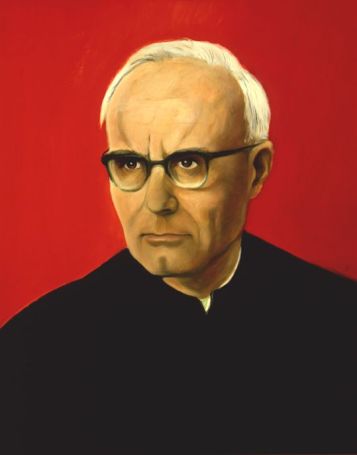
Karl_Rahner_by_Letizia_Mancino_Cremer

I recently came across this lovely passage from Rahner’s book, The Practice of Faith:

The cross and resurrection belong together in any authentic faith in Jesus. The cross means the no longer obscured requirement that human beings must surrender completely before the mystery of existence, which human beings can no longer bring under their control because they are finite and sinful. The resurrection means the content of the absolute hope that in this surrender there takes place the forgiving and blissful and final acceptance of a human being by this mystery, that when we let go completely we do not fall.

and again:

Christianity … embodies the single totality of existence, plunges this totality calmly and hopefully with the dying Jesus into God’s incomprehensibility and leaves all the details of life to us as they are, but without giving us a formula.

Needless to say, such a simplicity is not easy, leaving with us the full responsibility of living such a life. But I am moved by Rahner’s image of finding that ‘when we let go completely we do not fall.’ The letting go includes a letting go of any notion of God’s comprehensibility, of our competence, of theories of reality, of religious tidiness, of the magnificent yet fragile certainties of systems of thought (theistic or atheistic). What we take with us into this self-forgetting plunge is nothing less than the totality of all that we are. Ultimately, it is a plunge into death with the dying Jesus. And yet we do not fall. That is why it is a light burden.


quotations are from pp.10,11 The Practice of Faith, Crossroads, New York, 1992

Sermon for Easter 2

https://iconreader.files.wordpress.com/2011/04/altar-of-the-church-of-st-john-the-baptist-chesmenskaya.jpg

Touch. Simple, warm, human contact. Reassurance, comfort, strength. This is the thing that so many are missing right now as we live with the restrictions necessary to keep us all safe and well. All through our lives it is the simple act of touching that communicates so much of what it means to be alive and to love. It is the loving security we give to a baby, the healing warmth we give to an injured child, the expression of intimacy we give to a lover, the encouragement we give to a friend facing difficult times, the reassurance we give to one who is uncertain of us, the expression of communion and forgiveness we share at the Liturgy, the love we share with the dying. And all these experiences are the reasons we find it so hard to be distanced from one another at a time that we most strongly want to be in touch.

Today is the Sunday of Thomas, the day where we remember that disciple whose questions and whose faith are so compelling to those of us ‘who have not seen and yet believe.’ The traditional depiction of this Gospel in iconography carries an interesting title. Rather than ‘doubting’ Thomas, we are presented with ‘touching’ Thomas. He stretches out his hand to make contact with the wounded yet glorified flesh of Jesus at his invitation. Of course, the text doesn’t tell us whether or not Thomas did what Jesus invited – to put his fingers, his hands, on the scars so recently made. But it makes perfect sense to us that Thomas did just that. His touch is not the confirmation sought by a suspicious mind but contact desired by one who loved him. It’s not proof he’s looking for but intimacy. Belief for Thomas is not a matter of evidence but of embodied knowing, physically mediated truth.

For that is how we always know. We know with our bodies. We know what our senses open up for us. We know that food is good through smell, taste and sensation. We know that love is real through caresses and tones of voice. We know loss in the pit of our stomach, fear in the depths of our loins, joy in the lightness of our hearts, contentment in the restfulness of our breath. We learn skills through the training of our muscles in repeated movements and music through the refinement of our listening. And we pray through the bending low of our bodies and the lifting up of our hands, through the tracing of the cross upon our torso and taste of sweet wine on our lips, in the gaze of our eyes upon the face of Christ and the inhalation of aromatic incense. Prayer is in our knees and our hands as much as it is in our minds and memories.

So Thomas had it right when he expressed his desire to see and to touch, to feel the presence of Christ rather than simply to imagine it. The other name for the icon of Thomas’s meeting with Christ is the ‘assurance’ of Thomas. Faith is brought to life through contact.

So how does that work for us? In normal times, we get this through the rich physicality of our worship and I hope that some of that is possible for us even in this constrained online format. But we also continue to find faith in very physical experiences. When we take a deep and nourishing breath; when we feel the warmth of the sun on our skin; when we savour a mouthful of food and give thanks for the many labours that brought it to us; when our feet make contact with the firm earth that supports us; when we feel the warm hand of a loved one. All of these are sacraments that draw us close to one another and to the very source of life itself.

And for those who suffer in this present pandemic, the healing hands of carers, physicians, nurses, chaplains and friends bring an immeasurably powerful reassurance. For those of us at home, we still have the healing touch of a familiar voice to offer to others and the power of our prayerful breathing to share. Our breath connects us with all that lives so it is not surprising that the risen Jesus breathes on his disciples send their attention far beyond their limited horizons and to share with them the forgiving and healing love that first drew them to him.

So in this time of isolation, we may still find space to pray with our bodies and our breath, to savour the goodness of life in the food and fresh air that sustains it and to make contact with one another in whatever ways we can. In doing these simple things, we open ourselves to One who will come among us and say ‘peace be with you’ and to whom we respond, ‘My Lord and my God.’

An Empty Tomb

I’ve always found Ken Currie’s paintings compelling, even if occasionally disturbing. I think it’s the way he paints his figures with a combination of radiant light and intense fleshliness. At times the seem ghostly, but never anything less than human. Often vulnerable, but also luminous. In a pair of rare non-human images, he offers something more symbolic using the same palate. Here are Life Story I and II (badly reproduced from a book – sorry!):

KC LifeStoryI (2)KC LifeStoryII (2)

Even if one were to avoid making too simplistic an identification with the discarded graveclothes and empty tomb of Jesus, these powerful images would speak to me of the fertile emptiness that Easter opens up to us. There is a waiting and a receptivity that characterises Eastertide as much as it might be thought to characterise Advent, for Easter is a time to be opened up to life. Timothy Radcliffe quotes Tomas Halik:

Hardly anything points towards God and calls as urgently for God as the experience of his absence.

The empty tomb is an experience of God’s absence, but it is one that invites us to wait for the life that will fill the space we make.


Haec Dies

Haec dies | Me, senescent

Following on from yesterday’s thought, I love the way that the texts for Easter Week from the Roman Missal emphasise the unity of this week. It’s as if to say that the light of Easter Day is too bright to remain within the confines of 24 hours: we need a whole week of Sundays and a whole week of weeks to even begin to express the enormity of the transformation initiated by events of the early dawn of that first ‘eighth day’.

One of the repeated texts in the Missal is the Gradual: ‘This day was made by the Lord: we rejoice and are glad.’ (Psalm 117/118:24) The Hebrew could equally be translated, ‘this day, God has acted’ and I like the multiple meanings allowed by this simple phrase. Each day is at the same time a fresh gift and an opportunity to recognise the ‘action’ of God in raising Christ.

It feels to me like a similar insight as the one we find in the Prologue to St Benedict’s Rule, which invites us to to attend to the ‘today’ in the Venite, Ps 94/95:8 – ‘O that today you would listen to his voice’ – as an opportunity to wake up each day, be enlightened, be open to the world around us, be open to one another, be attentive to the voice of the Living One. In Anglican tradition, we a further thought to that one during Eastertide as we sing the Easter Anthems in place of the Venite, which invite us to ‘see ourselves as alive to God’ (from Rom. 6:9).

Here again, the tradition offers us a simple daily practice of being awake to Life. Each day offers a new opportunity, whatever lies ahead of us and whatever yesterday brought, to be alive rather than simply exist.

Everyday Resurrection

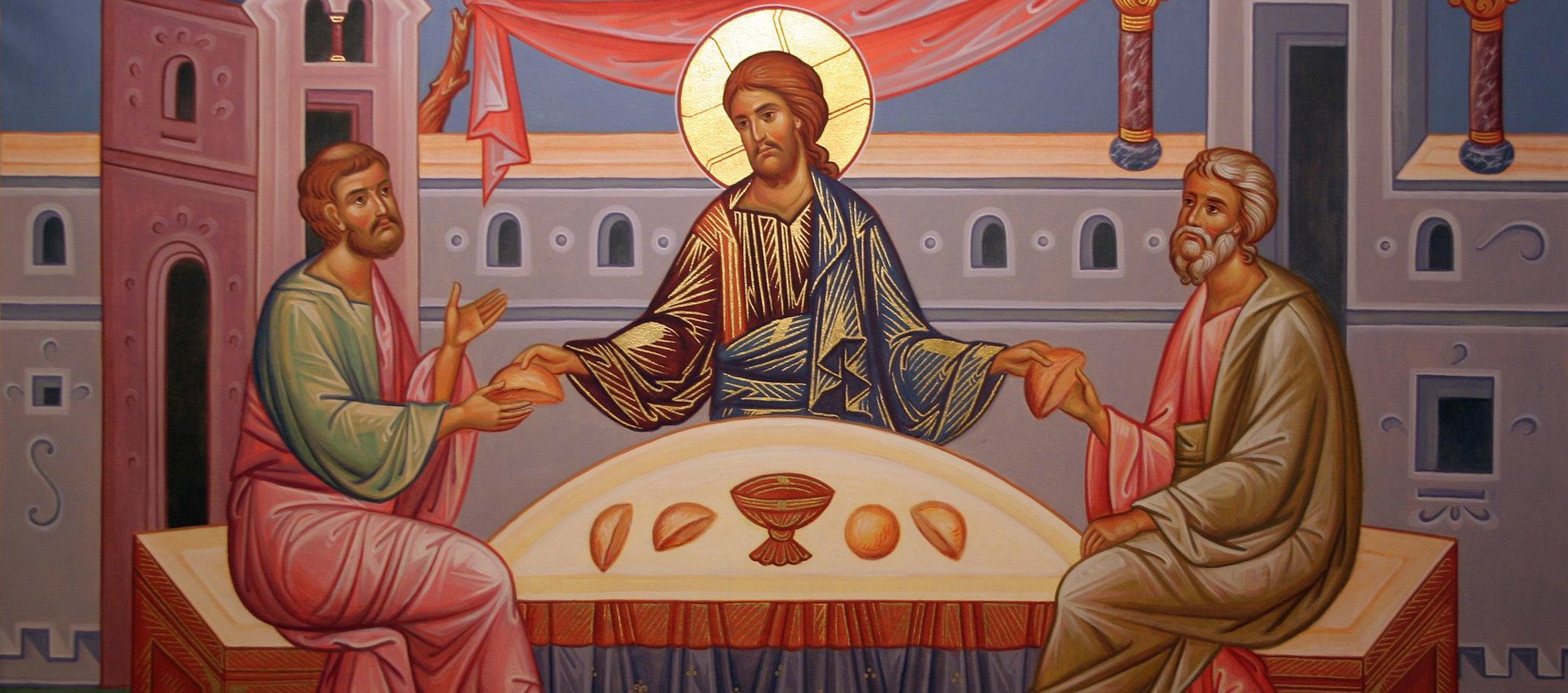
Emmaus icon - Crossroads Initiative

It seems to me that we, in the church, are pretty good at filling our Lent with lots of things to do, books to read, fasts to keep, lives of prayer to shape. I greatly appreciate this annual period of focused and intensified prayer. But I wouldn’t want to neglect the period of Eastertide as time for a different flavour of focused spiritual practice, so here are just a few brief suggestions for ways in which we might make each day of this bright season an opportunity for deepening our joyful faith. They are deliberately simple things because, although Pascha is a great mystery and the Feast of Feasts, it is also about our daily encounter with the new life that we embrace as a gift for now and a promise for the future.

  • Every dawn a Pascha. Each sunrise is a reminder of the Risen One and the opening of a new day. ‘In the tender compassion of our God, the dawn from on high shall break upon us.’ Even if we are not awake to see it, the sun’s return each day offers a moment for thanks and even a few words from Mattins at the outset of the day can serve to mark our thanks for God’s bounty.
  • Every meal a feast of the resurrection. Grilled fish by the shore and broken bread at Emmaus are paradigms not only of the Eucharist, the supreme Paschal feast, but also an invitation to see each and every meal as a sacred moment and a foretaste of the Kingdom. Every meal is an opportunity for nourishment, community – even if taken alone as no meal comes to us without the labour of many others – and sacrifice, in the sense of an act of gratitude and service. every particle of bread, every sip of water or wine is an occasion for contemplation of the one who is the Living Bread, the True Vine, the Living Water.
  • Every breath a gift of the Spirit. Each time we breathe, we taste the freshness and wonder of life; we savour the giftedness of life itself. we don’t ‘hold our breaths’ until Pentecost but recognise that the gift of the Spirit of the Risen Jesus is breathed into us every day, inspiring and renewing us. At this time of virus pandemic,we recognise even more acutely the preciousness of the breath that flows through our body and connects us to all that is. Taking time to breathe prayerfully is another daily opportunity for Eastertide.

Even in the absence of ‘normal’ church life, these simple practices offer ways of living a daily Pascha. I’d be delighted to hear of more suggestions!

Stations of the Cross

These reflections on some of the Stations of the Cross are by priests of Old St Paul’s.

First Station: Jesus Before Pilate
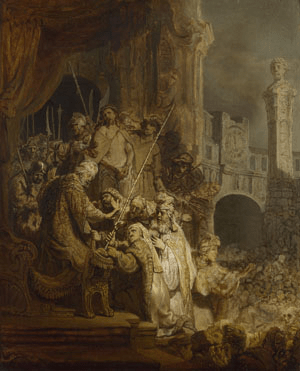
Rembrandt Jesus before Pilate

PILATE

Cool water over my fingers flowing.

The upstart

Had ruined a night and a morning for me.
I thrust that stone face from my door.

I was told later he measured his length
Between the cupid and the rose bush.
The gardener told me that later, laughing.
And that a woman hung about him like a fountain.

Another woman stood between him and the sun,
A tree, sifting light and shadow across his face.

Outside the tavern
It was down with him once more, knees and elbows,
Four holes in the dust.

More women then, a gale of them,
His face like a scald
And they moving about him, a tumult of shadows and breezes.

He hung close to the curve of the world.

The king had gone out in a purple coat.
Now the king
Wore only rags of flesh about the bone.

(I examined cornstalks in the store at Joppa
And discovered a black kernel.

Of the seven vats shipped from Rhodes
Two had leaked in the hold,
One fell from the sling and was broken.)

And tell this Arimathean
He can do what he likes with the less-than-shadow.

No more today. That business is over. Pass the seal.

George Mackay Brown, from his Stations of the Cross


Pilate’s callous dismissal of Jesus and his casual mockery of his sufferings comes from a place of expedience and business-like ruthlessness. The body of Jesus, so pitifully evoked here – ‘four holes in the ground’, ‘rags of flesh about the bone’ – is, by contrast, guarded and shielded by the women, treasured. Pilate is more concerned about his precious grain consignment than this broken body. Before Pilate, Jesus seems utterly defenceless. And yet, ‘He hung close to the curve of the world’. For me, this depicts not only his falls under the weight of the cross but his choice to remain close to the earth, close to the poorest and weakest, close to those regarded as dispensable or acceptable collateral damage. It is, I think, not by accident that the characteristically laconic GMB hints at resurrection by mentioning grain. Jesus is the grain of seed that falls into the ground, the ground he abides close to, and dies so that it may bear much fruit. Against such fragility, the ‘seal’ Pilate affixes to the tomb will prove insubstantial, less than a shadow. What abides is this risen, broken body.

Station 2: Jesus Takes up the Cross
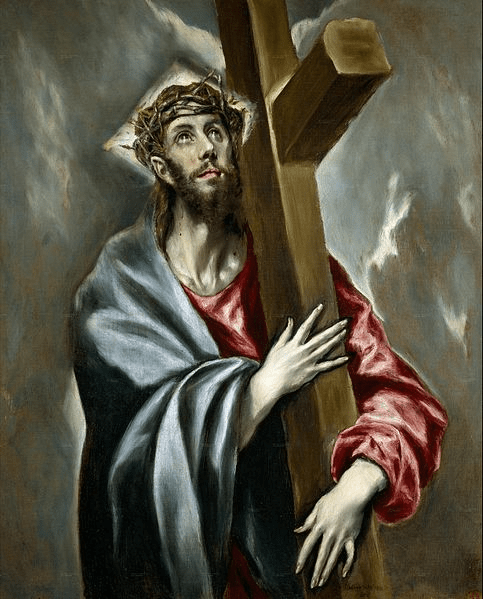
el greco jesus cross

‘Lord, it is time. Take our yoke
And sunwards turn.’

George Mackay Brown’s sequence, Stations of the Cross, begins with fourteen beautifully concise mini-poems, one for each station. For this one, he manages to hint at several scriptural allusions in two short sentences. ‘It is time’ evokes St John’s ‘the hour has come for the Son of Man to be glorified’ (Jn 12.23), a turning point in the narrative that points to the cross and leads immediately into his words about the grain of wheat falling into the ground. This long reflection then concludes in chapter 17 with Jesus’ prayer, ‘Father, the hour has come; glorify thy Son’ (Jn 17.1) and, ultimately, with ‘It is finished’ (Jn 19.30). This is not chronological time but the consummation of all time in the One who makes all things new.

‘Taking the yoke’ evokes a different scriptural tradition. Matthew 11.29 speaks of a light burden, an easy yoke. Surely the cross is no light burden! And it is light for us only because it has been borne by another. Nevertheless, El Greco’s painting of Jesus bearing the cross does have light about it, albeit light from a stormy sky. His face is not contorted with pain but at peace, trusting, tender. The cross is not merely carried but embraced, as if it were something to give life, as if it were a tree planted in the primordial garden, as if it were a sign of hope.

‘And sunwards turn.’ Face the rising sun. Face the dawn. Face Jerusalem’s empty tomb and find warmth, light and hope.

Station 3: Jesus falls for the first time
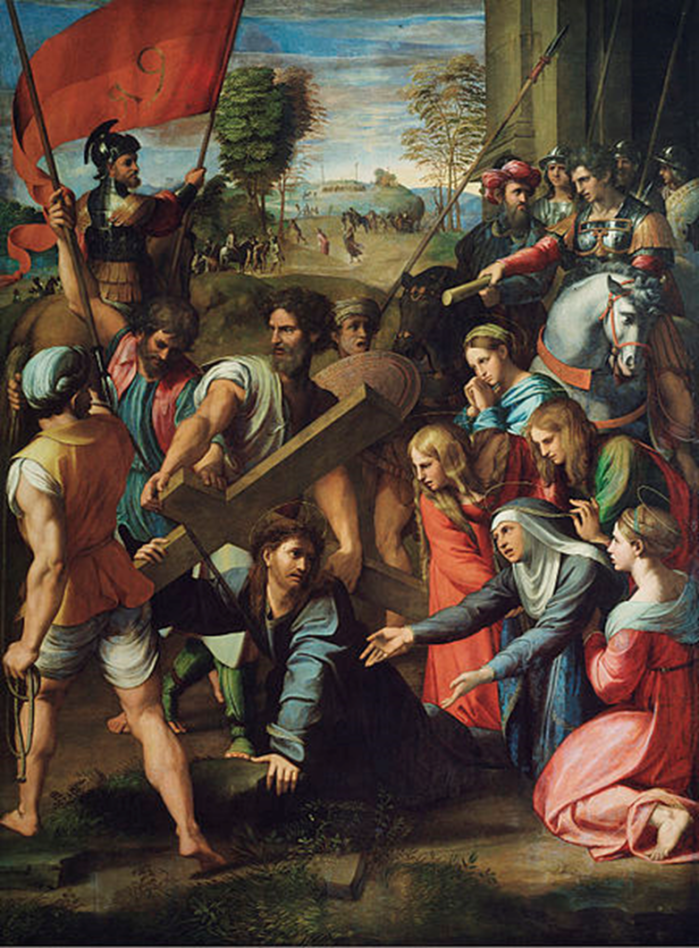
rapahael Jesus falls

Raphael’s painting of c.1514-16 both depicts the current scene of the sequence – the first fall of Jesus – and sets up the next two by including both Mary and Simon of Cyrene. In the far distance are crosses already erected with crowds surrounding one – this is no exceptional moment for the ruthless machine of imperial control but just one more example to be made to hammer home the supremacy of might. Spears, armour, horses, banners, batons; military strength is arrayed above Jesus as if to show just how much he is subjected to it. But Simon stands strong and faces it down, suggesting that it is not absolute, for beneath the cross he shows to us that there is another story. Here, by contrast, is tenderness, love, devotion and pain. Here is the face of Christ which shows, in the face of brute force, only mercy, only pity. ‘Those who live by the sword die by the sword’. ‘But I say to you, love your enemies.’ And Mary’s face shows the same pained tenderness:

Illos tuos misericordes oculos ad nos converte

Turn those merciful eyes towards us.

Station 6: The face of Jesus is wiped by Veronica
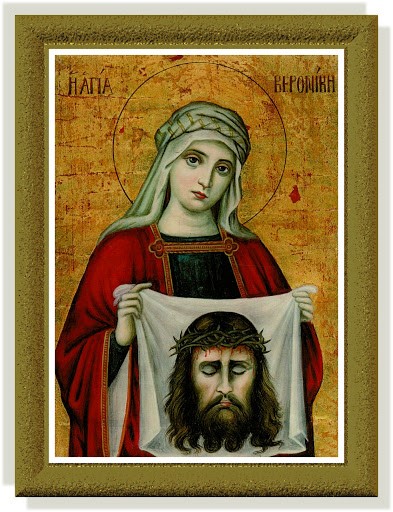
veronica

Who walked between the violet and the violet
Who walked between
The various ranks of varied green
Going in white and blue, in Mary’s colour,
Talking of trivial things
In ignorance and knowledge of eternal dolour
Who moved among the others as they walked,
Who then made strong the fountains and made fresh the springs

Made cool the dry rock and made firm the sand
In blue of larkspur, blue of Mary’s colour,
Sovegna vos

Here are the years that walk between, bearing
Away the fiddles and the flutes, restoring
One who moves in the time between sleep and waking, wearing

White light folded, sheathing about her, folded.
The new years walk, restoring
Through a bright cloud of tears, the years, restoring
With a new verse the ancient rhyme. Redeem
The time. Redeem
The unread vision in the higher dream
While jewelled unicorns draw by the gilded hearse.

The silent sister veiled in white and blue
Between the yews, behind the garden god,
Whose flute is breathless, bent her head and signed but spoke
no word

But the fountain sprang up and the bird sang down
Redeem the time, redeem the dream
The token of the word unheard, unspoken

Till the wind shake a thousand whispers from the yew

And after this our exile

T. S. Eliot ‘Ash Wednesday’

An anonymous woman is watching as Jesus is led out to the place of crucifixion and, moved by this young man burdened by the instrument of his execution, pushes her way through the gawping crowd, and taking out a cloth, possibly the head scarf she was wearing, wipes the sweat from his face. Why does she do this? Is this a statement? Does she recognise the Son of God? Is she simply protesting against the barbarity of this penalty? Or is this the response of a human heart to the suffering of another? Whatever her motive her act of compassion has earned her a place in the history of our redemption. She is an example to us how we are to respond to suffering wherever we find it. “In that you did it to the least of these you did it to me’” says Jesus and here we see this acted out on the way of the Cross. We can see the actions of Veronica all around us in the response to COVID-19, in the heroic act of our front line workers in the NHS, support services, and in the kindness of strangers in making deliveries and telephone calls.

Fr Paul Burrows

Station 8: Jesus meets the women of Jerusalem Luke 23.27 – 31
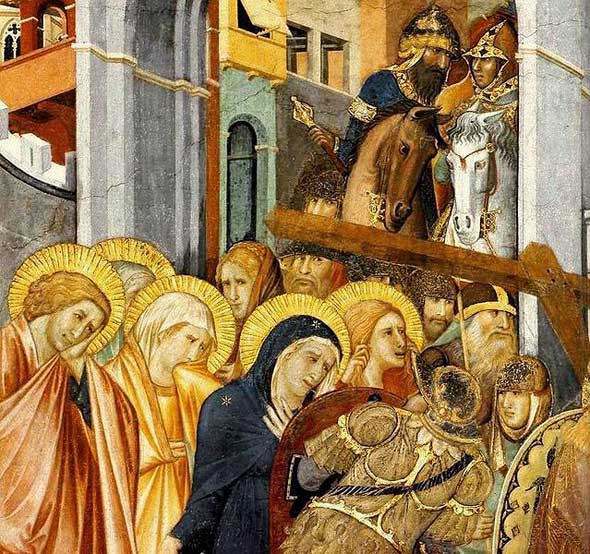
VIII-Jesus-women-Pietro-Lorenzetti-Assisi

Here, in the longest utterance by Jesus in any of the gospel accounts of his passion, he addresses a group of women among the crowd following him.
Who are these women of Jerusalem? Given the many women disciples Luke features in his version of the Jesus story, it’s highly likely they are among his followers, perhaps quite recent ones. The response of Jesus to them could seem unnecessarily harsh. But that is perhaps to misunderstand Luke’s point here; in line with his focus on Jesus’ prophetic ministry, Jesus is responding to their pain and sorrow with words of prophetic warning. Thus the focus shifts from Jesus, and what is about to befall him, to events lying in the future, to the Jewish/Roman wars and the destruction of the temple and city of Jerusalem.
Where does this take us? I cannot help thinking of the increasingly urgent warnings about climate change and its likely impact on all of us, especially on poorer countries around the world – and of the apparent ignoring of those warnings by so many. But in this present time of pandemic, Jesus’ words also bring sharply to mind how unprepared our developed societies have been for something that many scientists in the field of virology have been warning about for some years.
Jesus’ prophetic words, like the Hebrew prophets of old, were meant to call the people to ‘repentance’, that is ‘to return to the ways of justice and compassion’. So, as we offer prayer for all who are suffering from the virus, let us also pray that leaders and people of every nation will work for the common good and for all that builds human community.
Lord Jesus, the women of Jerusalem wept for you: move us to tears at the plight of the broken in our world, especially all those currently suffering with the coronavirus. Teach us the ways of justice and compassion, and give us a heart to love our neighbour at this time, whether near or far away. Amen.

Fr Tony Bryer

Station 10: Jesus is stripped of his clothes
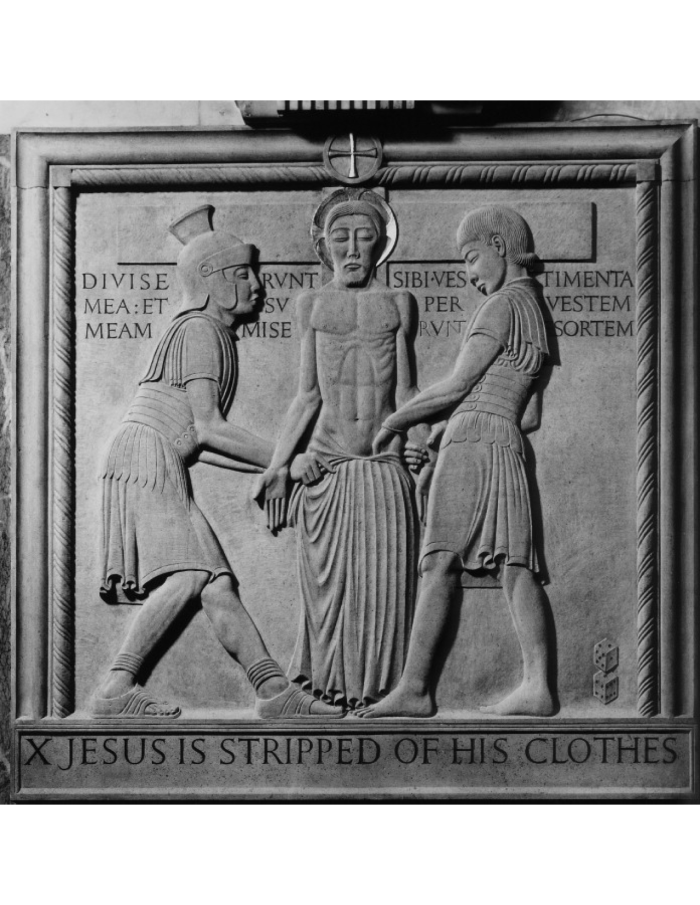
gil station 11

At least since the stories of Genesis, nakedness has been a symbol of shame and humiliation. Tormenters know that, and history is replete with ritual humiliations or degradations involving forcibly stripping clothes from captives. Enslaved people were stripped and displayed as merchandise in both antiquity and in more recent times. Concentration camps developed elaborate systems of stripping people that combined terrifying demonstrations of power and the dispassionate redistribution of seized possessions.

And so it is at this Station of the Cross: Jesus is violated by stripping his garments in actions meant to dehumanize him, to terrorize him, and to provide an economic prize for his captors.

An extraordinary depiction of this is found in Eric Gill’s 1914 carving for Westminster Cathedral, where the sculptor captures the leering privilege of mercenaries given complete control of a prisoner.  The violation they intend is menacingly ambiguous, while their anticipated reward is foretold in their chiseled hands and eyes, as well as in the waiting dice.  The inscription behind them connects this violation with prophecy. This station is about the apparent triumph of power intent on objectifying and commodifying the Human One.

It didn’t succeed; even such absolute, humiliating, violating power succeeded only in dehumanizing itself, and a portent of Jesus’ exquisite endurance and eventual triumph can be seen in Gill’s portrayal of Jesus’ face. Eyes closed in defiance, Jesus embodies the truth that nothing is so powerful that it can separate us from the dignity born with each of us.

Forces of power may try to strip us of our dignity or even our humanity, but it cannot succeed: our identity was forged in the love of God, and nothing can separate us from that love, or from the One who made us in the Divine image.

For I am persuaded,
that neither death,
nor life, nor angels,
nor principalities,
nor powers, nor things
present, nor things to come,

Nor height, nor depth,
nor any other creature,
shall be able to separate us
from the love of God,
which is in Christ Jesus our Lord.

(Romans 8:38-39, Authorised Version)

Fr Michael Barlowe

Station 12: Jesus Dies upon the Cross

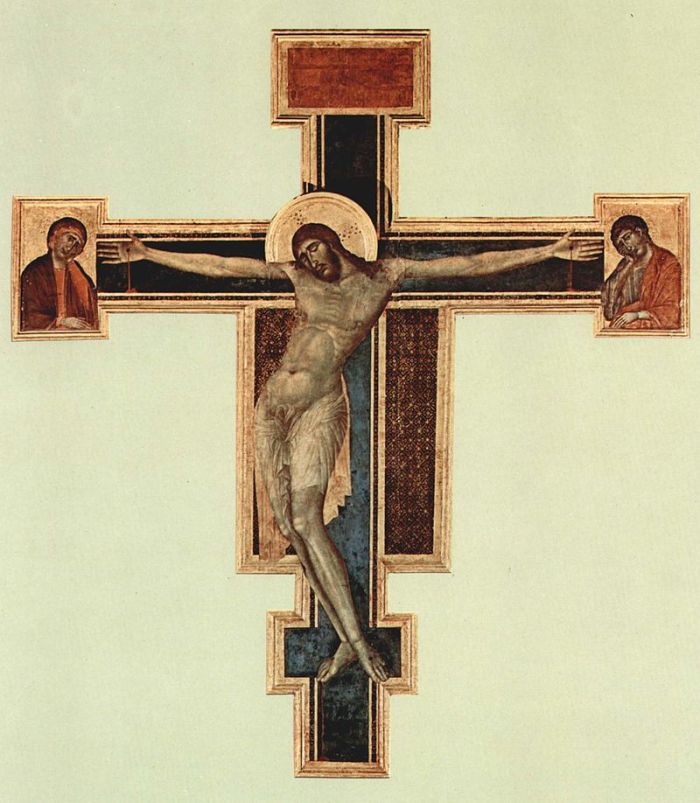
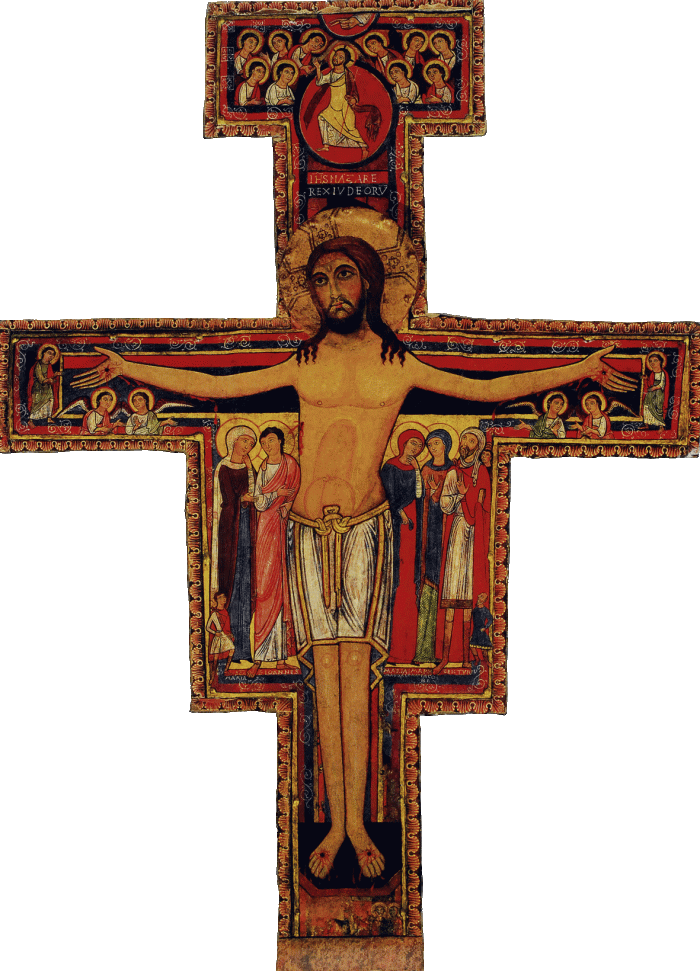
Cimabue Crucifix

The Killing

That was the day they killed the Son of God
On a squat hill-top by Jerusalem.
Zion was bare, her children from their maze
Sucked by the dream of curiosity
Clean through the gates. The very halt and blind
Had somehow got themselves up to the hill.
After the ceremonial preparation,
The scourging, nailing, nailing against the wood,
Erection of the main-trees with their burden,
While from the hill rose an orchestral wailing,
They were there at last, high up in the soft spring day.
We watched the writhings, heard the moanings, saw
The three heads turning on their separate axles
Like broken wheels left spinning. Round his head
Was loosely bound a crown of plaited thorn
That hurt at random, stinging temple and brow
As the pain swung into its envious circle.
In front the wreath was gathered in a knot
That as he gazed looked like the last stump left
Of a death-wounded deer’s great antlers. Some
Who came to stare grew silent as they looked,
Indignant or sorry. But the hardened old
And the hard-hearted young, although at odds
From the first morning, cursed him with one curse,
Having prayed for a Rabbi or an armed Messiah
And found the Son of God. What use to them
Was a God or a Son of God? Of what avail
For purposes such as theirs? Beside the cross-foot,
Alone, four women stood and did not move
All day. The sun revolved, the shadows wheeled,
The evening fell. His head lay on his breast,
But in his breast they watched his heart move on
By itself alone, accomplishing its journey.
Their taunts grew louder, sharpened by the knowledge
That he was walking in the park of death,
Far from their rage. Yet all grew stale at last,
Spite, curiosity, envy, hate itself.
They waited only for death and death was slow
And came so quietly they scarce could mark it.
They were angry then with death and death’s deceit.

I was a stranger, could not read these people
Or this outlandish deity. Did a God
Indeed in dying cross my life that day
By chance, he on his road and I on mine?

Edwin Muir

Fr Malcolm Richardson

And It Was Night

For those of us who live in Edinburgh, we have the enormous privilege of (normally) being able to visit Nicolas Poussin’s Seven Sacraments in the National Gallery. I’ve always been intrigued by the similarities and dissimilarities between the images for Penance and Eucharist. Both are in a darkened dining room, both are centred on a table where guests are reclining, both have bronze vessels for the washing of feet. And the theological connections are equally clear – both have at their heart two of the central tenets of Christian faith: love and forgiveness. The love in the Eucharist picture comes in many ways; in the New Commandment of Jesus to love one another, in the loving gift of himself to all. In the Penance picture, the love is shown lavishly by the woman who washes and anoints Jesus’ feet. The forgiveness in the Eucharist is pronounced in the Dominical Words.

https://upload.wikimedia.org/wikipedia/commons/f/fe/Sacrament_of_Penance_II_%281647%29_Nicolas_Poussin.jpg

The dissimilarities are also vital. In the Eucharist, the table is completely enclosed. There is no need for the open end of the triclinium because there is no need for access by servants. The servants are at the table. There is also a striking simplicity about the Eucharist image, unlike the more lavish setting for Penance. The festal character of the Mystical Supper is hidden, not ostentatious, for this bridegroom comes in humility and suffering even as he feasts in the New Kingdom. There is also, the Eucharist, much more of a focus on Jesus. Almost all eyes are fixed on him, save those of one disciple who watches Judas as he departs. This further creates a sense that this group gathered fully around the table are united in one Body, despite the rupture in that Body caused by betrayal. For even such a betrayal does not undo the overwhelming love and forgiveness embodied at that table.

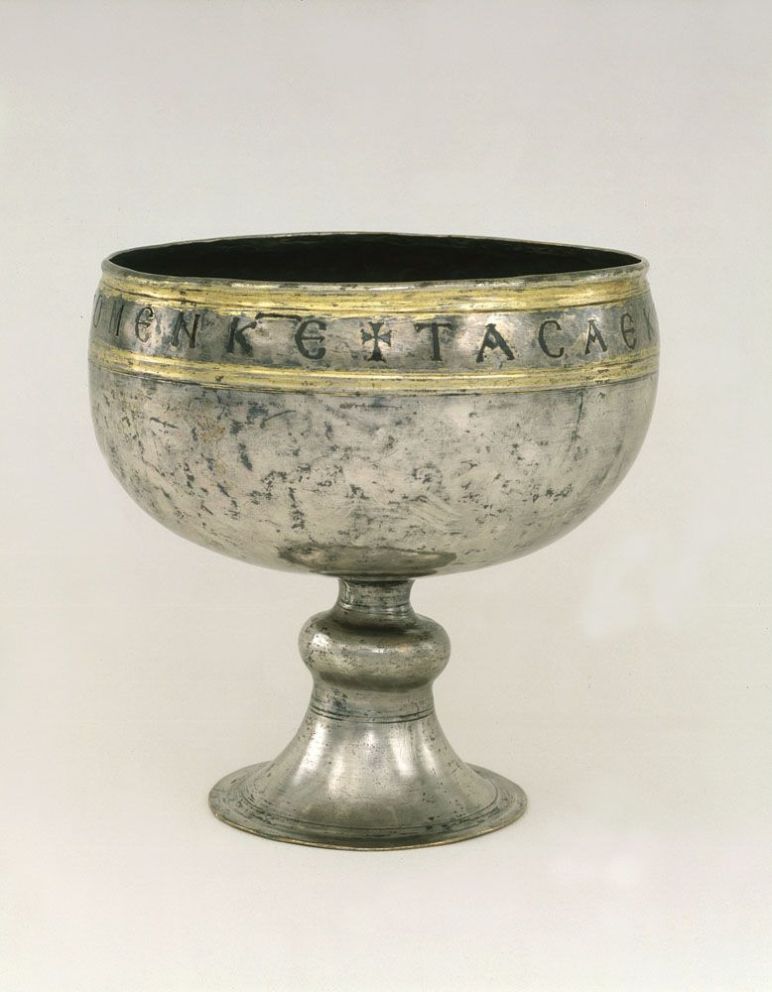
Even more than ever this year, our unity in the One Body is mystical – it belongs to the realm of what is beyond plain sight. We are not less united because we are unable to encircle the one physical table; we are no less loved and no less forgiven because we cannot share from the same chalice. Indeed, this year more than ever, we are invited to discover how the command to love one another is ‘new’. What new ways of loving are we being called to as we all share mystically in the one bread?

Sermon for Palm Sunday

As we heard again the account of the Lord’s Passion, I wonder what image came to your mind? The thing is, there are so many images of the crucified Christ that our memories are overwhelmed with them. Back in November at the Feast of Christ the King, I suggested just a few. Those were different days and we feel the pain of not being able to gather in this place to reflect on another aspect of Christ’s execution the hands of religious and political pragmatism. At this point in time, we might naturally feel drawn to what is the most common depiction of Christ on the cross, and that is of his suffering. Indeed, in other times of widespread disease, the image of Christ suffering in solidarity with the sick was a source of strength and comfort, and I’m sure your mind’s eye is taking you straight to Grunewald’s Isenheim altarpiece as stunning example of that. Christ’s agony is surely at the front of our minds as we consider the widespread suffering of this present pandemic.

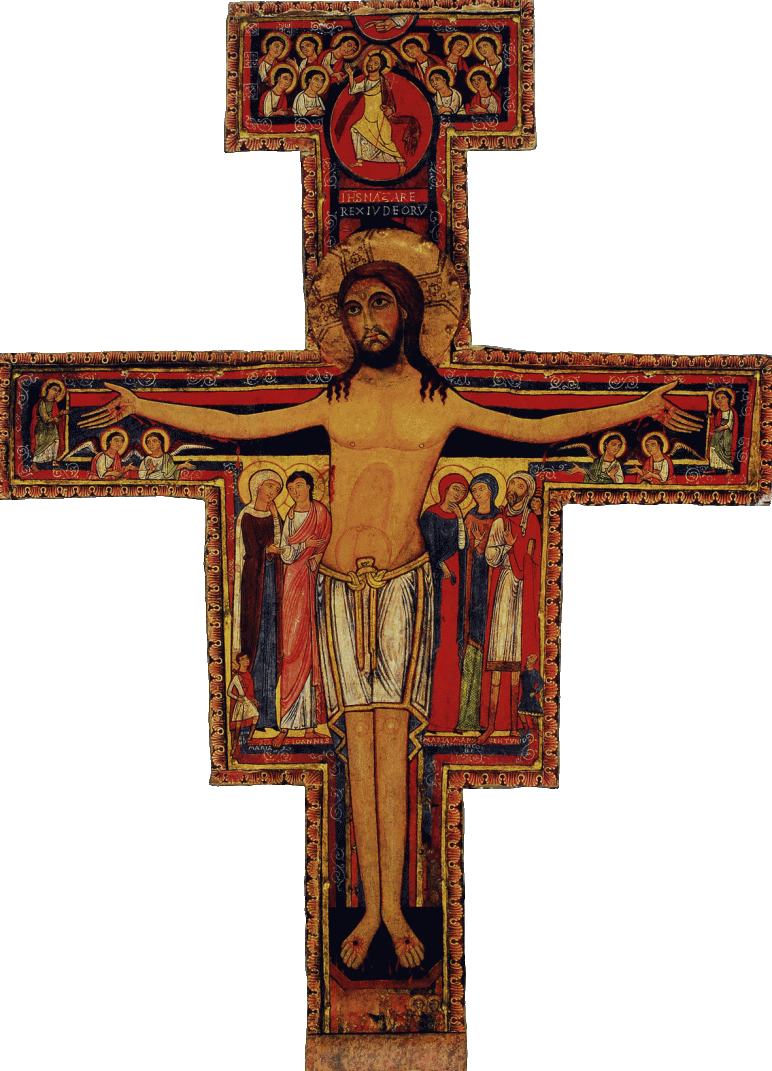
But that’s not where I felt drawn this morning. Instead, I couldn’t get away from another very well known, indeed, almost certainly better known image of the crucified one, and that is the iconographic crucifix that once hung in the little church of San Damiano in the valley below Assisi where St Francis heard, three times, the call from Christ to rebuild his church. It’s such a familiar image that we might have stopped noticing how strange it is. I don’t know about you, but these last few weeks have caused me to look again at many things in the light of a deeply unfamiliar set of circumstances. And this particular image has been with me for a long time, as I’m sure it has for many of you, especially those who have a connection with the Franciscan family. My first real acquaintance with the San Damiano Crucifix was as a student, visiting Alnmouth Friary regularly in my late teens and early 20s.

For those who are less familiar with it, I’ve posted it on my blog or you can easily find it online, but let me briefly describe it and its oddness. It is a large piece, painted in an iconographic style that shows how close early Italian ecclesiastical art was to Byzantine art. It is full of detail, but I don’t want to get into that. Instead, I want to focus on the image of Christ himself. Unlike earlier depictions, which focused on his regal triumph over suffering and death, and later ones that showed his suffering and pain, the San Damiano cross shows Christ in attentive stillness. His body is not contorted in pain, as Cimabue would begin to show a few decades later; his eyes are open though not looking directly at us, and his face shows no hint of agony. How would you describe that expression? It’s neither resigned nor submissive; not exactly serene and not in any kind of ecstasy. Two words suggest themselves to me: still and open.

The stillness is a sort of unflinching steadiness, a total presence. Jesus is present to the reality he faces and present to those who look upon him. He bears with his circumstances and refuses to flee. It is something more powerful than resolve; it is an abiding presence and I find that very comforting in these difficult times.

The openness is an invitation to meet with him. It’s no surprise that Francis heard a voice speak from that face and many after him have found a deep encounter with Christ in contemplating this image. It’s an invitation and it’s a boundless openness that is willing and able to embrace not only the circumstances he faces but the circumstances of all who come to him. Nothing is excluded from that gaze.

We might protest that images like this do not do justice to the real human suffering of Christ or to the historical realities of a crucified man. But historical retelling, even if it were fully available to us, would not exhaust the meaning of the cross. Icons like this unfold the mystery of Christ. They present us with the inner meanings of his paschal self-offering and they are many. Each of the days in the coming week will offer us a particular facet on the paschal mystery. We are doing more than recounting history. We are delving deep into the truths that lie beneath the surface.

And the truth that the San Damiano cross unfolds to us is that died as he lived – in boundlessly open love towards all. This is the same Christ who entered into mystical union with the Father in prayer by night and on deserted hills and who entered into the mystery of human lives every time he encountered one who was prepared truly to meet with him: the Samaritan woman, Nicodemus by night, Mary and Martha in their grief, Peter in his shame, his Mother in her agony by the cross, Mary Magdalene in the garden. In this face we see the love of one who will abide close to us, unflinching, no matter what we face. We see the love of one who will not flee the direst circumstances. We see the stillness of one whose word to us will always be one of peace. We see the forsaken one who will not forsake us.

The coming days will offer us the chance to encounter the stillness and openness of Christ in new ways. We won’t have everything we’re used to but perhaps that will allow us fresh insights into the meaning beneath the surface of the events we recall. Holy Week is not a re-enactment, but an encounter that comes alive when we too keep still for long enough to allow our hearts to open up in loving response to Christ.

Image for Palm Sunday

I will be referring to this well-known image in tomorrow’s sermon. It’s the crucifix from the church of San Damiano that spoke to St Francis of Assisi and is now in the Basilica of St Clare in Assisi.

San Damiano Crucifix

Online Eucharist?

I really shouldn’t venture into the field of liturgical theology because I know next to nothing about it! However, as priest I do, of course, care deeply about the Eucharist because it is at the heart of my life. Indeed, it is at the heart of every Christian’s life because it is the joyful celebration of the Wedding Banquet of the Lamb, foretaste of heaven where we are united and transformed with Christ through the offering his ‘single, holy, living sacrifice’. In these current circumstances, we are all struggling to find the best way to continue to place the Divine Liturgy at the heart of our life of faith. Do we continue to celebrate it with the priest being the only person present in the building as we pray the Liturgy together? Does the impossibility of assembling in one physical space and receiving the life-giving Gifts in the way we usually do make the whole celebration a long-distance spectacle? These concerns are very real, but I have a strong sense, having served the Liturgy a couple of times now online as the only person present in the church building, that I was not alone. Furthermore, those who joined with me in offering the Liturgy either as active participants (pre-recorded) or as equally active online pray-ers, also report that they sense that they are not alone. More than that, they tell me that they feel profoundly connected to the Liturgy being celebrated and to the Body of Christ gathered in this way.

I am not going to attempt a metaphysical justification for this because I do not have the intellectual equipment to do so, but I will offer some words by one of the few liturgical theologians I actually read as a way of explaining why it seems right to me to keep on doing what we’re doing:

Genuine faith lives not by curiosity but by thirst. The “simple” believer goes to church in order primarily to “touch other worlds” (Dostoevsky). “And almost free, the soul breathes heaven unhindered” (Vladislav Khodasevich). In a sense, he is not “interested” in worship, in the way in which “experts” and connoisseurs of all liturgical details are interested in it. And he is not interested because “standing in the temple” he receives all that for which he thirsts and seeks: the light, the joy and the comfort of the Kingdom of God.

I don’t know what Fr Schmemann would have made of our current situation, but his words provide all the reason we need to continue to offer the Liturgy – our thirst compels us.


The quotation is from Alexander Schmemann’s The Eucharist, pp. 46f; SVS Press 1987