Christian Mindfulness

Love of wisdom means always to be watchfully attentive in small, even the smallest actions. Such a person gains the treasure of great peace; he is unsleeping so that nothing adverse may befall him, and cuts off its causes beforehand; he suffers a little in small things, thus averting great suffering.

Dobrotolubiye page

These words, quoted from St Isaac, are in the edited Russian version of the Philokalia, the Dobrotolubiye. It was compiled in the 18th century by St Paissy Velichkovsky and translated into Russian by St Theophan the Recluse in the 19th. These words occur in a section of the ‘Directions to Hesychasts’ by the monks Callistus and Ignatius, from 14th century Constantinople, just after the Hesychast cause was so powerfully championed by St Gregory Palamas. I give these bits of background simply to make the point that this rich tradition of spirituality has a long pedigree, even if it was little known in the West until the 20th century. Indeed, the English translation from which I’ve quoted by Kadloubovsky and Palmer from 1951 did much to bring this fine tradition to the attention of the English speaking world. But to the substance!
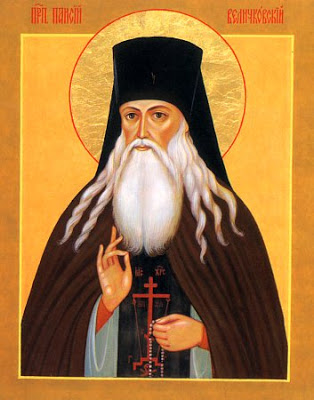
Full of Grace and Truth: St. Paisius Velichkovsky the Righteous

Hesychasm, of course, means stillness and stillness means an inner as well as an outer disposition. Attentiveness, watchfulness, wakefulness, sobriety are all synonyms for what we now know as ‘mindfulness’ and it’s important for Christians to know that we have our own deep sources for this practice. The acquisition of inner peace is a wonderful thing in itself and needs no justification, but it is also both a sign of the indwelling Spirit of God and a preparation for a fuller apprehension of divine beauty: ‘What is more joyful than the thought of the splendour of God?’ ask Callistus and Ignatius.

Attention to small things allows for a fuller awareness of the arising of thoughts in our minds so that they may be ‘cut off’ as they arise. This is core teaching in the desert tradition of Christian monasticism and has very close similarities with some Buddhist teachings. These ‘thoughts’ – logismoi – are the first stirrings that lead to anger, anxiety, distraction or greed, all the poisons that threaten our inner peace. That inner peace does not need to be created – it is our natural state – but it can easily be disturbed by these thoughts when they spiral out of control. But how do we first spot their arising and how do we then cut them off?

The practice of giving our full attention to small things is cultivated through patient effort in concentrating on the thing we are doing and by setting aside times of quiet prayer or meditation where we focus on a single point – usually a word or short phrase and/or our breathing. In hesychast prayer, this is not simply a mind-body exercise (though it is also that) but a loving attention towards the God who is the source of all life. In this way, our attention is not on our own immediate concerns but on that which is ultimate, and yet is also more intimate than we could imagine. This cultivation of attentiveness allows us to be more alert to the arising thoughts. Cutting them off simply means refusing to entertain them or allow them to develop. It may also mean replacing those thoughts with an appropriate word or phrase to counter its intent – ‘peace’, ‘love’, ‘mercy’. Evagrius of Pontus developed a whole range of such counter-words in his AntirrhetikosBut the main tool in this practice is ‘attention’ itself, something like a spiritual muscle that we can train through repeated and simple actions. For many, the constant repetition of the Jesus Prayer is the greatest tool we have in this journey towards a restoration of the inner peace that is our divinely created nature.

Sermon for Pentecost 2

BLM Protest : Edinburgh

‘When he saw the crowds, he had compassion for them.’

After many weeks of quiet streets and social distancing, the recent sight of many thousands of people gathering together to protest against the brutal death of George Floyd 3 weeks ago, and against the unjust structures that maintain discrimination on the grounds of race, has been all the more powerful. As people of faith, we cannot fail to be moved by a global call for a conversion of heart to overcome racial injustice in response to this most appalling act of violence which showed how such injustice is both personal and systemic. The crowds that gathered to protest, and continue to do so, offer a picture of the determination, anger, fear, and solidarity provoked by this one act of brutality that stands for so many other acts of violence experienced by people of colour across the world. ‘When he saw the crowds, he had compassion for them.’

Jesus’ compassion for the crowds has so many resonances for the historical events we are witnessing. His compassion is evoked because they are people who have suffered harassment and because they are vulnerable. But it is also a compassion born of the awareness that they are like sheep in search of a shepherd. We should not hear these words as suggesting a desire for any kind of infantile dependency but with the echoes of prophetic speech which have a very specific target. When the prophets used this image, the shepherd they had in mind was a just and merciful leader. The absence of such a ruler was what made the people vulnerable to abuse and those who were already poor were, in the absence of justice, all the more susceptible to violence, illness and exploitation. Jesus’ compassionate response to these crowds was to send out labourers who would tend their wounds, gather in the excluded and proclaim that a new kind of kingdom was at hand, one founded on the very compassion and justice they lacked, a kingdom that was built on the foundation of renewed relationships, not executive orders. These labourers were to go into those situations that might well leave them vulnerable to abuse themselves, for this new kingdom undermines the lust for power that corrupts too many. They were to use every ounce of cunning they could muster, but always in the service of dove-like peace, always without guile, without violence, without clinging to possessions or power.

So what does Jesus’ compassionate response to a shepherdless crowd suggest to us as we seek to respond to the issues raised in our own day by so many crowds seeking justice? Well it seems to me that, for a start, the only kind of moral leadership that could be credible for the church today would be one based on people willing to ‘go out’ from the place of familiarity into the places where the wounded seek healing and the oppressed seek justice. It could only be credible if it begins with the rolling up of sleeves and the feeding of hungry bellies. In addition, Jesus’ instructions to those he sends out suggest some very specific characteristics.

Firstly, all the details about no bag, no cash, no spare clothes may seem unworkable and extreme to us, but what they are saying is that those who go out must do so with an attitude of complete openness. When we rely on the hospitality of others, we open ourselves to them in trust and with an open ear. This is surely the most important characteristic we must adopt if we have been born into a position of privilege in our society – the willingness to hear the voices of those who have not shared that privilege. Firstly, the voices of those with whom we share a community, but also the voices of those from our history, whose story is not proclaimed in stone on the top of plinths and pillars.

If this radical act of listening requires a kind of self-forgetfulness, a kind of dove-like innocence, then the next characteristic requires a full self-awareness, a serpent-like wisdom. The second characteristic required by those Jesus sends out is discernment. He tells his sent-out ones to be discerning about which houses they should stay in on their journeys. I think what this means is that the disciples should seek out those who share their values and are hospitable to the vision of the kingdom – fellow-travellers, allies. The reason this needs discernment is that these partners in the vision of the kingdom may not be that obvious, not necessarily those who might naturally be in their circle of friends and associates. That’s why self-knowledge is essential and superficial judgements dangerous. In practical terms, for those of us responding the call to racial justice in our societies, this means a prior commitment to understanding our own prejudices and preferences so that we do not simply end up reinforcing what we’ve always done and how we’ve always thought. The Christian spiritual life has plenty of resources for this kind of self-examination.

Finally, Jesus urges a revolutionary patience in those who would allow themselves to be sent out – the one who endures to the end will be saved. True changes of heart and mind take time and the willingness to carry on through setbacks and disappointments. For the life of the disciple is a whole life lived in the footsteps of Jesus.

Merton on St. Columba

Old Saint Paul's Church, Edinburgh - Tripadvisor

It may surprise you to learn that Thomas Merton had a bit of an interest in St Columba, though anyone who reads Merton will not be surprised that he might have picked up a copy of Adomnan’s Life of the saint (in Latin, of course) and will be even less surprised that he committed his thoughts to paper. Here’s the entry in his journal in full. It’s from the 12th of July 1964 (Dancing in the Water of Life p. 126):

Deeply moved by Adamnan’s life of St. Columba. A poetic work, full of powerful symbols, indescribably rich. Through the Latin (which is deceptive – and strange too) appears a completely non-Latin genius, and the prophecies and miracles are not signs of authority but signs of life, i.e., not signs of power conferred on a designated representative (juridically) – a “delegated” power from outside nature, but a sacramental power of a man of God who sees the divine in God’s creation. Then the miracles etc. are words of life spoken in the midst of life, not words breaking into life and silencing it, making it irrelevant, by the decree of absolute authority (replacing the authority of life which life has from its Creator).

Merton offers a really interesting take on sacramentality here, not as something external to creation but intrinsic to it, brought to light by those who have the purity of heart to see it. The miracles in the Life are truly fascinating and many are are deeply practical – a misplaced staff finds its way to its owner, the wind helpfully blows in two different directions to speed two monks on their separate ways, inedible fruit made sweet, protection from plague in places where his monasteries were founded. His intimate relationship with the creation was not all peaceful – he was happy for a charging wild boar to be struck dead, killed ‘by the power of his terrible word’ – but on the whole, the miracles associated with the saint are harmonious. I particularly like the story of a knife blessed by the saint which could do no harm to human or beast.

The other feature of Adomnan’s Life that particularly catches my attention is that holiness is indicated by luminosity, with light shining from the saint as a child, later as a priest ‘consecrating the holy oblation’ at the altar and shortly before his death. In this respect, as in many others in this account, we are reminded of the closeness of Columba’s mystical experiences with those of the desert monastics in Egypt (Admonan’s Life has a few deliberate echoes of Evagrius’ Latin version of St. Athanasius’ Life of St. Anthony).

Without trying to say too much about a supposed ‘Celtic’ nature-mysticism, and certainly avoiding any Celtic exceptionalism, I think Merton is right in identifying a more integrated view of how human beings are located in God’s creation than we often assume to be present in Christian theology. Holy lives are marked by the radiant transfiguration that is God’s telos for all creation, not by ‘dominion’ over that creation.

Speaking Truth to Power – Zen Style

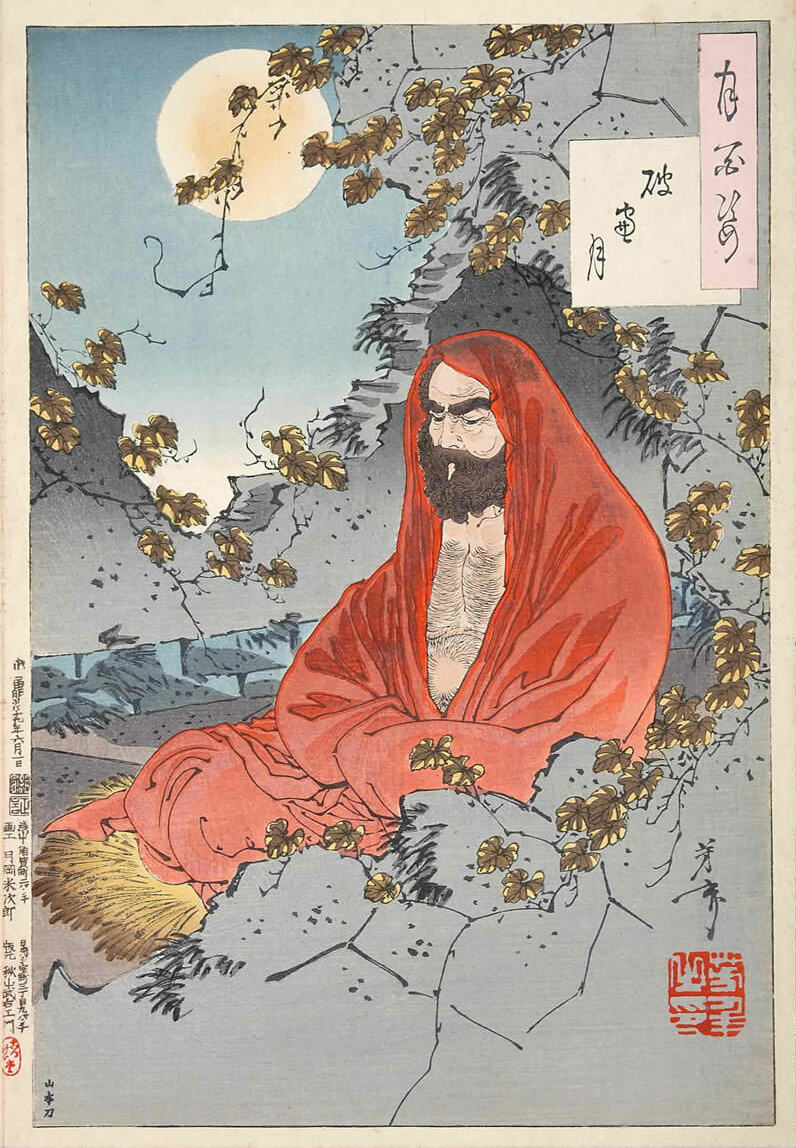
There is a well-known legend of the meeting between the first Zen Patriarch, Bodhidharma, and the Chinese Emperor Wu of the Liang dynasty, part of which forms the first case in the koan collection, the Hekiganroku or Blue Cliff Record. Dogen includes the longer version of it in fascicle 31b, Gyoji Ge, of his Shobogenzo but the legend is many centuries older.

BodhidharmaYoshitoshi1887.jpg

Well known as a benefactor of Buddhist religious foundations, the Emperor begins his conversation with Bodhidharma by enumerating his many achievements in the promotion of Buddhism. He asks, ‘What is the merit of having done all this?’ Bodhidharma says, ‘There is no merit.’ When pressed further by the emperor, he goes on to describe such ‘minor achievements’ of humans as little more than a cause of desire. They’re not real. When asked what, then, is real merit, he says;

When pure wisdom is complete, the essence is empty and serene. Such merit cannot be attained through worldly actions.

The rest of the dialogue goes like this:

Emperor: ‘What is the foremost sacred truth?’

Bodhidharma: ‘Vast emptiness, nothing sacred.’

Emperor: ‘Who is it that faces me?’

Bodhidharma: ‘I don’t know.’

The emperor didn’t understand so Bodhidharma just went on his way.

Human power, at whatever level, desires credit, acclaim, recognition for its successes (‘no merit’, ‘vast emptiness’ is what Bodhidharma offers instead). It desires shrines which might serve as a suitable backdrop for staged political moments (‘nothing sacred’ is what Bodhidharma offers instead). It desires tame gurus to give affirmation and credibility (‘I don’t know’ is what Bodhidharma offers instead). But Bodhidharma’s responses are not mere nihilism – they are a challenge to the usefulness of the questions themselves. The path to an awakened life is not formed by might, and certainly not by casting aside any who might stand in the way with tear gas and rubber bullets. It is not ‘formed’ at all, but opens up in ‘vast emptiness’ of compassion, the boundless openness that is founded on ‘not-knowing’. ‘Not knowing’ is the wisdom that listens to all sounds, to all voices, in the way that the Bodhisattva Kannon does. ‘Not knowing’ is the refusal to assert dominance, the refusal to possess another in any way.

I wonder what would happen if a certain present-day emperor decided to spend an equal length of time in zazen as he spends on his Twitter feed…

Thomas Merton on Racism

Watching the events of the last few days unfold in the US has led me back to what Merton wrote about similar events in the 1960s. It’s not that Merton had the last or the best word to say on these matters but, as with so much else, his perspective as a contemplative monk and as a writer always offers an angle that doesn’t usually emerge from the less nuanced rhetoric of politicians and partisan commentators.

Thomas Merton, the problem of war and the character of Christian ...

His major contribution on the issues around racial justice in the US comes in his book, Seeds of Destruction with its ‘Letters to a White Liberal’. He begins the book with a persuasive rationale for a contemplative monk like him to be offering thoughts on a matter like race. His argument is that monks may ‘flee the world’ but what they shun is not the flow of history itself but ‘the accumulated inheritance of past untruth and past sin.’ It is not freedom from time but freedom in time that they seek. Monasteries are a kind of laboratory for the examination of human motivation, of delusion and of untruth, a place for clear sight firstly of oneself, but always of oneself as located in history, not in abstract. Furthermore, for a monk not to comment on the affairs of the world is to risk a complicity in its unexamined structures of sin. The monk or, indeed, any religious person, does not claim a privileged place from which to comment on the affairs of the world but the place from which they speak does, nonetheless, offer peculiar insights.

Merton was clear that the issue at hand was not merely one of insufficient tolerance in society but of structural injustice. This is why simply to say ‘I am not a racist’ is never enough. It’s not a question of individual attitudes alone but of deep-rooted economic and material injustices. And it is clear that these injustices benefit many and that is why they persist. Therefore, to overcome them requires not merely ‘acceptance’ but a significant revolution – a fundamental change in circumstances that will bring what may seem like material losses to those who currently benefit from the status quo. It was clear to Merton that racial injustice has a very particular character and a very specific history which has a name: colonialism. The systematic subjugation and exploitation of peoples regarded as inferior to feed the economic prosperity of the coloniser is the structural sin at the heart of racial injustice that continues to plague not only the USA but European nations – not least our own – whose wealth was equally built on such violent foundations. Merton suggested that, in many ways, the response of the political right wing to street protests mirrors this ‘original sin’: protection of property trumps protection of black lives and all in the name of ‘order’.

Merton saw the street demonstrations of his own time as a kairos, a time of opportunity to confront the sin at the heart of injustice, the sin of colonialism driven by greed and materialism, and to listen to the voices that are alone able to offer new ways of being together that overcome injustice, that is the voices of those who have suffered long. As a contemplative, he still has much to teach us about these most vital arts of self-examination and listening.

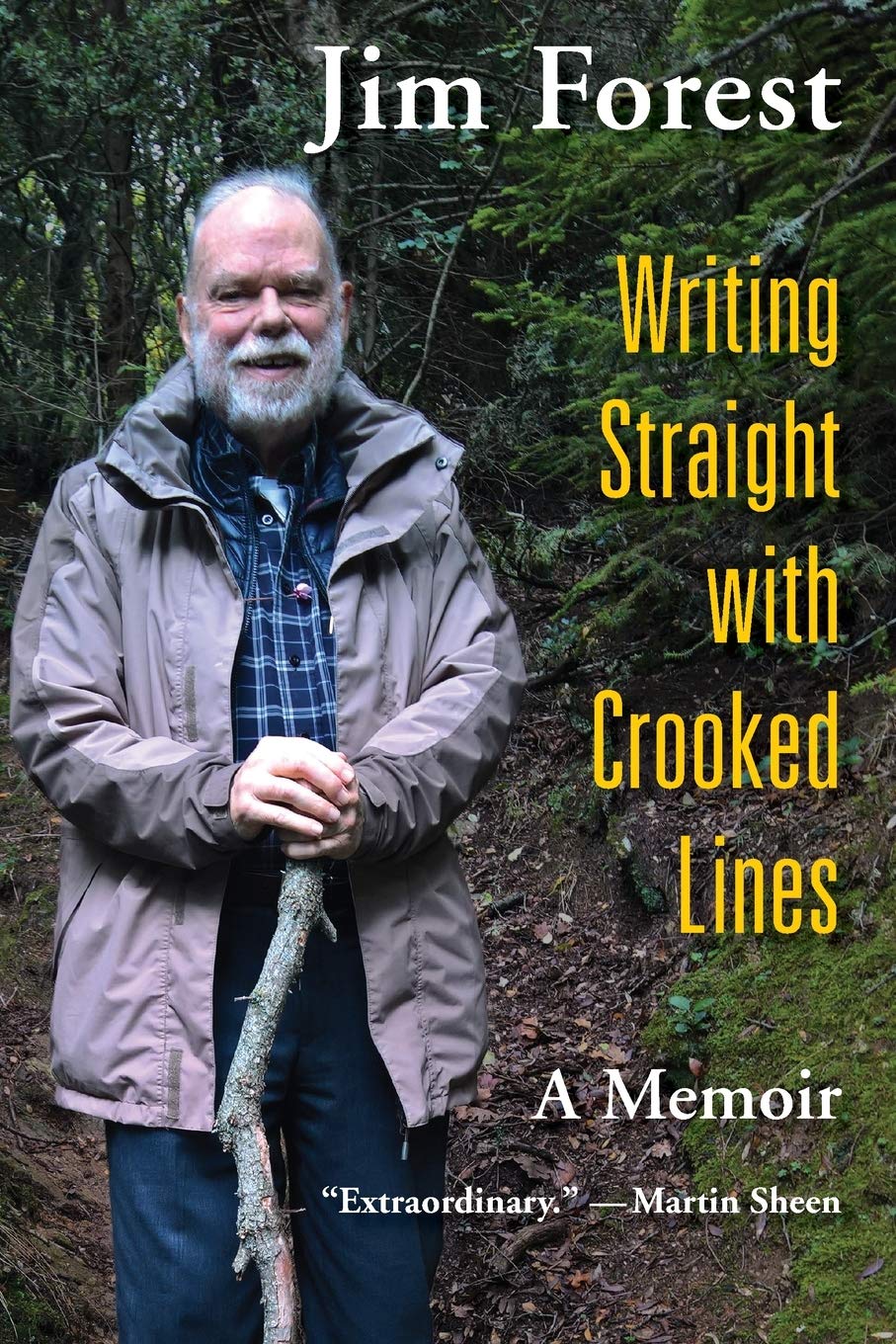
‘Writing Straight with Crooked Lines’ by Jim Forest – a Review

Writing Straight with Crooked Lines: A Memoir: Amazon.co.uk ...

I don’t often use this space for book reviews but felt that I wanted to give this one a special mention because it touched me deeply. Jim Forest is a writer and peacemaker, a man who, in his own words, ‘has looked for ways to overcome enmity.’ He has worked over the years with many peace organisations, beginning with the Catholic Worker movement, and continues to write and speak about this most crucial Christian calling.

His memoir – note that he doesn’t call it an ‘autobiography’ – takes us vividly through decades of racial discrimination, the Vietnam war, the Cold War with its constant nuclear threat and charts these events with a good journalist’s care for detail. His account of the trial of the Milwaukee Fourteen who were involved in burning draft records and of which he was one, is mesmerising. He writes with a direct and colourful mode of expression and paints a great many superb portraits of the people with he met along the way. Many of these people have a significant place in that bigger story and Jim Forest’s encounters with them are often at a deep and sustained level: Thomas Merton, Thich Nhat Hanh, Dorothy Day, Henri Nouwen, Dan Berrigan to name only a few (he could also, by the way, easily pick up the phone to Pete Seeger or Joan Baez). But if this sounds like name-dropping, it does not read that way. Indeed, the thing that impresses me most about this non-autobiography is the way in which Jim Forest manages to write an account that is deeply personal and unfailingly honest without being in slightest bit self-obsessed or self-important. It is not confessional and he wisely side-steps things that must remain private. I met Jim a year or two ago and he winced when told me that his next book was to be a memoir. He is a genuinely humble man.

Jim also writes books on the spirituality of the Orthodox church, of which he has been a part for over 30 years. His books on the Beatitudes, icons and confession are accessible yet profound meditations on the spiritual life. I would warmly recommend them. And it is his integration of spirituality and peacemaking that continues to offer a compelling vision of Christian life that is rooted in its tradition without being sectarian, profoundly prayerful and simultaneously outward-looking, humbly open to new things yet well-grounded. This book is an exceedingly well-told story of a rich life. It is also a prophetic reminder of the church’s calling to make peace and to make sure that the peace it offers comes from a peaceful heart. It is an urgent and welcome reminder. Thank you Jim.

Sermon for Pentecost

O Heavenly King, the Paraclete, the Spirit of Truth, who are present everywhere, filling all things, Treasury of Good and Giver of Life, come and dwell in us, cleanse us of every stain, and save our souls, O Good One.

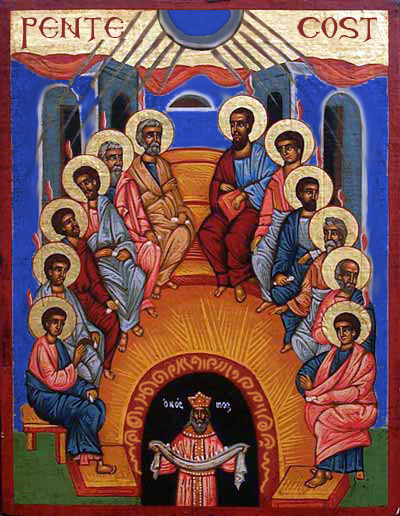
Icon-Pentecost

Sometimes Pentecost is referred to as the birthday of the church, and no one could deny that this day is the one where we see the followers of the risen and ascended Jesus gathered in one place and enthused, empowered, equipped by the Spirit to continue his work of reconciliation and transformation. But the words of the prayer I have just said suggest that Pentecost has a somewhat wider reach than the life of the church in any narrow sense. These words, from an ancient prayer addressed to the Holy Spirit, point to the one who fills all things, who gives all life, who saves, cleanses, abides, is present far beyond the limits of the church in its institutional or communal reality, though all these things must surely be true of the church as well. But the work of the Holy Spirit, the life-giving life of the Holy Spirit, is free, boundless and generous; beyond our grasp and certainly beyond our control.

The traditional icon of this feast of Pentecost, which you can see on your screens now, tells us something about the realm of the Spirit’s operation. At first glance, this image seems to bring the focus very clearly onto the gathered church, seated here in a semi-circle, with the apostles receiving the gift of the Spirit in a tongue of fire. There are some very interesting features of this icon, which may not be obvious on first viewing. First of all, this is not a scene from history. There is no attempt to recreate the scene described in today’s reading from Acts because the 12 here are not just the disciples called by Jesus, but also the 4 Evangelists and Paul. This is not about mere events, but the eternal reality of the Spirit’s inspiration on all who follow in the way of Christ. Another key feature of this image is its central absence. Right in the place where we would expect to see an enthroned figure, the teacher, there is a gap. In the middle of the semi-circle is a space which is unoccupied, or, rather, a space that is occupied by Christ who is no longer present in historical form, but present now in his abundant openness, his cosmic reality filling all things.

But most curious of all is the strange figure right in the centre of the foreground. In a dark space at the heart of the image is an old king, wearied by time, holding out a sheet in which is held 12 scrolls, symbolic of the teaching of the 12 apostles seated around him. He is Cosmos, the world, eager to hear a word of life, desperate to be awakened into new life. He longs to hear words of release, of forgiveness, of healing. He longs to be freed from the darkness that surrounds him, animated by a new spirit of truth and enlightenment. He is the longing of every oppressed, weary, fearful or constrained creature who reaches out towards the light.

So what does the Holy Spirit offer to this Cosmos who holds out his hands and asks for a gift?

At Easter, you may have heard me complaining about the paucity of images of the resurrection in our churches and I’m tempted to complain once more about the relative lack of images of the Holy Spirit. But I don’t need to complain too much this time, because we have a very powerful image of the Spirit right here at the focal point of the church. Above my head are 7 oil lamps which symbolise the gifts of the Spirit of God. Traditionally, these are the gifts enumerated by St Paul in Galatians: love, joy, peace, long-suffering, gentleness, goodness, faith meekness, self-control. But the gifts of the Spirit are not restricted to this or any other list! God pours out gifts upon the whole earth, to be embraced by any who are open to receiving them, gifts beyond our imagining, beyond our limitations. And if the Pentecost icon depicts weary Cosmos holding out his hands to receive gifts for the better living of this life, what gifts might we seek today? What would bring life to this world of ours at this time?

These gifts may not be spectacular, and they may not be what we would normally think of as charismatic gifts, but they are the most precious gifts of all. Let me suggest just a few. First is the gift of wisdom, Sophia. This is insight into the true nature of things, which is their divine nature. This is the insight that refuses to consign anything to mere utility or, worse, expendability. Wisdom reveals the God-breathed nature of all things and demands that we see worth in everything that breathes.

Next, this wisdom leads to the gift of discernment. This is the subtle gift of knowing how best to decide, how to judge a situation and respond in such a way as to benefit the common good, how to choose a path that is godly, life-giving and generous. It is the gift of a courageous and constant commitment to truthfulness and is much needed in our times.

Then there is the gift of understanding. The gift to see life from other perspectives, to see beyond our prejudices and see that God is present beneath the surface of things, always at the heart of the matter.

Then there is the gift that allows these others to work freely – the gift of inner peace. This is the gift that dispels the clouds from our true heart, our true centre, so that we may see clearly. It is the gift of quiet, of simplicity, of stillness, of inner stability; the gift to go beyond the inner turmoil or anxiety that may prevent us from acting freely and truthfully. This is the spiritual gift that is granted to any who find a way to sit still and listen, just like those disciples seated in the Pentecost icon.

I am not suggesting that these spiritual gifts, so desperately needed by weary Cosmos, are only available from the church. The Spirit is not confined. But they are given to those who follow in the way of Christ and who are willing to receive them, not for their own edification, but for the sake of the world. Wisdom, discernment, understanding, peace – these are not badges of honour but gifts to be received humbly and offered humbly, to be nurtured patiently and exercised thoughtfully. They matter now more than ever, so let us seek them with all our hearts. May God the Holy Spirit grant them to us that we may live lives that are full, free and gracious.

O Heavenly King, the Paraclete, the Spirit of Truth, who are present everywhere, filing all things, Treasury of Good and Giver of Life, come and dwell in us, cleanse us of every stain, and save our souls, O Good One.

Send Your Holy Spirit Upon Us

Scottish Episcopalians are generally pretty chuffed to have a proper epiclesis in the Eucharistic anaphora. By ‘proper’, of course, we mean that it makes it clear that the transformation of the bread and wine into the Body and Blood of Christ is the work of the Spirit, that the Spirit is also invoked upon the people and that the prayer of invocation is placed after the anamnesis and oblation rather than before the words of institution as in most Western rites. This means that the implied theology of our Eucharistic rites is closer to Orthodox than Western Catholic emphases, though I don’t think the gulf is as wide as we might imagine post-liturgical movement.

File:St Peters Holy Spirit window 01.jpg

What is distinctive, though, is that our more recent Liturgy (1982) does not necessarily see the work of the Spirit upon those for whom he is invoked as being dependent on the reception of the consecrated elements in the way that our earlier liturgies may have implied. At the very least, these earlier forms focussed on the effects of God’s Spirit on those who receive. In the ’82 rite, the Spirit ‘kindles us’ with the fire of God’s love and ‘renews us’ for the service of God’s Kingdom because we have prayed for that Spirit to descend upon us and because God is faithful in granting such a prayer. However, this insight is not new and I’m grateful for the insights of Lev Gillet in respect of the Orthodox liturgy, where he insists that God can give spiritual gifts to those who never receive the sacramental signs (Orthodox Spirituality, London 1945). The Eucharist is not magic, conjouring up the presence of Christ through a set incantation, but an expression in time and in a particular place of what cannot be contained by time or space. The Eucharist is a door through which we pass into the cosmic work of renewal that is the outpouring of the Father’s love through the working of the Spirit, who makes Christ present to us.

To have the invocation of the Spirit at the heart of our paradigmatic Christian prayer is to recognise the universal nature of what we see in the death and resurrection of Christ. The whole world is reconciled to God in the paschal mystery, not just the lives of believers. Nonetheless, this work of renewal does concern us in our own particularity – it’s not just ‘out there’. Indeed, our point of contact with this universal mystery is the renewal of our own lives through the working of that same Spirit. I suspect there are many ways in which the particular and the universal connect. Among them, surely, is the necessity for inner transformation before any true and lasting change can happen at a communal level. But the activity of God’s life-giving Spirit cannot be limited by the extent to which we are individually transformed. That’s why we don’t just pray for ourselves. Life in the Spirit is a matter of ‘joining in’ with what the life-giving God is doing.


Sermon for Easter 7

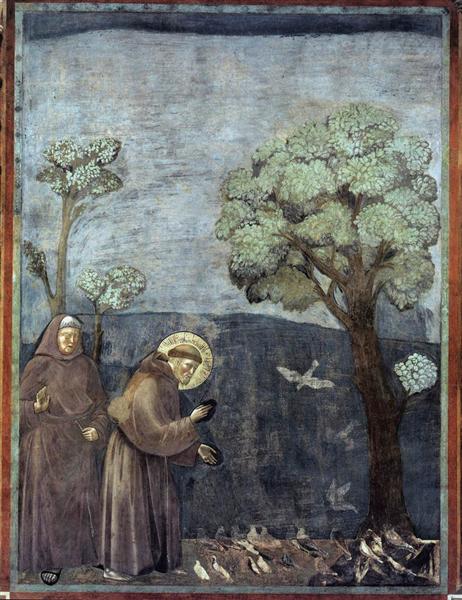
Five years ago, Pope Francis issued a most remarkable text, an encyclical unlike any that precedes it because it is addressed to all people of goodwill and because it confronts a matter of grave concern, which is the wellbeing of the creation itself. Laudato Si’ is also remarkable in taking as its starting point that great hymn of St Francis, the Canticle of the Creatures, with its opening words as the title of the encyclical in the medieval Italian of the troubadour rather than the formal Latin of the academy. He has invited people everywhere to reflect on this text over the last week and, if you’ve not yet had the chance to read it, it’s easily available for free online. It’s far more than just a call to action in respect of the steps we all must take to protect the integrity of the creation. It’s also, and perhaps above all, a call to see the creation differently, not as stuff to be consumed by us greedy humans but as an intricate whole of which we are a part, a vibrant, living system that proclaims the love of its Creator, and invites the grateful praise of its articulate creatures.

St. Francis Preaching to the Birds, 1297 - 1299 - Giotto

If all of this seems like an intrusion into the liturgical cycle, just as it approaches its Paschal climax at the great Festival of Pentecost, I would like to suggest that it unquestionably belongs here, at this pivotal point between Ascension and Pentecost. In the Ascension of Christ, we may appear to be telling a story of his being taken away from the earth, but what is actually going on is rather different. Far from indicating a removal from the created realm, Jesus’ ascension reveals the nature of his presence in the world. He may not be obviously available to our usual way of recognising another person in the narrative flow of history, but his presence is no less real. Indeed, his ascension reveals that he fills all things. John’s Gospel makes it clear that Jesus must go from his disciples in order to be present with them and within them in a different way. But it’s not really a new way. God’s creative presence in his creation was there from the start.

I think we’ve got too used to thinking of creation as a process of production – you make something and then forget about it, letting it do its own thing. You get the stuff together, make it into something else, and set it on its course. But biblical insight offers a much more dynamic picture than that. Think of that most eloquent Psalm of creation, Ps 104, which is recited every single evening in the Orthodox service of Vespers. In verses 29 and 30 it says:

You hide your face, they are dismayed; you take away their breath, they die, returning to the dust from which they came. You send forth your spirit, and they are created, and you renew the face of the earth.

Creation is not a machine. It is alive, and its very life is dependent on the sustaining love of God who breathes his life into it from moment to moment. God’s very presence energises all that lives. Nothing is inert, nothing is static, the whole creation hums with the energies of God, charged, as Gerard Manley Hopkins said, with the grandeur of God. He went on to speak of the Holy Ghost brooding over the curve of the earth with warm breast and bright wings. The earth lives because the living God sustains it in life.

What the Ascension of Christ reveals to us is that this loving, sustaining presence is none other than the presence of the one who healed the sick, welcomed the outcast and dined with sinners. There is, then, an intimate connection between our love for the marginalised and the suffering, and our love for the pulsing, energetic, diversity of creation. God, who is present sustaining all life, is God who binds up wounds, God whose wounds we bind when we tend the needs of the weakest. We care for creation because God is in it. We care for creation because God is in us. We cannot be indifferent to life. We care because we love, because we desire the fullness of life for all.

If climate catastrophe is to be averted, it is unlikely that we will achieve what must be done through political calculations alone. Without passionate love for creation, will we truly find the motivation to change the way we live? Without a true conversion towards the very stuff of the earth, will be able to move away from seeing ourselves as consumers and begin to see ourselves as brothers and sisters of all that lives? This current crisis of a pandemic, caused by our carelessness with the creation, offers an opportunity to refresh our awareness of the intimate connections we share with all that lives, and to do so with a deepened compassion. Our lockdown has caused us to look again at what we really need to live well and to appreciate the small things. Our awareness of the sufferings of others has caused us to see again the impact of our actions on others. Our sense of fragility has opened up to us the opportunity to delight in the freshness of each new day, the vibrancy of each budding flower or passing bird. And at this time when we look in vain towards heaven for the ascended Christ, we are invited to open our eyes and see him in every living molecule. As we await the coming of the Spirit, we embrace life with every breath and give thanks for the one who breathes it into us. ‘Bless the Lord, O my soul! O Lord my God, how great you are, clothed in majesty and honour, wrapped in light as with a robe!’


Desert as Icon

Explore the clifftop monasteries of Meteora, Greece

Early on in Laudato Si’, Pope Francis pays tribute to the ecological spirituality and leadership of the Ecumenical Patriarch, Bartholomew. Francis refers to the spiritual roots of environmental problems as identified by Bartholomew, who invites us ‘to replace consumption with sacrifice, greed with generosity, wastefulness with a spirit of sharing, an asceticism which “entails learning to give, and not simply give up.”‘ Bartholomew urges us;

to accept the world as a sacrament of communion, as a way of sharing with God and our neighbours on a global scale. It is our humble conviction that the divine and the human meet in the slightest detail in the seamless garment of God’s creation, in the last speck of dust of our planet.

My reflections on Laudato Si’ have been focused on the dimension of spirituality, on the primary motivation for our renewed – converted – relationship with the earth because it strikes me that the tasks in hand are not contentious; carbon reduction, renewable energy, reduced consumption. What is much harder is discovering the motivation to do this. Both Francis and Bartholomew offer much wisdom in this regard.

An Orthodox approach to ecological spirituality is beautifully presented in John Chryssavgis’ book, Creation as Sacrament. Having previously written (equally beautifully) on the Desert tradition, it is not surprising that he returns there to affirm a spirituality which is both ascetical and mystical. It is ascetical in demonstrating a pattern of life that seeks not dominance over creation but respectful, affirming submission to it. In the desert, one must travel light and learn the fundamental disposition of letting go ‘which is necessary to a proper relationship with God, world, and oneself.’ One faces ‘the pain and passion of life in all its intensity’, far from any distraction, pride or pretence.

The desert instills a spirituality that is mystical in that those who enter it do so out of a love for the place and who discover there an icon of Divine Beauty, and I use that word in its specific, theological sense. Icons are kissed, venerated as true, sacramental portals to the reality they present. They are honoured as windows to the divine, but not worshipped as God. This leads us to another vital understanding in an Orthodox approach to the nature of God in the world. God is not absent or distant from the world, but intimately present through his energies. The whole world is energised by divine presence such that it is possible to affirm that the world is part of God but not the whole of God. It is important to affirm that God is both near and far, present both in and beyond what we can see and, therefore, able to sustain and transform the world, including ourselves as part of it.

With these two insights held side-by-side, we both assume full responsibility for our place in the world, and delight in the One whose ‘power sustains’ and whose ‘love restores’ it (Eucharistic Prayer IV, Scottish Liturgy).