And It Was Night

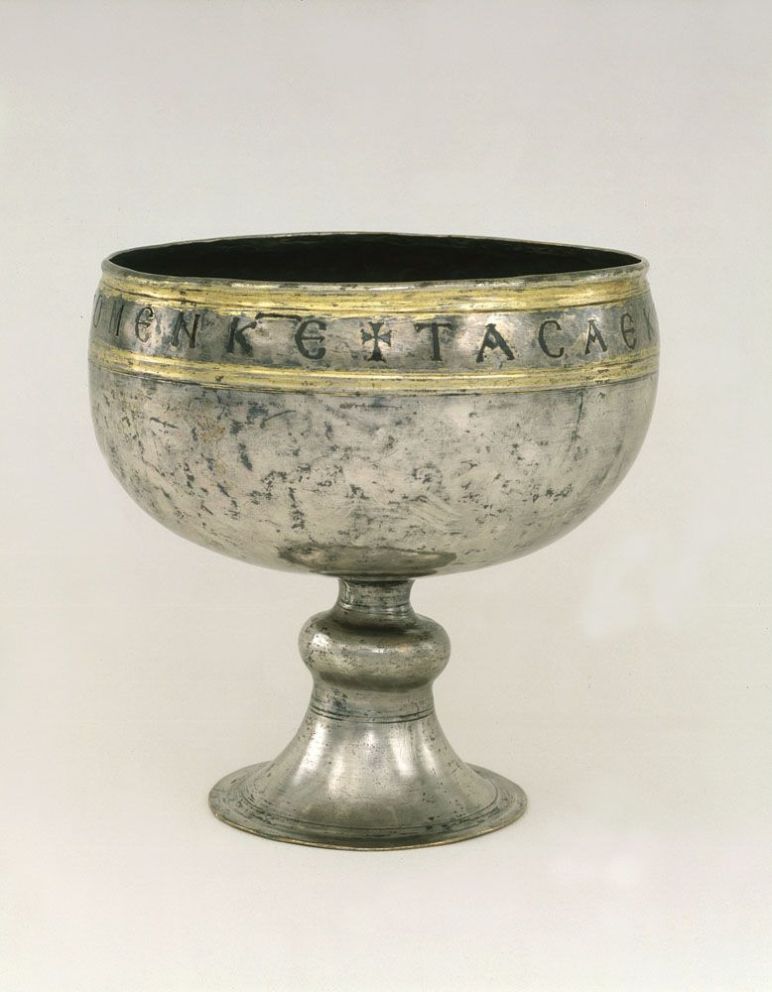
For those of us who live in Edinburgh, we have the enormous privilege of (normally) being able to visit Nicolas Poussin’s Seven Sacraments in the National Gallery. I’ve always been intrigued by the similarities and dissimilarities between the images for Penance and Eucharist. Both are in a darkened dining room, both are centred on a table where guests are reclining, both have bronze vessels for the washing of feet. And the theological connections are equally clear – both have at their heart two of the central tenets of Christian faith: love and forgiveness. The love in the Eucharist picture comes in many ways; in the New Commandment of Jesus to love one another, in the loving gift of himself to all. In the Penance picture, the love is shown lavishly by the woman who washes and anoints Jesus’ feet. The forgiveness in the Eucharist is pronounced in the Dominical Words.

https://upload.wikimedia.org/wikipedia/commons/f/fe/Sacrament_of_Penance_II_%281647%29_Nicolas_Poussin.jpg

The dissimilarities are also vital. In the Eucharist, the table is completely enclosed. There is no need for the open end of the triclinium because there is no need for access by servants. The servants are at the table. There is also a striking simplicity about the Eucharist image, unlike the more lavish setting for Penance. The festal character of the Mystical Supper is hidden, not ostentatious, for this bridegroom comes in humility and suffering even as he feasts in the New Kingdom. There is also, the Eucharist, much more of a focus on Jesus. Almost all eyes are fixed on him, save those of one disciple who watches Judas as he departs. This further creates a sense that this group gathered fully around the table are united in one Body, despite the rupture in that Body caused by betrayal. For even such a betrayal does not undo the overwhelming love and forgiveness embodied at that table.

Even more than ever this year, our unity in the One Body is mystical – it belongs to the realm of what is beyond plain sight. We are not less united because we are unable to encircle the one physical table; we are no less loved and no less forgiven because we cannot share from the same chalice. Indeed, this year more than ever, we are invited to discover how the command to love one another is ‘new’. What new ways of loving are we being called to as we all share mystically in the one bread?

Watchfulness – Mindfulness

When I wrote a little yesterday about the Bridegroom services of Orthodox Holy Week, I touched on the theme of watchfulness which comes from Jesus’ parable of the wise and foolish bridesmaids in Matthew 25:1-13. The above illustration is from the 6th century Rossano Gospels. It is, of course, a parable about keeping watch, being alert, ‘for you know neither the day nor the hour.’ Conventionally, we may imagine this exhortation to refer to a specific future event but I think that the earlier Christian insights into watchfulness are nearer the mark, as they see watchfulness as a state of being which relates to all of life rather than a single eschatological moment.

You see this theme most strongly in the desert tradition, with an entire section of the thematic collection of the Sayings focusing on ‘being ever watchful’. One of the most vivid and pithy of these sayings was from Abba Bessarion:

The monk ought to be all eyes, like the cherubim and seraphim.

Several phrases and metaphors give a flavour of what the desert mothers and fathers meant by ‘watchfulness’: keeping guard over the heart, the remembrance of God, being sober, being mindful, avoiding distraction, stillness, avoiding contempt for others or pride of self. Indeed, this whole body of monastic literature is often described as ‘niptic’, referring to the notion of sober watchfulness.

For these monastic writers, the main things of which one ought to be aware are the thoughts [logismoi] of our minds/hearts. These can be good, bad or neutral. What matters is to keep watch over them so that the bad ones don’t take root and so that their multitude does not distract. Abba Macarius offers a lovely image of the soul being like a mother gathering her wandering and boisterous children together into the house so that she may instruct them. The soul should;

gather up her logismoi constantly (to the best of her ability) and to await the Lord in firm faith so that, when he comes to her, he may teach her true, undistracted prayer.

Watchfulness is, then, the opposite of distraction, the opposite of dissipation or ‘being all over the place.’

What deep wisdom this is! Prayer is simply a matter of being ‘gathered’ rather than ‘scattered’. I say ‘simply’, but it is a difficult art which requires practice and care. One way to practice is through ‘monologistic’ prayer – the prayer of a single word repeated with full attention repeatedly and gently, though the wisdom of the desert shows that all of life is an opportunity to practice watchfulness.

The days of Holy Week are an invitation to practice that watchfulness as, indeed, are these days of isolation. So I hope Abba Macarius’ words about being gathered into the house ring true for you today!


Quotations are from The Book of the Elders, translated by John Wortley; Cistercian Publications 2012

Watching for the Bridegroom

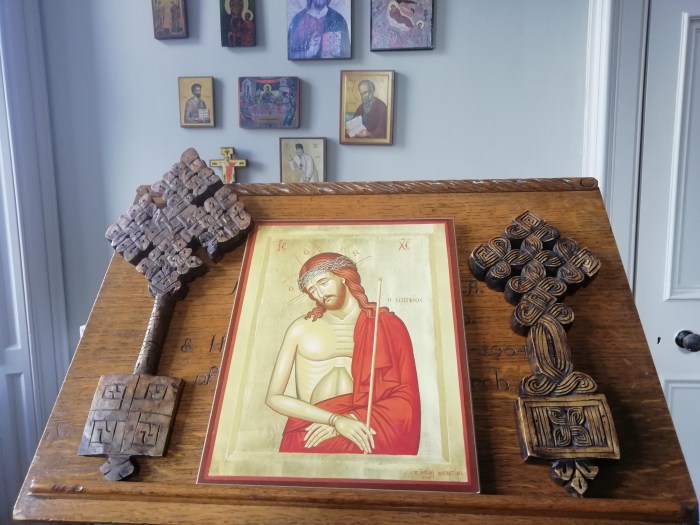
The distinctive image for Orthodox Christians in this first part of Holy Week is of Christ, the Bridegroom, the one for whom we await, watchful, sober, alert. But he is not depicted in iconography as you might expect. He is not robed in festal garments but in the mocking kingly attire forced on him by his tormentors, bound and humiliated:

bridegroom

The texts that accompany the first appearance of the Bridegroom, on Monday in Holy Week, richly juxtapose scriptural images and give us that tone of ‘bright sadness’ that is so prevalent in Byzantine hymnography for this season. Here is one of the texts from Mattins:

The first-fruits of the Lord’s Passion fill this present day with light. Come then, all who love to keep the feast, and let us welcome it with songs. For the Creator draws near to undergo the Cross; He is questioned, beaten, and brought to Pilate for judgement; a servant strikes Him on the face, and all this He endures that He may save humankind. Therefore let us cry aloud to Him: O Christ our God who lovest humankind, grant remission of sins to those who venerate in faith Thy Holy Passion.

In the Western tradition, we are not so used to thinking of these days as being festal and light-filled, but these Orthodox texts are bold in the way they hold together deeply paradoxical moods of bitterness and joy, exaltation and humiliation, servanthood and glorification. In the same office, we see Joseph, whose loss is lamented by Jacob but who is later ‘enthroned’ on a chariot as a king, offered as a type of Jesus, who humbled himself and was then raised. Christ’s self-emptying in the incarnation is carried right through to his Passover.

I find this paradox to be powerfully appropriate in Holy Week this year. There is, indeed, a great and bitter sadness in these days of pandemic, but the light of hopeful prayer shines brightly, and so does the humble service of so many who are working to relieve the sufferings of others.

Be at peace with one another and with all people; think humbly of yourselves and ye shall be exalted.


Texts from the Lenten Triodion, translated by Mother Mary and Metropolitan Kallistos; Faber and Faber 1978

Sermon for Palm Sunday

As we heard again the account of the Lord’s Passion, I wonder what image came to your mind? The thing is, there are so many images of the crucified Christ that our memories are overwhelmed with them. Back in November at the Feast of Christ the King, I suggested just a few. Those were different days and we feel the pain of not being able to gather in this place to reflect on another aspect of Christ’s execution the hands of religious and political pragmatism. At this point in time, we might naturally feel drawn to what is the most common depiction of Christ on the cross, and that is of his suffering. Indeed, in other times of widespread disease, the image of Christ suffering in solidarity with the sick was a source of strength and comfort, and I’m sure your mind’s eye is taking you straight to Grunewald’s Isenheim altarpiece as stunning example of that. Christ’s agony is surely at the front of our minds as we consider the widespread suffering of this present pandemic.

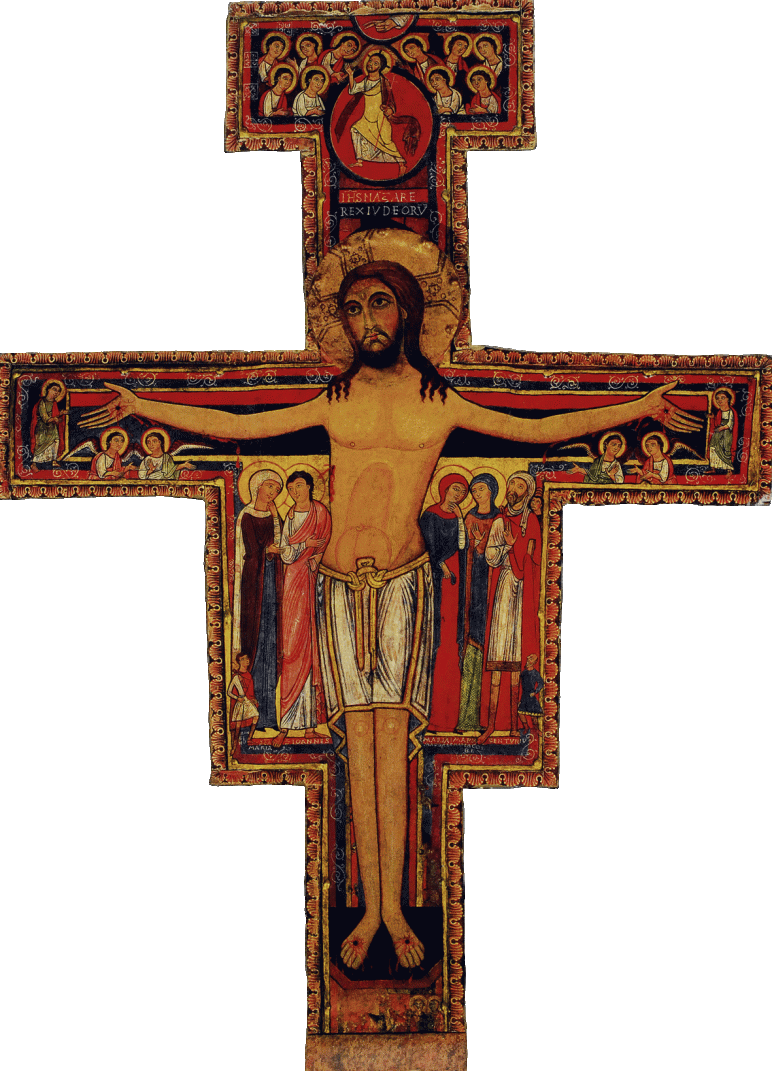
But that’s not where I felt drawn this morning. Instead, I couldn’t get away from another very well known, indeed, almost certainly better known image of the crucified one, and that is the iconographic crucifix that once hung in the little church of San Damiano in the valley below Assisi where St Francis heard, three times, the call from Christ to rebuild his church. It’s such a familiar image that we might have stopped noticing how strange it is. I don’t know about you, but these last few weeks have caused me to look again at many things in the light of a deeply unfamiliar set of circumstances. And this particular image has been with me for a long time, as I’m sure it has for many of you, especially those who have a connection with the Franciscan family. My first real acquaintance with the San Damiano Crucifix was as a student, visiting Alnmouth Friary regularly in my late teens and early 20s.

For those who are less familiar with it, I’ve posted it on my blog or you can easily find it online, but let me briefly describe it and its oddness. It is a large piece, painted in an iconographic style that shows how close early Italian ecclesiastical art was to Byzantine art. It is full of detail, but I don’t want to get into that. Instead, I want to focus on the image of Christ himself. Unlike earlier depictions, which focused on his regal triumph over suffering and death, and later ones that showed his suffering and pain, the San Damiano cross shows Christ in attentive stillness. His body is not contorted in pain, as Cimabue would begin to show a few decades later; his eyes are open though not looking directly at us, and his face shows no hint of agony. How would you describe that expression? It’s neither resigned nor submissive; not exactly serene and not in any kind of ecstasy. Two words suggest themselves to me: still and open.

The stillness is a sort of unflinching steadiness, a total presence. Jesus is present to the reality he faces and present to those who look upon him. He bears with his circumstances and refuses to flee. It is something more powerful than resolve; it is an abiding presence and I find that very comforting in these difficult times.

The openness is an invitation to meet with him. It’s no surprise that Francis heard a voice speak from that face and many after him have found a deep encounter with Christ in contemplating this image. It’s an invitation and it’s a boundless openness that is willing and able to embrace not only the circumstances he faces but the circumstances of all who come to him. Nothing is excluded from that gaze.

We might protest that images like this do not do justice to the real human suffering of Christ or to the historical realities of a crucified man. But historical retelling, even if it were fully available to us, would not exhaust the meaning of the cross. Icons like this unfold the mystery of Christ. They present us with the inner meanings of his paschal self-offering and they are many. Each of the days in the coming week will offer us a particular facet on the paschal mystery. We are doing more than recounting history. We are delving deep into the truths that lie beneath the surface.

And the truth that the San Damiano cross unfolds to us is that died as he lived – in boundlessly open love towards all. This is the same Christ who entered into mystical union with the Father in prayer by night and on deserted hills and who entered into the mystery of human lives every time he encountered one who was prepared truly to meet with him: the Samaritan woman, Nicodemus by night, Mary and Martha in their grief, Peter in his shame, his Mother in her agony by the cross, Mary Magdalene in the garden. In this face we see the love of one who will abide close to us, unflinching, no matter what we face. We see the love of one who will not flee the direst circumstances. We see the stillness of one whose word to us will always be one of peace. We see the forsaken one who will not forsake us.

The coming days will offer us the chance to encounter the stillness and openness of Christ in new ways. We won’t have everything we’re used to but perhaps that will allow us fresh insights into the meaning beneath the surface of the events we recall. Holy Week is not a re-enactment, but an encounter that comes alive when we too keep still for long enough to allow our hearts to open up in loving response to Christ.

Image for Palm Sunday

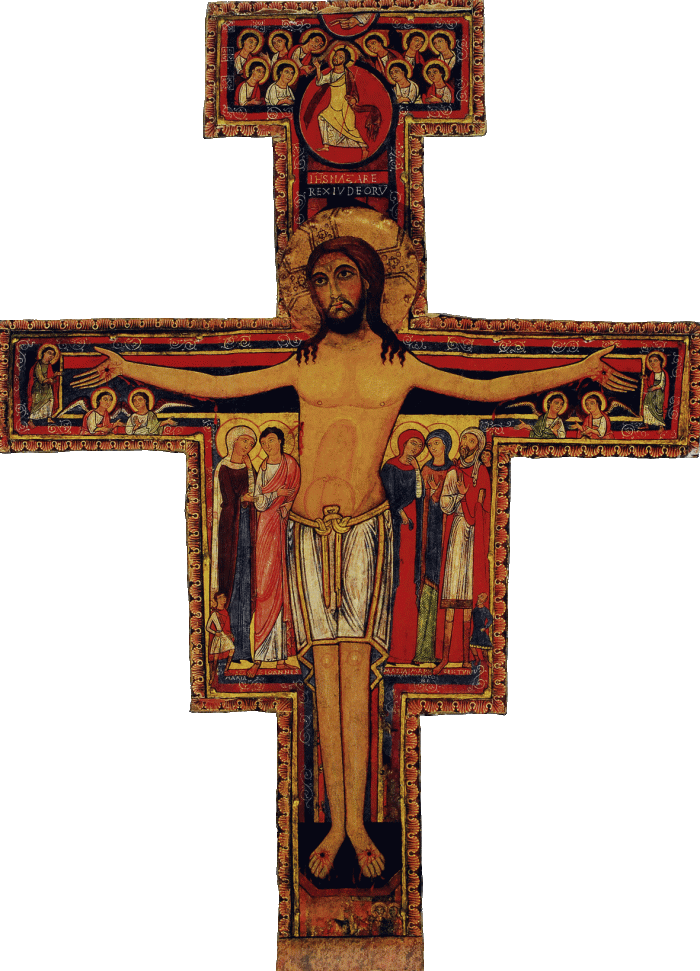
I will be referring to this well-known image in tomorrow’s sermon. It’s the crucifix from the church of San Damiano that spoke to St Francis of Assisi and is now in the Basilica of St Clare in Assisi.

San Damiano Crucifix

Online Eucharist?

I really shouldn’t venture into the field of liturgical theology because I know next to nothing about it! However, as priest I do, of course, care deeply about the Eucharist because it is at the heart of my life. Indeed, it is at the heart of every Christian’s life because it is the joyful celebration of the Wedding Banquet of the Lamb, foretaste of heaven where we are united and transformed with Christ through the offering his ‘single, holy, living sacrifice’. In these current circumstances, we are all struggling to find the best way to continue to place the Divine Liturgy at the heart of our life of faith. Do we continue to celebrate it with the priest being the only person present in the building as we pray the Liturgy together? Does the impossibility of assembling in one physical space and receiving the life-giving Gifts in the way we usually do make the whole celebration a long-distance spectacle? These concerns are very real, but I have a strong sense, having served the Liturgy a couple of times now online as the only person present in the church building, that I was not alone. Furthermore, those who joined with me in offering the Liturgy either as active participants (pre-recorded) or as equally active online pray-ers, also report that they sense that they are not alone. More than that, they tell me that they feel profoundly connected to the Liturgy being celebrated and to the Body of Christ gathered in this way.

I am not going to attempt a metaphysical justification for this because I do not have the intellectual equipment to do so, but I will offer some words by one of the few liturgical theologians I actually read as a way of explaining why it seems right to me to keep on doing what we’re doing:

Genuine faith lives not by curiosity but by thirst. The “simple” believer goes to church in order primarily to “touch other worlds” (Dostoevsky). “And almost free, the soul breathes heaven unhindered” (Vladislav Khodasevich). In a sense, he is not “interested” in worship, in the way in which “experts” and connoisseurs of all liturgical details are interested in it. And he is not interested because “standing in the temple” he receives all that for which he thirsts and seeks: the light, the joy and the comfort of the Kingdom of God.

I don’t know what Fr Schmemann would have made of our current situation, but his words provide all the reason we need to continue to offer the Liturgy – our thirst compels us.


The quotation is from Alexander Schmemann’s The Eucharist, pp. 46f; SVS Press 1987

The World is not a Cake That I Have to Eat

One of the things that we might be learning as we live through the restrictions of the pandemic is that our primary identity in this world is not as consumers. We find, instead, that our lives consist in many small acts of care and attention. When there are no places to go, thrills to seek or sprees to be undertaken, we see that our day consists in rest, time together, contacts with others, food to be made, messes to be tidied, quiet to be savoured,  life to be lived. It is unspectacular and undramatic. At times, it may be intense, especially where there is sickness and loss, and there is nowhere to go to flee that intensity. So we learn how to abide with it, to sit with it, to go through it rather than round it.

bio silence

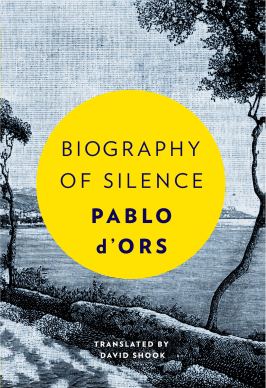
The title of this post comes from a wonderful little book by the Spanish priest and novelist, Pablo d’Ors. His Biography of Silence is an account of his attempt to do what I have just outlined – to learn how to live. And his constant teacher in this school is silent meditation.

Meditation – or should I simply say maturity? – has taught me to appreciate the ordinary, the elemental. I will live for these things according to an ethics of attention and care.

Attention is the practice of a steady gaze, unflinching and unjudging. Care is the practice of compassion for all things, breathing or not. Compassion for weakest and also care for the material world; compassion for ourselves and also care taken over the words we speak and thoughts we allow to grow. All of these things are practised in silent meditation where we attend to our breath and our posture, our prayer words and our emerging thoughts, where we learn to open our hearts in compassion. I don’t think this practice is any easier in this time of confinement, but I do think it is more urgent.

Patience – The Faithful Doctor

One of Kierkegaard’s least know works is his Upbuilding Discourses, presented as a series of sermons and, unusually, published under his own name.

Søren <>

I was involved a few years ago in a book which presented these discourses in the form of dialogues. They were reworked by George Pattison, a theologian and Kierkegaard specialist, and Helle Moller Jensen, a Danish Lutheran priest and theologian. George’s own version of the original discourses can be found here. One of the dialogues was title ‘Learning Patience’ and it seems rather relevant at the moment. My own contribution to the book was to offer a pastoral response to the dialogues and I summarised the main images of patience from ‘Learning Patience’ as these:

  • The weapon of the weak. For many people in constrained circumstances, the exercise of patience can be a way of gaining some autonomy in the face of apparent powerlessness – putting up a bit of resistance, as it were.
  • Finding the eternal in us. When we are put in a position where we have to settle in for the long haul, how do we find a lasting awareness of what it is that endures beyond the circumstances we are currently in?
  • The Faithful Doctor. This is a lovely expression of Kierkegaard’s. He personifies patience as one who has ministered to others and can minister to us. Personification of virtues or skills is a way of recognising that they have a life beyond our own abilities to master them – they have served others well and we can borrow them for a while.
  • An Angel guarding the borders of human experience. Another personification of a ‘strong one’, an angelic helper who patrols the borderlands of what we can manage and, perhaps, one who can bear witness to our struggles, giving them recognition and honouring them.

Here’s one section of ‘Learning Patience’ to finish with:

When it comes to being who you are, it’s no good rushing at it or battling your way forward, and even if you’re living through a time of crisis when big decisions and heroic actions are being called for, you can only every find your self quietly and patiently. In fact, the quieter you are about it the better!

Sermon for Lent V

It may seem odd to us that, as we turn our attention towards the cross on this first day of Passiontide, we have two accounts of being raised from the dead. But this shouldn’t be too strange for us. People of faith, over many millennia, have discovered that the presence of life in the midst of death is not unusual. Indeed, we have discovered that the only way to life is through a kind of death; dying to self, relinquishing our ideas about what we had thought to constitute life, learning to live with constraints, learning to find freedom where choice is limited. I might go so far as to say that the discovery of life through dying is the heart not only of our religion, but of human experience at its deepest. There is no way to life that does not require a radical letting go; and if we do not find a true understanding of the constraints that face us, we will not find a way through to a fuller life. Christianity is, I believe, not idealistic, but utterly realistic in facing human reality as the only way to realise its transformation. That is what these days of Passiontide invite us to. That is what these days of pandemic crisis ask of us. They ask of us that we do not find paralysis in this difficult time, but hope and love. Nothing can defeat love. And if today’s account of the raising of Lazarus is about anything, it is about love. Jesus wept over his lost friend and they said, ‘see how much he loved him.’

Our two images from today’s two readings challenge us to confront the reality of what we face in this current crisis and three images from the world of art help us to see these realities in their specific detail. I’ve put them on my blog, which you can access from the OSP website if you’d like to see them for yourself. In the Ezekiel reading, we see an image of lifeless, desiccated fragments of what were once human bodies. In a rare example of Jewish representational art, a fresco from the 3rd century synagogue of Dura-Europos in modern-day Syria depicts this scene and shows the dry bones not as skeletal remains but as disconnected body parts. On one level, it is gruesome but on another it is profoundly moving. It shows that the real trauma for us human beings is in separation, in dismemberment. We do not thrive, we do not live when we are not connected to one another. Fragmentation is a major source of suffering for us and there is a risk that our necessary isolation in this current situation could lead to some degree of fragmentation. There is a risk that our anxiety could lead to a focus on our narrow concerns for our own wellbeing and lead us away from a commitment to the common good. In Ezekiel’s prophecy, however, life returns when fragmentation is replaced by connection, when there is a re-membering of the parts that have been severed. In the current situation that means contact, compassion, awareness of each other, selfless love.

Turning to our Gospel story, let me describe the scene as depicted by the early 14th century Italian master, Duccio. His painting of the raising of Lazarus shows him standing erect in the opening of a tomb but bound very tightly by his grave clothes, like a mummified body. A crowd stands to the left of the scene. One man is embracing the stone that had sealed the tomb. Most turn to face the risen Lazarus with astonishment and some with disgust. Mary and Martha, however, face Jesus. It is entirely faithful to the fourth evangelist’s account and leads us to the threshold of the moment of true liberation when Jesus, having already called Lazarus to come forth, now calls for him to be unbound, to be set free from his constraints. His life is not just about breathing again, but about being released from all that diminishes him.

Again, this rings true for us who currently face considerable constraints on our normal activities. We feel as if we are in the position of Lazarus, waiting for a word of release to let us step free of our limitations. But we are in the place of Lazarus in Duccio’s painting, alive but restricted. But I wonder if Duccio has not found something profound in choosing to freeze his image at this moment in time. Lazarus is not yet unbound, but he is alive. We can find freedom even when severe constraints appear to limit our choices. In Duccio’s image, I see that freedom in the face of Lazarus, who looks out on the whole scene with a steady gaze which meets the gaze of Jesus. He connects, even while he is still bound. We, too, are free to look upon the world with loving connection, even from the four walls of our living room.

I want to mention one final depiction of this scene, which is by a later Italian painter, Sebastiano del Piombo. His Lazarus is not emerging from a rock-hewn tomb, but from the ground. He is not bound but in the very process of wriggling free from his bandages. His muscular body is shedding its bonds and even his big toe is doing its bit in peeling off the restraining cloths. Where Duccio showed a moment of freedom in the midst of constriction, del Piombo shows a surge of strength and an assertion of vitality. For me, at this point in time, this painting hints at a future hope of resurrection. It suggests an irrepressible life-force which cannot be contained. But something is amiss. No one in the large crowd can look at Lazarus, not even those helping him to undo his bandages. Not one. Except Jesus. He alone can bear to look in the eye one who was dead and see in him the vigour of life, for he is the one who knows that he, too, must undergo the darkest of days before he can embrace the eternal light.

In him is our life, our hope, our consolation and our strength. In him is the promise that the full vigour of life will not be destroyed. In him is the willingness to look upon that which seems unbearable and see it through to the light of Easter’s dawn.