Oppenheimer and Images of Mass Destruction

As one review noted, Christopher Nolan’s remarkable new film about the creation of the Atom Bomb avoided one rather significant dimension: it did not directly depict the suffering of the people on whom the bombs were dropped. The closest it gets is the imagined terror in Oppenheimer’s mind’s eye when he finds himself having to utter words of congratulation and praise for the ‘success’ of the bombs to a group of his colleagues. There, we see a few brief images of the kind of horror unleashed on human flesh by these monstrous weapons.

There is, I think, a kind of power in refraining from showing the horrors of destruction caused by the bombs in Nagasaki and Hiroshima. That power is nowhere more expertly wielded than in the hands of Thomas Merton, whose stunningly ironic prose poem, Original Child Bomb, recounts the events shown in Oppenheimer with the use of deliberately flat, understated language.

Here are two of its 41 sections to give a flavour:

32: The bomb exploded within 100 feet of the
aiming point. The fireball was 18.000 feet
across. The temperature at the center of
the fireball was 100,000,000 degrees. The
people who were near the center became
nothing. The whole city was blown to bits and
the ruins all caught fire instantly
everywhere, burning briskly. 70,000 people
were killed right away or died within a
few hours. Those who did not die at once
suffered great pain. Few of them were soldiers.

33: The men in the plane perceived that the
raid had been successful, but they thought of
the people in the city and they were not
perfectly happy. Some felt they had
done wrong. But in any case they had obeyed
orders. “It was war.”

Merton makes reference to the many religious terms used by those in the project, again noted flatly to emphasise the idolatrous sense of awe generated by such a demonstration of human prowess. He was all too aware that language laced with superlatives could never touch the real depth of horror faced by the residents of those two cities. Equally, the dry understatement heightens the sense of pathological dissociation that must exist for human beings to be involved in the deliberate annihilation of fellow humans. It generates a language field in which all compassion has been deliberately excised.

I think Oppenheimer did succeed in presenting the very real moral turbulence created for many of those involved in the Manhattan project, not least Oppenheimer himself. And it skillfully shows how real human suffering can be consigned to a footnote in geo-political narratives.

Another deeply affecting work by a Catholic author does, however, give us an unflinching depiction of the suffering of the bombs’ victims. Takashi Nagai’s, The Bells of Nagasaki, recounts the author’s first-hand experiences in the wake of the bomb.

The authority of his prose comes from his direct involvement in the events he describes rather than from any kind of literary manipulation – he also employs a simple, factual style of description and that is what makes it so devastatingly powerful. Nagai dedicated himself to peacemaking for the remainder of his life, a life shortened by the effects of radiation, not from the bomb, but from its therapeutic use in his medical work.

These two Christian voices add much to the narrative so effectively brought to the wider public’s notice again by Nolan’s film. Together, might they shake us out of our collective complacency about the appalling, inhuman weapons on which we continue to rely?

Bibliographical note: Merton’s poem was published as a limited edition of 8000 copies, which are reasonably affordable if you look around. It is more easily accessed in a number of other collections, including his Collected Poems and the collection, Thomas Merton on Peace.

On Spiritual Appropriation

In his wonderful overview history of Orthodox Christianity, Fr John McGuckin intriguingly suggests that the treasures of Orthodoxy, if willingly shared and gratefully received, might find that their perseverance in the West will be at least as much in the non-Orthodox churches as in the relatively poor and often ethnically specific churches of the Orthodox diaspora. My understanding is that these treasures might include such things as iconographic traditions, spiritual theology, ascetical practices, liturgical texts and music, and so on. Clearly, such ‘borrowings’ (if that’s what they are) are very much in the mainstream for many churches in the ‘West’ if you consider the prevalence of icons in many non-Orthodox settings, the widespread use of the Jesus Prayer (see, for example, Franz Jalics’ work) or the broad-based engagement with Desert spirituality (Nouwen, Merton, Ward, Williams, Chitty, etc.).

Some Orthodox are troubled by this tendency, seeing it as a kind of appropriation of Christian traditions of one part of the Christian family by another. This can be problematic both because of the imbalanced history of relations between these families of churches and because the adoption of only some traditions, torn from their primary context in a living community, can look rather like a pick ‘n’ mix spiritual consumerism, lacking integrity or coherence.

I don’t deny this risk, but I would want to make two suggestions for other processes that may be at work here. One is the simple reclaiming of lost elements of shared spiritual heritage. The iconographic traditions of early mediaeval Scotland or Italy could be (and have been) mistaken for images deriving from Coptic or Byzantine sources. The Jesus Prayer ultimately finds its roots in the Desert Fathers, not least Diadochus of Photiki, who should rightly be seen as a saint of the undivided church. The ‘Eastern’ manner of making the sign of the cross was common to all Christians before the modern period. These practices need not be seen as belonging to only one part of the church any more than the use of the Psalter as the core prayer book of all Christians who are serious about a disciplined life of prayer. I am cautious about the Anglican love of the ‘Vincentian Canon’ (that which has been believed everywhere, always and by all) because it risks a simplistic view of the development of tradition (see David Bentley Hart’s excellent work on this). However, it does express something important, which is that there is something like a common repository of spiritual texts, insights, doctrines and practices which properly belong to the mainstream of catholic/orthodox Christianity. It can’t be defined as neatly as to be called a canon, but we would surely all agree on some elements of that shared inheritance that go beyond Scripture and Credal faith (Eucharist, Baptism, other sacramental rites, works of compassion, some level of Patristic witness, certain practices like fasting, devotional gestures, some degree of common iconography, patterns of daily prayer, recognition of certain saints, patterns of ordained ministry in continuity with the Apostles, musical traditions etc.). Some of these elements are hotly contested, some missing from certain traditions, and some are more strongly local in their flavour than others. For Anglican Christians like me, who have a keener sense of continuity than disruption in their view of how we fit into the sweep of Christian history, it is vital that we relearn some of the habits that were lost in that iconoclastic blip we experienced in the early modern period. To do that, it seems reasonable to do that relearning by humbly listening to those who did not experience such ruptures without, of course, falling into the trap of imagining that we will find some kind of pristinely preserved source.

The second process I would propose is not unrelated. It is the desire that many of us have to see the closer unity of Christians. The road to that unity is one in which mutual learning is vital, and the gradual adoption of shared practices seems desirable as we learn how to grow closer together. This is not a one-way street. Orthodox churches might benefit from the insights of those who have long practised Christian faith in ‘Western’ contexts in terms of what cultural forms resonate with believers here.

I have long benefited from the wisdom of many Orthodox teachers who have cultural roots in the West (Clement, Gillet, McGuckin, Behr-Sigel, Ware) as well as those from lines of inheritance deeply rooted in the Orthodox cultures of Eastern and South-Eastern Europe, some of which were transplanted in the West. It is hardly surprising that these interactions would lead to an enrichment of Western European Christian life with treasures from its shared roots with spiritual siblings from other parts of our small continent, roots which might well have flowered in more similar patterns had history taken different turns. I pray that their rediscovery will be a means of greater unity and, possibly even more importantly, spiritual growth.

Good Shepherd

I have an instinctive aversion to the image of Jesus as a Good Shepherd which is due entirely to the prevalence of those terrible 19th century images of which most Anglican churches seem to have at least one. They are terrible to me only because of their very sugary depiction of Jesus and the paternalism that they evoke. I should, of course, know better, having grown up in rural Aberdeenshire, but it took a rather adventurous trip to a hermitage on Crete to remind me that shepherds could be something other than a benevolent Victorian gentlemen.

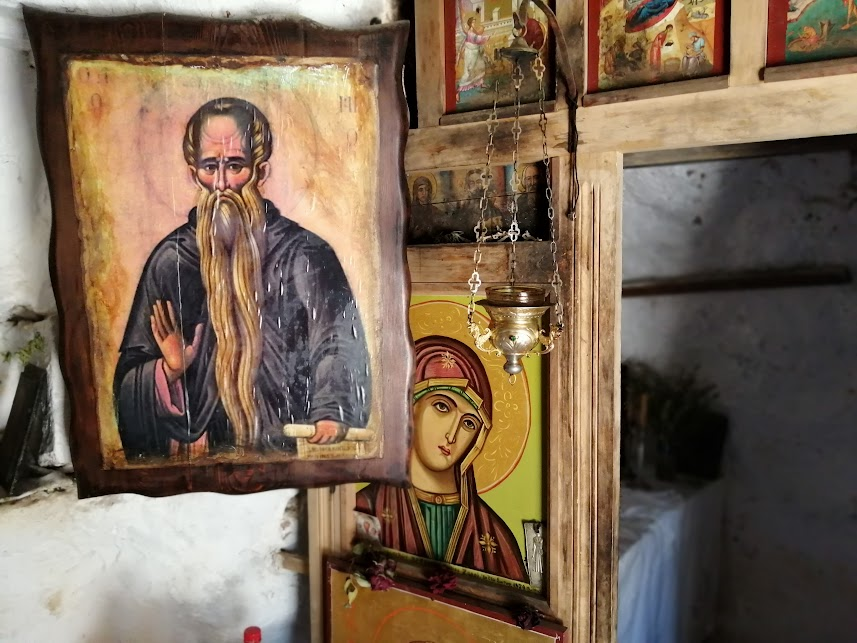
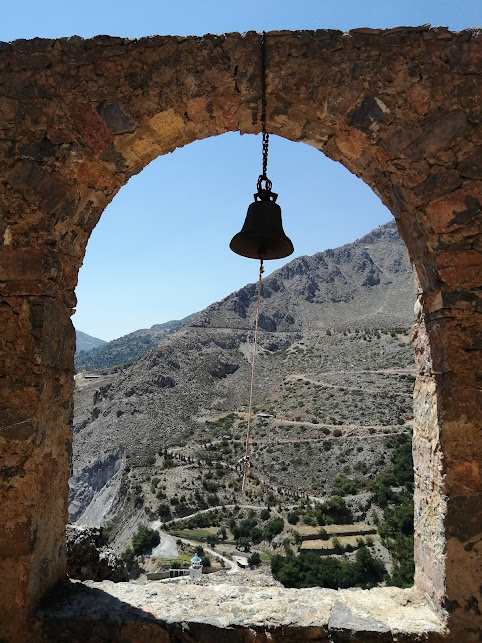
The trip was adventurous thanks to Google Maps’ optimism about what constitutes a driveable road. Half way up the mountain, I had to abandon the very under-powered hire car and walk the remaining few kilometres to the stunningly located hermitage of Saint Euthymius. Here are some pictures:

And here’s one of the interior of the chapel with an icon of the eponymous saint:

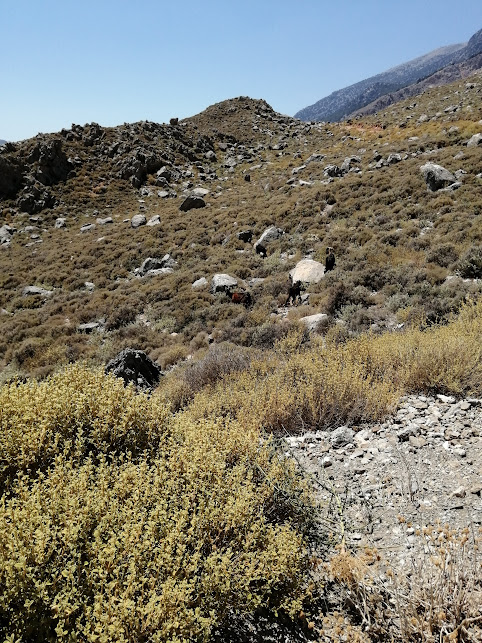
Along the way, I passed a shepherd’s hut and here are some of his flock (you’ll have to look hard!):

The terrain is a long way away from the lush pastoral scene we might imagine from these damp Atlantic islands. The ground is rocky, the vegetation is hardy shrubs and aromatic mountain oregano, not sweet green grass. The shepherd’s rudimentary hut is remote, though he did have a slightly feral and over-curious hound to keep him company.

There was a wildness about the place and the hermitage was no more comfortable than the shepherd’s hut:

In this terrain, a shepherd is something like a hermit, one who knows something about life in rugged spaces, someone who can see far because there are few interruptions, inner or outer. Nothing much grows here, so it’s a good landscape for remembering that troubling thoughts will also wither if the conditions are right. The Good Shepherd is a guide through such places: a navigator of solitude; a rescuer of the stumbling; a life-giver when nourishment is scarce; a gatherer of the scattered.

Creative Liturgy

I always hesitate to write anything about liturgy because it’s ‘not my area’ (“You do not have an ‘area’, Crilly!’ as Bishop Brennan said to Fr Ted), by which I mean that I am not a liturgical scholar and don’t take an active interest in the history, development or creation of liturgical texts. However, every Christian is deeply invested in The Liturgy, the church’s offering of the Holy Eucharist, because it is who we are. I say it is ‘who we are’ rather than ‘what we do’ because the Liturgy is not simply one of the activities of an organisation called ‘the church’ but is, rather, the (at least) weekly expression of the entire Paschal mystery, the sacrifice of praise and thanksgiving made on behalf of the whole creation, the coming together of the Body of Christ to be immersed in the mystery of Christ’s self-giving for the life of the world. It is the proclamation of the Kingdom of God and our participation in the heavenly worship, so of course it is of the greatest importance to us.

It is unsurprising that, given this importance, ‘liturgy’ – the way in which we offer the Eucharist – can also be something of a battleground for competing understandings or emphases. This is another excellent reason to leave it well alone! But I do want to offer one thought about an assumption that can sometimes be heard about a perceived gulf between liturgical expressions that are thought to be ‘creative’ over against those that are seen, by contrast, as ‘traditional’. The assumption, I think, is that human creativity is primarily expressed in ‘making something new’. In liturgical terms, this might include new texts, new pieces of visual art, new music or new ways of using the space in which the Liturgy is celebrated. However, does this mean that every artist who performs an ancient piece of music or makes an icon following traditional forms is not being ‘creative’? And surely the word itself begs the question of whether or no the Liturgy itself requires ‘creativity’ in order to be worthwhile, and if so, what sort of creativity is required.

I would start by suggesting that the primary quality we bring to the Liturgy is attentiveness. It is our disposition of prayerful openness and steady attention that enables us to participate most fully in the Liturgy, whether or not one has a designated role in it. I think this quality is equally important for every style of liturgical expression. Secondly, I would suggest that, in the Liturgy, as in any sacrifice, there is both an offering and a receiving. We offer our best in an act of gratitude, we receive the transforming gifts of God in return, not as reward but as free gift. ‘Offering our best’, is the place where we might locate a desire to be as creative as possible in gratitude for what we receive. This may also be seen as in ‘missionary’ terms as a means to make the Liturgy as appealing as possible to those who do not yet participate in it, but I think these considerations are secondary to the primary concern, which is our faithful response to divine love. For some of us, ‘offering our best’ in a spirit of prayerful attentiveness is not well served by any focus on liturgical novelty that draws more attention to the Liturgy’s style or novel content than to its Godward direction. I am very conscious that this may be a matter of personal preference, but I would be reluctant to see an emphasis on familiarity and repetition as an aid to undistracted attentiveness as ‘less creative’ than the making of new things. By analogy, the Jesus Prayer would simply not ‘work’ if it were not repetitive. For me, the creativity in ‘traditional’ styles of liturgy lies precisely in its demand for fully attentive and embodied presence. This requires an active concentration as well as a certain passivity, for the truth is that the main creative act in the Liturgy is God’s work of creating us anew in the likeness of Jesus Christ.

Here are a few of the ways in which I believe that our embodied, attentive presence in the Liturgy is a creative act:

  • It calls forth from us qualities that exceed our normal patterns of casual interaction or being a passive spectator
  • It demands that we give careful consideration to the use of material things, not least our own bodies through posture or gesture, voice or gaze, but also in the handling of the holy gifts themselves and the vessels that contain them, along with other liturgical items – candles, crosses, iconography, fabrics etc
  • Although I do not think that interpretive mental activity is of primary importance in liturgy, there is a kind of imaginative reflection going on whereby we receive and consider non-visual images or metaphors
  • There is creativity involved in the way we interact with one another in liturgical space, attending to one another’s needs, taking our place alongside others in a harmonious chorus of voices and bodies – think even of the simple act of walking together in procession

These are simple, creative acts that are open to anyone who attends the Divine Liturgy, whatever their role. In performing them faithfully, prayerfully and with a joyful self-forgetting, we enter into the mystery of our theosis, ‘offering unto thee thine own of thine own, in all and for all.’

Our Place Among the Things

I’ve been reading three books recently which all, in different ways, ask the urgent question of how we, as human beings, relate to the other beings and objects with which we share this planet. James Bridle’s book, Ways of Being, asks how we might work alongside other forms of intelligence in our world in order to create more cooperative and less destructive patterns of interaction. He shows how limited we are when we see other intelligences only as versions of our own, whether that be the singling out of facial recognition as the preeminent sign of self-awareness in other animals, or the construction of forms of AI solely as competitive systems form maximising production, or the failure to recognise the profoundly social nature of the intelligence of plant systems.

Writing from a very different perspective, Metropolitan John (Zizioulas) asks, in a series of of essays edited by John Chryssavgis, whether our ecological crisis might be more than simply a moral one, for example a matter of over-consumption, greed or heedlessness, and may, in fact, be much more a problem of ontology. He suggests that our failure to understand ourselves as bodies and the strangely persistent notion of ourselves as having a body leads to the kind of dualism that places mind over matter, leaving matter itself as a lower form of being, ripe for exploitation and manipulation. Did we forget about the incarnation?

I might find time to explore these rich works in more depth at some point, but I want to focus on the third book I’ve been reading, one which has touched me deeply. Again, it’s in a completely different genre – fiction – but I think that Ruth Ozeki’s Book of Form and Emptiness helps us address the question of our place among the things in an imaginative way that engages the heart and moves us beyond the realm of ideas to the realm of relationships. The novel is multi-layered, but the narrative is primarily concerned with a woman and her son, and how they respond to the sudden death of their husband/father. The story is told with a depth of compassion and without judgement as it deals with Annabelle’s increasing tendency to hoard and Benny’s ability to hear the voices of objects around him, which becomes increasingly overwhelming. The objects tell their stories, many of which relate experiences of pain or exploitation.

Benny encounters two other characters, who offer different ways of interacting with the things and beings they come across. One is a young woman, an artist he meets on a pediatric psychiatric ward and with whom he reconnects when he finds refuge in a large public library. The Aleph, as she is known, makes art from materials found in dumpsters, including snow globes that portray images of environmental harm. She also makes trails of message for people to find and follow, inviting them to make connections through the world. The Bottleman is a Slovenian poet and philosopher who lives on the streets and is overlooked as a drunken down-and-out by many. However, he is one of the few to take Benny’s questions seriously and to enter his world, respecting his questions.

The mental health challenges of the main protagonists are treated neither romantically nor patronisingly but with patient understanding. Similarly, the running theme of a self-help book on decluttering by a Zen priest in Japan, which Annabelle dips into from time to time in an effort to deal with her hoarding, is taken seriously while also inviting a more subtle engagement with the Zen Buddhism which underlines so much of the book’s character (Ozeki is, herself, a Zen priest and the title refers to the Heart Sutra).

The book moves slowly towards different ways of relating to the material world, largely through the characters of the Aleph and Bottleman, who are both possessionless but hardly abstracted from the world. The Bottleman helps Annabelle redistribute many of her cluttering possessions to those who might enjoy them and the Aleph makes art from ‘trash’.

Finally, the book moves us to a place where the relationship between Benny and Annabelle is restored and deepened, enabling them to support each other in the loss that had previously driven them apart. There are many other layers to the book which I won’t explore here, but I want to emphasise the fundamental relationality of the characters to the material world around them. Objects have stories and voices but need to be kept on the move rather than possessed in a way that ends with us being possessed by them. Similarly, the voices of the marginalised are brought to the foreground of the narrative, inviting us to hear one another, and especially to hear voices that sit on the edges of the all-consuming world of ‘success’, ‘progress’ or ‘rationality’. Most wonderfully, though, the book does this not with the heavy-handed prose of the preacher or politician, but with humour, playfulness and delight.

An Urban Hesychast

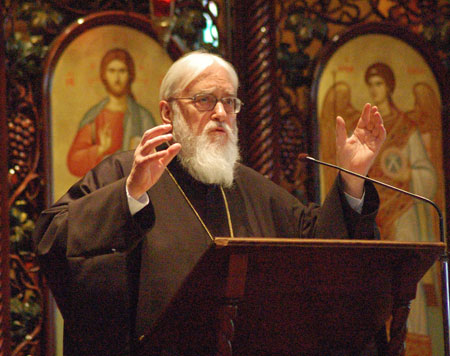
The English-speaking Christian world has lost one of its most respected theological voices. Metropolitan Kallistos fell asleep in the Lord yesterday morning and, for many of us, his passing has caused us to give thanks for decades of his gentle teaching and thorough scholarship, bringing the texts and insights of the Philokalic tradition and of Byzantine liturgy to a wide audience. As for many others, my first encounter with his writings was his ‘The Orthodox Way’ (my copy is dated 1988) with its superb selection of apt quotations at the end of each chapter which offered a tantalising introductory taste of teachers as diverse as Isaac the Syrian, St Symeon the New Theologian, Paul Evdokimov and Mother Maria of Paris.

It is Metropolitan Kallistos’s teaching on the prayer of the heart that I still find most compelling. In an essay on hesychia originally published in 1973 but updated in his collection, The Inner Kingdom, in 2000, he gave a wide-ranging analysis on the meaning of this rich word. He reminded us that, although the outward context of our quest for inner stillness may be important – indeed, many monastic writers stress the vital importance of the cell in their practice – true stillness may be practised even by those whose lives are lived in the context where much speech and little solitude may be possible: ‘what matters is not our spatial position but our spiritual state.’ He thought that ‘the vocation of an urban hesychast was by no means an impossibility.’ Indeed, he may well have embodied that vocation himself as an academic living in a busy city who was drawn to the prayer of the heart.

I would go further and take his endorsement of such a vocation as an indication of its necessity in our cities. What greater gift could we give to our busy, noisy, challenging urban environments than the gift of the pursuit of true prayer? The rest, fulfillment, inner balance and spacious openness to the Father that is the fruit of the prayer of the heart is nothing less than the Kingdom of God. Kallistos quotes Met. Anthony: ‘At that moment, the eschatalogical moment is realized and, in the words of St. Paul, ‘God is all in all.’ The one who practises hesychia ‘can appreciate the value of each thing because he sees each in God and God in each.’ There is much more to say about the spiritual legacy of this great Father in God, but for now, I thank him for his insight into the urgent vocation of seeking God in the stillness of the heart, especially in the unstill heart of our cities.

George Mackay Brown on Poets

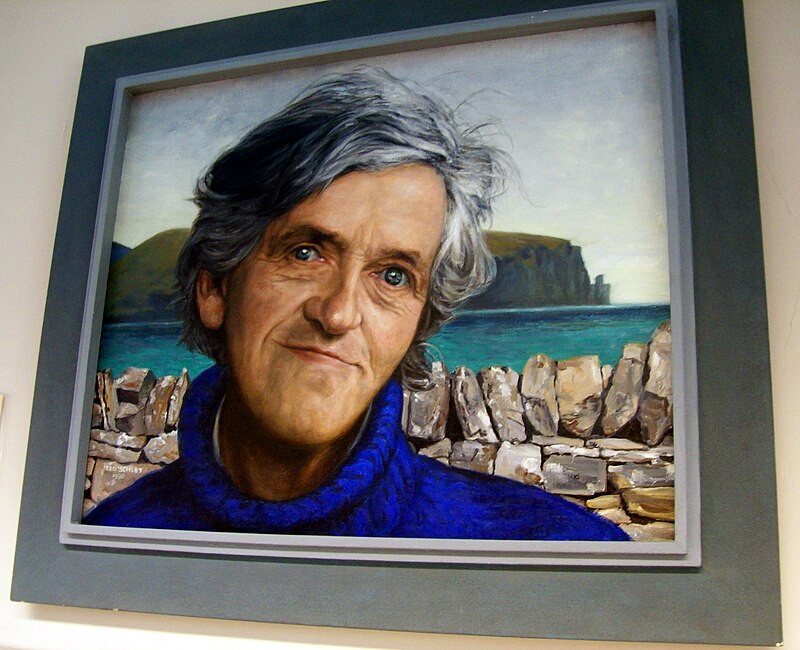
GEORGE MACKAY BROWN IN STROMNESS LIBRARY (9275790292).jpg

Yesterday was the centenary of GMB’s birth so to mark that occasion, here’s a poem he wrote about the art, craft, graft and spirituality of poetry:

Four Kinds of Poet

1

‘Here, now. A new time, a new place. Write something. This
is expected by publishers, readers. Try to render both actuality
and soul of the place, look, and write. Quick. Time passes. The
place is changing as I look and write. I wither. The place ingath-
ers in a mesh of words. Words, keep me, keep all, now: a poem.

2

‘This place is boring, like most places. There’s nothing I feel
inclined to say about it. When (out of boredom) I try to find
equivalent words, the place changes: a fog shifts, lifts. There are
the stones, piers, windows, chimneys, children of light and water
that once he saw in a good dream – long forgotten: a poem.

3

‘What happened here? congregate, ghosts, among the
weathered and cracked stones. Take my mouth, speak. dance.
There was nothing but ritual on earth once. I imagine cere-
monies. I will make masks: among those shadows buying and
selling: a poem.

4

‘Creation of a word, this place. What word? The word is
streaming across time, holding this place and all planets and all
grains of dust in a pattern, a strict equation. I am always trying
to imitate the sound and shape and power of the unknowable
word. Dry whisperings: a poem.’

While the last stanza reaches a mystical depth, the first three are not to be despised. For GMB, there was work, effort involved in the making of a poem. It did not only flow when the Muses stirred but was also the result of patient abiding, well-honed craft, willingness to attend to the particularities of place and the endurance of fabled memories.

For a Christian reader of this poet who was a Catholic Christian, this all makes perfect sense: ascesis yields to insight; patience paves the way to theoria, myth and ritual hold eternal meaning, and who could fail to see The Word in ‘the word’ of that last stanza?

Thank you, faithful interrogator of silence, for your many and beautiful imitations of the sound and shape and power of the unknowable W/word!

Heaven Underneath Your Hand

Little grebe - Wikipedia

Thomas of Celano tells of a moment in St Francis’s life when he is crossing the Lake of Rieti. A fisherman offers the saint a little water-bird ‘so that he might rejoice in the Lord over it.’ Francis took the bird gently in his hands and invited it to fly away freely. The bird was content to rest in the saint’s hand and Francis ‘remained in prayer’. Here is how Ann Wroe reflects on that story in her wonderful book of ‘songs’ about Francis:

A water bird, he says it is,
as he draws on
his slapping oar to get across
before day’s gone;
a water bird, light as a shell,
whose rainbow sheen
breathes heaven underneath your hand,
intact, serene;
a water bird whose opaque eye
half-closed in sleep
contains this lake, this mountainside,
snowed height, black deep.
trembling you guard this being now,
warm as coal,
just-held, as by the dipping prow
your life: your soul.

This moment of utter simplicity seems to me to be a perfect icon of Francis’s way of being in the world – a chosen fragility whose strength is compassion. It is Christ’s way of being in the world – as fragile and as nourishing as broken bread.

In its freedom, the bird chooses to rest rather than to fly, just as the contemplative chooses to sit with the reality of the world in clear-sighted trust rather than to turn away towards the lure of any distraction that offers its momentary sparkle. In contemplative awareness, the bird ‘contains’ the lake and the mountain – no separation, no distance.

If the church were to offer only one gift to humanity in its struggle to restore nature’s fragile balance, it might choose to offer this contemplative way: holding all of life gently; choosing to abide with all that challenges us; open-eyed in contemplative awareness; seeing ‘heaven in ordinarie’; seeking the way of peace and rest.

Having Nothing to Offer

What do people of faith have to offer to this world?

Nothing.

No technique.

No prescription.

No theory-of-everything.

No answer.

No blueprint.

No clever fix.

No solution.

No concept.

So what?

On having nothing, we offer only silence.

Only possibility.

Only space.

Only the emptiness that awaits fullness.

Only humility – the wisdom of the earth, of dust.

Only a heart broken open to receive.

Only a willingness to abide, not knowing.

Only longing.

Only a naked intent, reaching out.

Abiding in the True Vine – Easter 5

Last week, the winners of a food photography award were announced, and the overall winner was a stunning picture by a Chinese photographer called Li Huaifeng. It shows a mother and father with their daughter making dumplings in a vaulted front room, the sunlight pouring in smoky shafts through old and patched windows and the ill-fitting front door. The camera angle shows the family from above; the father on the left cooking over a very hot wok, heated from below with a simple wood stove; the mother seated on the rights folding dumplings which are being neatly arranged in their dozens on large trays. Her daughter looks at her with a smile of complete delight, lit by one of those sunrays. It is an arresting picture and its appeal lies in the combination of a location that is fascinating in its particularity and unfamiliarity to us, and the complete familiarity of a universal image of food preparation, with its promise of nourishment, taste, togetherness and sharing.

Food is always both universal and particular, global and local. Something as Scottish as haggis is also a staple food in Serbia and elsewhere, and what use would it be without a decent amount of pepper, a spice so familiar that we forget its distant origins and its need for the kind of sun we just don’t see here. And I think there is something of that universal and particular nature of food when St John the Theologian takes the Eucharistic elements of bread and wine, of grain and grape, and meditates on them in passages like the one we’ve just heard. Vines, of course, are famously responsive to their particular place, their terroir, as you’ll know if you’ve ever had a tour of a French vineyard and endured the long chat that separates you from the tasting session. But their fruit has a long reach, and the symbolism that St John employs also hints at the rich complex of meanings evoked by wine as a festive and ritual drink, the stuff of weddings and libations, of weekly shabbat and annual Pesach, of gladdened hearts and warmed faces.

But the universal dimension is also concerned with the very matter of the vine itself, root and fruit, branch and trunk, and here St John gives us one of his most enduring metaphors, which is that of abiding. I am glad that the NRSV retained this rich word, which is the same word asked by Jesus’s first disciples in chapter one when they ask him where he is staying, where he is abiding. In the light of the way the word is used in this passage, they might as well have been asking, ‘where are you rooted?’ or ‘what is your sphere of operation?’. It’s an existential question which is not restricted to a question of geographical origins – a first century equivalent of the deadly Edinburgh question, ‘what school did you go to’ – but is much more concerned with where we find our true centre of gravity, the place we are rooted and at home, secure and nourished, most freely and fully ourselves without the superficialities of status, achievement, wealth or exterior characteristics.

Where do you abide? Abiding is also, I think, a perfect word to describe contemplative prayer. I don’t mean the stuff we say to God, but the sense of being still in one place, of squarely facing reality with open eyes and hearts, of commitment to the discipline of remaining close to the source of our life, the True Vine, in silence and in trust. How do we abide in Christ? By choosing to remain in his presence, again and again, without expectations or theories, programmes or techniques, simply conscious of the miracle of being alive.

But I think there is also a particularity about this abiding, which mirrors the commitment to regular contemplative prayer, and that has to do with choosing to dwell fruitfully in our particular place. The story goes that a pilgrim asked an old monk, ‘what do you do?’. His reply was ‘I live here.’ In a time of ecological crisis, it has never been more vital to understand what it means to live here. And for a church community like ours, that means not only the locality where we live, but also the part of God’s creation where we choose to gather to celebrate the mysteries of our new life in Christ. This church, this holy temple, is a meeting place with the divine, a portal between earth and heaven, but it is also in one particular place. And our calling to abide here has specific implications. What is our impact on this part of God’s earth? What are we emitting into the atmosphere here? How do our lives touch those of the people who live in, work in and visit this part of our city? What are our most pressing concerns as a church community? Are they to do with our own needs and convenience, or those whose lives are rooted in this place?

As the sharp impacts of this pandemic begin to retreat for us, it may be time for us to take up this question with ever greater focus. And our experience of this last year has offered us insights into the many dimensions of our own abiding as a church community. As so many aspects of our church life have been constrained, we have been led to seek once more the place of our own deepest abiding. And as this cruel disease has shown us so much about our global connections and about our local inequalities, we have also been led to seek once more the practical implications of the life we choose to live in this place.

Jesus said, ‘My Father is glorified by this, that you bear much fruit and become my disciples.’ We are always becoming, always learning more fully how to abide in Christ, so we need not fear the scale of the challenge. We seek nothing more and nothing less than to live here, to be alive in this place, to be life for others, to become disciples, grafted onto the True Vine who is the source of all our strength and inspiration.