Beautifully Limited

The poet Alice Oswald once described her medium as ‘beautifully limited’ and, in this, she was likening it to music. In the same interview, she talked about her sense of what it was to be a poet and used phrases like; ‘it’s a question of paying attention’ and ‘you get drawn into the big human questions: how to live’. I respond very strongly to these descriptions and they strike me as deeply spiritual. In the spiritual life, the ‘methods’ at our disposal are also beautifully limited. Our practices, our historic texts, our liturgies are all abundantly rich in meaning and offer the most profound encounters, and yet we know them to be limited. They are beautiful forms, but they are just that. They should not regarded as of ultimate value, only of proximate value.

The spiritual life is, like poetry, a matter of paying attention. It is nothing more and nothing less than our response to the invitation to see clearly and a simple discipline of attentive, concentrated silence, of radical openness to what is in front of us, of seeing the connections. And it is, above all, concerned with the question of how to live. The spiritual life can never be reduced to theory (though I wish more theologians took seriously the task of considering spirituality in an analytical, conceptual and contextual way…) and is always a matter of vital seriousness (though one of its hallmarks is self-forgetting humour).

So if poetry and the spiritual life have so much in common, I wonder if we might not gain rather a lot by applying Alice Oswald’s thoughts to our primary spiritual texts – what we call sacred scripture. If we read these texts as ‘beautifully limited’ expressions of faith, then we might see their succinct and incomplete character as strengths rather than weaknesses. The Bible is not all we have to say about faith, but a way to open us up to encounter with the Absolute. Not definitions but invitations. And if reading the Bible is a matter of paying attention, then our encounter with it is a school for contemplative consciousness. And if we come to it with the question of how to live, seeking not instructions but a mirror to be held up to our most challenging experiences, then we will find hope, honesty, love, betrayal, fear, wisdom reflected back at us in new clarity.

Maybe that’s a good way for us to read the accounts of Christ’s Passion this week. I’ll give it a try!

A Friendship With An Unpromising Start

“Intense, one-sided, humorless, propagandist, morally indignant” – not a promising description of someone you will later describe as a ‘firm friend’, yet these are the words written by the English Benedictine monk Dom Aelred Graham in Atlantic Monthly about Thomas Merton and his earliest religious writings, most notably his famous autobiography, The Seven Storey Mountain. Graham found Merton to be narrow-minded and ascetical and his critique of such a notable religious figure caught the attention of Time magazine in 1953. The criticisms stung Merton, but if we fast-forward a decade, we find Merton writing in the warmest terms about Graham’s book, Zen Catholicism, in the journal America. What happened in between to change the atmosphere between the two monks?

Aelred Graham wrote a fascinating set of autobiographical reflections a couple of years after Merton’s death in 1968. In The End of Religion, he recalls that earlier spat with Merton and is regretful of the language he used in his critique, though not of his view of the sometimes harsh narrowness of the early Merton. He recalls how he invited himself to Merton’s abbey after the publication of his essay in order to engage face to face with the man he had so publicly criticised. He remembers long conversations and a gradual warming of their relationship into a friendship that would last until Merton’s death. As an example of how far they travelled, in his journal for March 10 1964,  Merton writes: “Good talks with Dom Aelred on Sunday. He is very open and sympathetic and one of the most pleasant, understanding people I have ever run into. A lot has gone under the bridge since the Atlantic article (which in any case was not so far wrong!). This is something to be grateful for and a real manifestation of the life of the Church in us.’

This friendship was to bear fruit in one most significant way. It was Graham who made the introductions and provided the contacts for Merton’s Asian journey in 1968. Graham was an early pioneer of Christian inter-faith exploration and had travelled in India and Thailand. He was able to supply Merton with a range of contacts who would introduce him to the living Buddhism he longed to encounter. In his Asian Journal, Merton also notes that he was, at that time, reading Graham’s new book, Conversations: Christian and Buddhist, a collection of transcripts of conversations Graham had had with Buddhists in Japan. This book is significant in the development of Merton’s awareness of Japanese Buddhism as it represented a widening of his sources which had, for a long time, been dominated by the rather partial views of D.T. Suzuki. It is a great pity that Merton never made it as far as Japan on his journey. His intended visit there would have brought him face to face with Japanese Zen practitioners in their own context as well as the three Jesuits of Sophia University – Dumoulin, Lassalle and Johnston – whose writings have done so much to further understanding between Christians and Zen Buddhists.

Aelred Graham’s own contribution, however, should not be forgotten. He was a true pioneer and a man of gentle yet probing spiritual insight. He may not have the lasting fame of his friend Thomas Merton, but I think he deserves a place in our growing appreciation of the spiritual revolution that took place in the Christian church in the second half of the 20th century, a revolution whose work is not yet complete and whose fruit continues to ripen.

Visual Literacy and Theology

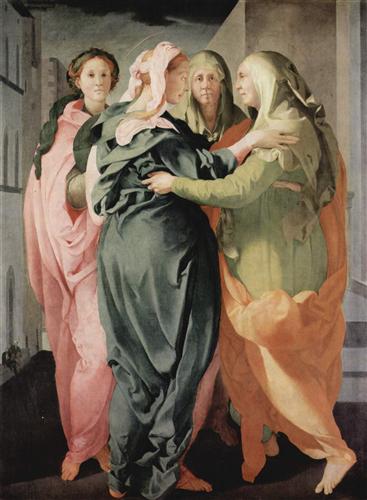
I have just attended an excellent seminar by Dr Chloe Reddaway from the National Gallery in London where she presented a stunning overview of the representations in art of the Visitation of Mary to Elizabeth. Her main aim was to focus on a significant aspect of the theology portrayed in images of that encounter – the New Creation that is brought to birth in Christ and the active part played by these two women in that act of (re)creation. A survey of some couple of dozen pictures brought more theological insight than most exegeses of that biblical text I have ever heard or read. From explorations of liminal spaces depicting thresholds of new life to depictions of the primal void of creation, she showed how art can draw the viewer into an expanding community of those who embrace the already-and-not-yet new creation through their recognition of the creating presence of God within, between and among us.

pontormo2

But I was also fascinated by a side-comment about the carelessness with which most theologians treat our visual expressions of theology. We would never, she said, consign our biblical texts to ‘cultural history’, so why do we do so with our visual canon? She suggested that we should take seriously the challenge to read these works as carefully and as creatively as we read our scriptures. There is, indeed, a growing number of theologians and spiritual writers who draw on our visual canon but it is still not seen as a mainstream activity. This is a great pity, given the potent role of visual art in human expression and in the spiritual quest. Indeed, humanity’s first religious expressions were in cave art, which predates writing.

When I was training to be a priest, I was taught how to read biblical texts in their original languages, how to interpret theologians who wrote about these texts, I was even taught how to sing them! But I was never taught the value of looking at a painting or given the conceptual and analytical tools to interpret it. I have tried to pick some of these up along the way because I like to look at great art – it moves me and draws me into contemplative modes of seeing – but it would be wonderful if we gave more people more confidence in looking at a work of art and seeing it as a primary piece of theological expression and exploration.

I hope the kind of vibrant and creative theological work done by people like Chloe Reddaway is the beginning of a new and mainstream focus on the visual means at our disposal to encounter the Word made flesh.

God and Equality

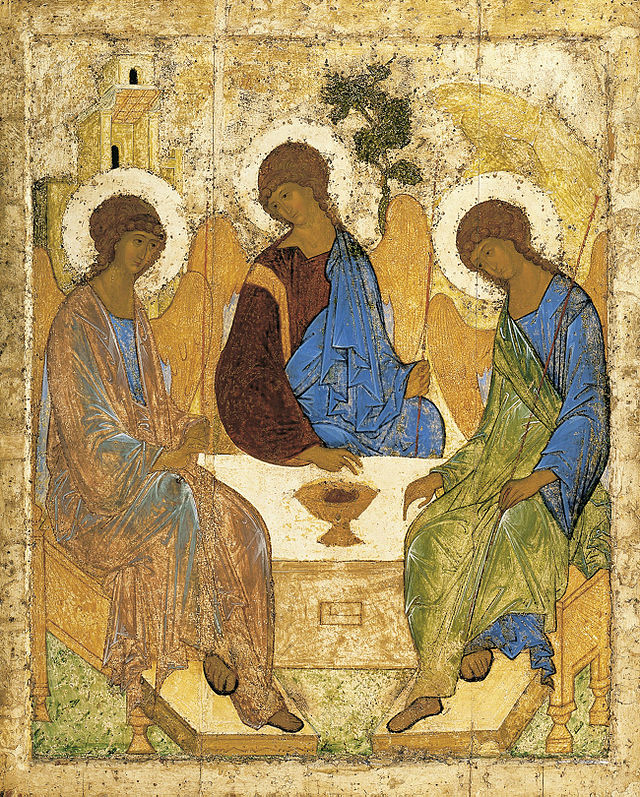
I have been puzzling about the church’s struggles to express the equality of all when we know that the equality of persons in the Trinity looks something like this:

Rublev Trinity