On the uselessness of priests

At a time when there are increasing pressures on priests and ministers to be professional, with those who have no experience in the ‘real world’ being particularly suspected of having nothing of any use to offer, I would like to make an appeal to the urgent necessity of clerical uselessness!

  • The priest has nothing to offer. He or she is only there to serve as a symbol of what is of absolute value.
  • The priest has nothing to give. Each of us has all that we need to become the fully free human being we are invited to be. But it does help to have someone to remind us of this from time to time.
  • The priest is primarily engaged in useless ‘activity’. Prayer, the primary business of priests (which isn’t to say that it’s not everyone else’s primary business), has no value in the world – it has no goal, no measure, no purpose and no standard. It accomplishes nothing more than is accomplished by a bird of the air or a flower of the field.
  • The priest has no specialism, no professional accreditation. All that matters is that she or he is conscious of standing in a lineage of those who commit themselves to way of being. As Zen teaching would say, it’s a matter of mind-to-mind transmission, not special learning.
  • The priest is incompetent. In matters of spirituality, who is competent? All that matters is that the priest has an awareness of a Great Doubt – a fundamental sense of our deepest longing – and a Great Faith – a fundamental sense that this longing can be directed towards something fulfilling.
  • The priest has no work plan other than to be present.
  • The only work a priest claims to do is absurd, because it claims to be the ‘work of God’.

The strange thing is, I think the church needs this particular brand of uselessness. And I dare to suggest that those not in the church are crying out for it too. Well, that’s enough for now. I’m off to sit in silence on a cushion for half an hour. What insanity!

Practice Makes Perfect

In a fascinating piece in today’s Guardian, Tim Harford makes a very compelling argument for caution as we develop an ever more automated life for ourselves. Using the example of a tragic airplane crash where the pilots had lost the skills necessary to intervene when the autopilot handed back control to them, he urges a different approach to the use of automation in such developments as the driverless car. The problem is one that any musician or sportsperson will recognise: when you don’t practice your physical skills, you lose the ability to react well when instinctive responses are needed. It’s one thing to know in your head what you need to do, quite another to have the physical skill to enact what you know. In particular, he suggests that it is the process of regularly navigating complex or dangerous situations that prepares us for more extreme challenges. Those who have read John Irving’s book, A Prayer for Owen Meany, will remember the eponymous hero’s regular practising of ‘the move’ that he knows will someday become a matter of life and death (I won’t say more so as not to spoil the plot!).

It is no coincidence that Zen ‘practitioners’, in common with many other Buddhist traditions, speak of their ‘practice’ rather than their ‘faith’. What we do sitting on a cushion every day is nothing more nor less than practising life. It’s not a question of ‘getting our heads straight’ about life or refining our ideas about life, it’s a question of practising what it means to be alive, free from notions and attachments, free simply to live in the present attentively. This is as much a physical as a mental practice (if one can talk of these things separately) which develops our capacity to be fully present and can stand us in good stead for those times when all we want to do is be somewhere else rather than face what is in front of us.

I am not what I think I am

Zen has a rather stark response to any attempt we might make at saying that this or that ‘is who I am’. Am I my job? No, that’s not it. Am I my temperament, my likes and dislikes? No, that’s not it. Am I my religion, my relationships, my memories or my history? No, that’s not it. Am I then the totality of all these things and many more besides? My body, my intellect? No, that’s not it.

img_20160523_115706

So what is the answer to the question, who am I? There isn’t one. Or if there is, it’s not one we can know. If, in Christian language, we say ‘I am a child of God’, does that get us any closer? Well, in one sense it does, in that it doesn’t give us any kind of precise answer but does remind us of our common humanity, our fraternity, with all other children of God. But I think there is great wisdom in shifting attention away from the question as it is formulated. For one thing, such a question risks leading us down the path of wondering what it is that makes ‘me’ unlike ‘you’, a path of differentiation. I don’t think our identity consists in such separations.

If our response to the question ‘who am I’ is ‘I don’t know’, we are probably getting closer to truth. ‘I’ am not primarily a ‘knowing’ being, contra Descartes, but a ‘being’ being. So perhaps the question is better put as ‘how shall I live’ than ‘who am I’. In sitting zazen, we let go of the notion that we are a mind controlling a body and simply realise our existence. Indeed, one gets to the point of no longer even saying ‘I am’, but simply ‘am’ and then, perhaps, to the point of saying nothing at all. It is in the place of such self-forgetting emptiness that we touch the true fabric of life, the generative, spacious emptiness from which life springs (formless and void, to use the language of Genesis!).

But at a very practical level, there is a great simplicity and a great relief in simply letting go of the kind of self-preoccupation that places a question of our identity at the heart of life. It turns out that we realise our true identity by not fretting about it. Somewhat like ‘the birds of the air and the lilies of the field’ as one perceptive teacher once put it…

Do Not Do What You Are Told!

The question of how one shapes one’s life according to one’s principles and insights, religious or otherwise, is a perennial one. In Western terms, we can sometimes have a tendency to think that the basic pattern is to implement our ideas, in other words, to do what we are told. We are told to act in a particular way, let’s say by criminal law, or the rules of a sports governing body, or the Ten Commandments or the Beatitudes, so all we have to do is to know something then do it. The problem is that this doesn’t work. I regularly tell myself to be more organised. I know I need to be more organised and I know how to be more organised, but I don’t do it. It’s the same thing with compulsive or addictive behaviours. We know we shouldn’t do them, but we keep on doing them all the same.

So I come to the conclusion that it’s our model that’s wrong. Maybe the whole business of transforming our lives is not a question of having the right ideas and implementing them, but of changing our way of seeing things by first changing our way of doing things. In other words, we need to learn that the business of life is a question of practice or, to use an old-fashioned religious term, discipleship. By practice, I mean the business of repeatedly doing the right thing again and again, starting with one characteristic and defining thing. In Zen practice, that one defining thing is sitting – seated, non-discursive meditation. Why should this be such an important foundation of our business of engaging with life as a matter of practice? Well, put simply, because we know it works from those who’ve tried it. I know that’s not a very clever answer, and I’m sure I could come up with other reasons, but this is a rather compelling one.

https://i0.wp.com/ileauxepices.com/blog/wp-content/uploads/2013/01/Bodhidharma.jpg

Well, maybe I will give just one or two other reasons why this kind of practice might be foundational. The main one is that this very simple practice is a way of trying out a way of living that is free from compulsion, free from our fixation with ideas and free from grand aspirations. When we sit still, breathe deeply and do not entertain our thoughts as they come and go, we learn the simple path of attentiveness. It seems to me that pretty much everything else flows from that. Of course, to set out on a course of action to change our behaviour requires that we want to change it in the first place, but even then I think it is possible to learn more about how much we want to do something simply by beginning to do it. So be a practitioner, a disciple, a beginner!


In Praise of Mono-Tasking

When I worked as a college chaplain, one of the colleagues who impressed me most with his very earthed spirituality was our head gardener. The college had extensive grounds and plenty of work to keep Michael and his team busy, but the one thing he made sure he did every day was to place fresh flowers around the building. In this simple task, he brought colour and beauty to the place and, as a useful by-product, he brought visibility to his own team’s work and put himself in the position to bump into members of the college on a daily basis. He gave himself to this task with quiet attentiveness and unfussy concentration.

In spiritual terms, this quality could be described as ‘purity of heart’ – doing one good thing with our full attention. In fact, I think that the discipline of doing one thing well is far more demanding than the more commonly praised skill of  multitasking, of doing many things at the same time. It is very easy to be doing too many things at once. As soon as we let our minds drift to the next thing on our agenda, we have ceased to do the current thing with our full attention. This is particularly problematic when that one thing is to be present to another person.

In Zen, the daily practice of zazen schools our minds and bodies in the art of doing just one thing with our full attention, but this should never be the only thing we do in this way – it is a skill for all of life. As Jesus had it (I paraphrase!), ‘seek first the Realm of God and everything else will fall into place’. The thing we are doing right now is always the ‘one thing necessary’.

Wisdom in Dialogue

Today I want to shamelessly steal some words by the great prophet of dialogue, Raimon Panikkar. These words preface his collection of essays on ‘The Intrareligious Dialogue’ and are a sort of ‘sermon on the mount’ for those undertaking such dialogue. However, they stand on their own as deep wisdom for all who seek an authentic religious path in our complex and multi-religious world. He uses the word ‘intrareligious’ in recognition of the common impulses and instincts we find with the ‘thou’ who is our partner in dialogue.

When you enter into an intrareligious dialogue, do not think beforehand what you have to believe.
When you witness to your faith, do not defend yourself or your vested interests, sacred as they may appear to you. Do like the birds in the skies: they sing and fly and do not defend their music or their beauty.
When you dialogue with somebody, look at your partner as a revelatory experience, as you would- and should – look at the lilies in the field.
When you engage in intrareligious dialogue, try first to remove the beam in your own eye before removing the speck in the eye of your neighbour.
Blessed are you when you do not feel self-sufficient when in dialogue.
Blessed are you when you trust the other because you trust in Me.
Blessed are you when you face misunderstandings from your own community or others for the sake of your fidelity to Truth.
Blessed are you when you do not give up on tour convictions, and yet you do not set them up as absolute norms.
Woe unto you, you theologians and academicians, when you dismiss what others say because you find it embarrassing or not sufficiently learned.
Woe unto you, you practitioners of religions, when you do no listen to the cries of the little ones.
Woe unto you, you religious authorities, because you prevent change and (re)conversion.
Woe unto you, religious people, because you monopolise religion and stifle the Spirit, which blows where and how she wills.


The Contemplative’s Crucifix

In the Christian West, our most central devotional image, that of the crucified Christ, usually carries two major resonances. One is theological: it represents the salvation of the world through the loving self-offering of the Saviour in his victory over death. The other, more devotional resonance is of the suffering of Jesus and most representations of the crucifix have this character – the suffering of Jesus is shown powerfully and graphically as he bears in his own tortured body the suffering of the world. However, this emphasis is surprisingly late in Christian art. It is really only from the 13th century or so that we see Christ depicted more consciously in his suffering. Until then, his image was not one of pain but of victory, even to the extent of showing him crucified as a king.

Perhaps the most famous example of this earlier form is the crucifix before which St Francis heard his call to rebuild the church, which hung in the church of San Damiano. This powerful image can still be seen in the Basilica of St Clare in Assisi.

https://upload.wikimedia.org/wikipedia/commons/3/31/Kruis_san_damiano.gif

It is surprisingly large, almost 2 metres tall, and is rich in symbolism and narrative. The art shows strong influences from the Christian East and shows how close the iconographic traditions of the churches were at that time. Incidentally, this tradition has been revived in the icon painting of the ecumenical community at Bose in Italy. But I don’t want to get distracted into art history because my purpose in sharing this profound image is a spiritual one.

I have often felt that it is a pity that Christian art does not have an equivalent of the Buddhist iconography of the Buddha Shakyamuni in meditation. Jesus is shown teaching, healing, at supper with his disciples, on the cross, risen, but only very rarely at prayer. Given how often the Gospels refer to his withdrawal by himself to pray, this is surprising. But in revisiting this image, which has held a very important place in my own spiritual journey for about three decades, I has struck me with a great force that this is the supreme image of Jesus in meditation! The Jesus who emptied himself and took the form of a slave is here depicted in that boundless and loving emptiness. Stripped of all outward embellishment, he stands erect, open-eyed, open-armed, serene, united with the Father and with all of life, not in suffering but transcending suffering. This is Jesus-Sunyata: having let go of all things, even life itself, he fills all things with his boundlessness. This is the-one-who-does-not-cling (Phil 2:6) and is therefore open to all in unbounded compassion. This is how he saves – not through some legal-theological process, but by the utter poverty of self-emptying love. Suffering and violence are transcended by the complete renunciation of the savage system of blame and revenge that can sometimes pass for justice, and peace is realised through the courage to enter the unknowable void of egolessness.

The Seed has fallen into the ground and has died. It has let go of life that Life might flower.

Bede Griffiths and Godly Paradox

I think it is fair to say that Bede Griffiths was one of the 20th century’s most notable religious pioneers, a true adventurer in the deepest realms of human existence. The experimental monastic community in Tamil Nadu he inherited from his spiritual forebears, Jules Monchanin and Abhishiktananda, combined the life of a Hindu Ashram with Benedictine monasticism but this was not only an experiment in the external aspects of inculturation. What Bede sought to embody was the true coming together of religions in his own person. His goal was the reconciliation of opposites in advaita, non-dualism, a profound level of unity in which all things are held together. In part, he was motivated by what he saw as an excessive reliance in the West on rational processes and their resulting technologies. Ever since an early experiment in simple communal living with two friends in the 1930s, Bede shunned many of the products of industrial activity. Indeed, when he entered Prinknash Monastery shortly after that experiment, he was appalled by the comforts of a monastic life that was considered by many to be exacting! He felt deeply that Westerners, Christians included, had lost touch with the fullness of human life, losing confidence in the darker and intuitive aspects of the human psyche in favour of control and reason.

Bede went to India to find ‘the other half of his soul’ and this journey, a life’s journey, was one of unifying feminine and masculine, ordered and spontaneous, light and dark, intimate and self-contained aspects of his person. In religious terms, he insisted on using texts and symbols from other religions in the Ashram’s liturgies. One of the most potent of these symbols was the cross outside the Temple at Shantivanam:

The use of the sacred syllable, Om, in the middle of a Christian cross aroused anger from conservative Hindus and Christians. And, despite Bede’s unstinting commitment to welcome all who came, some found this desire to embrace all religions as fundamentally expressing one great Truth to be completely unacceptable. Bede dealt with considerable levels of conflict in his life and I suppose this is inevitable for those who try to hold ‘opposites’ together in their own person. For those whose faith is ‘this and this only – never that‘, Bede’s insistence on true faith as always residing in ‘this-with-that’ poses a deeply uncomfortable threat.

For Christians in particular, Bede’s exploration of non-dualism asks hard questions of traditional Christian polarities such as evil-good, law-gospel, dark-light, human-divine, death-life, creator-creature. Do these melt away into an indistinct singularity? I think Bede’s answer would be that distinctions remain, but in constant relationship, in ultimate unity and sometimes in painful tension. To use a phrase from Teilhard, ‘union differentiates’. All the same, the truest reality, the reality we call God, is one. This means that human fulfillment is found in the unity of opposites, the reconciliation of contradictions and the fearless of embrace of paradox.

On Giving up Prayer for Lent

https://c2.staticflickr.com/8/7265/7586726888_a17ba4e9c6_b.jpg

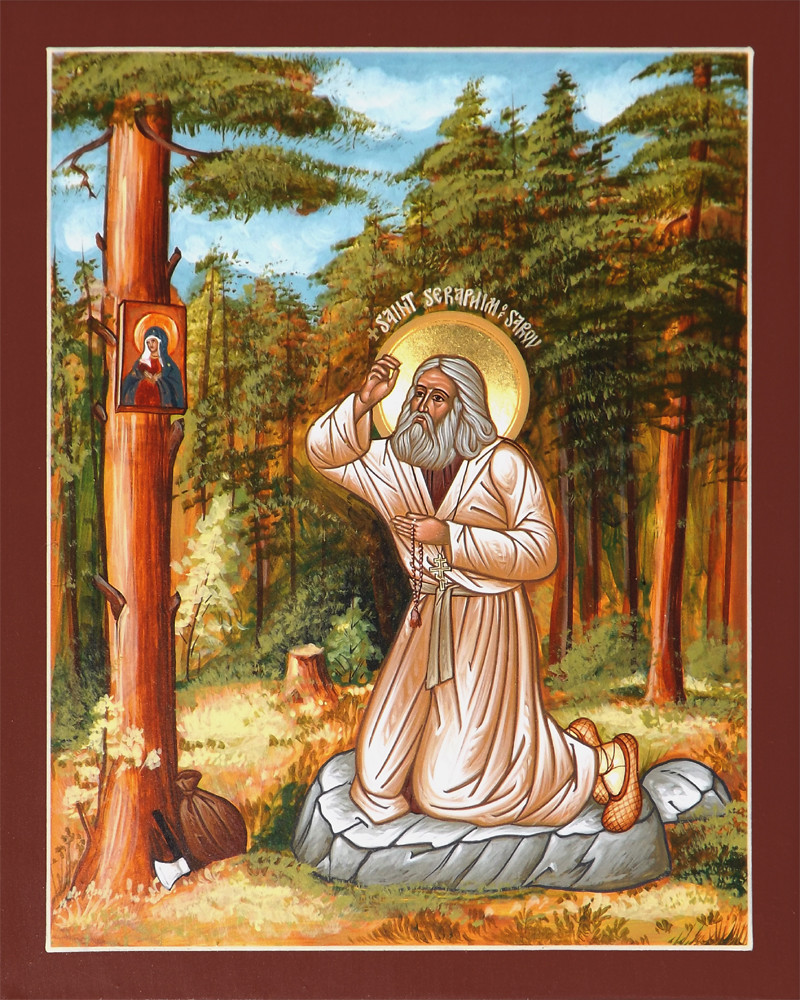
One of the most extraordinary testimonies of spiritual encounter in the Eastern Christian tradition is Nicholas Motovilov’s meeting with St Seraphim in the forest near Sarov in November 1831. Famously, this dialogue between the staretz and his disciple culminates in an experience of divine light, radiating from both men as they are filled with warmth, peace and calm. But in the course of their conversation, Motovilov records some remarkable words from Seraphim about the practice of prayer. In speaking about the mystical gift of stillness, he says:

Many explain that this stillness refers only to worldly matters; in other words, that during prayerful converse with God you must ‘be still’ with regard to worldly affairs. But I will tell yo in the name of God that not only is it necessary to be dead to them at prayer, but when by the omnipotent power of faith and prayer our Lord God the Holy Spirit condescends to visit us, and comes to us in the plenitude of His unutterable goodness, we must be dead to prayer too.

This last phrase is one of the most startling expressions of apophatic theology in Christian tradition, but it is entirely in keeping with the experience of many that it is only in letting  go of what we think of as prayer that we truly enter the fullness of divine reality. No words, no images, no thoughts, no intent of gain, no technique, no activity, only complete stillness of body and mind and a radical emptiness or openness.

It is very hard indeed for us to ‘do nothing’ in prayer. We want to be in control, to have an outcome and to feel that we have accomplished something. And surely when the world is in a big mess, the impulse to ‘do something’ is even greater. Paradoxically, however, the act of radical letting go that is true prayer is the only way to turn our own hearts from the dangerous notion of an isolated self and to realise the fundamental connectedness of all things. We let go of the idea that I am here, you are there, God is somewhere else and prayer is some kind of negotiation between these separate loci. Without such a metanoia, we remain the realm of oppositions, a realm that too easily becomes a power struggle. In prayer – in giving up prayer – we let go of all such notions of power over-against another and open ourselves to compassion. Christ Jesus, ‘who emptied himself, taking the form of a slave’ showed us the way and invites us to do the same. One simple way to train ourselves in such a demanding way of life is to give up our notions of prayer in order truly to pray in the utter stillness of compassion and trust.


On Duelling and Dualism

Why do we love to see things in terms of either-or rather than both-and? It seems that we have a bias towards oppositional understandings and I struggle to know to what extent this is coloured by cultural norms and to what extent psychological ones, as if it were possible to separate these things out! In any case, Western thinking, including Western religious thinking, often seems to opt for a binary model of reality. There are winners and losers and no one wins unless and until another loses. This kind of zero-sum-game is played out in so many different contexts that it’s hard to choose only one as an example. Our British political culture, of course, sets out this binary model in graphic terms with an ‘opposition’ whose job, over-against that of the government, is to contradict those sitting on the other side. The symbolism of our House of Commons is unmistakable. This is a kind of ‘social darwinism’ of the worst sort.

In religious terms, to pick up a theme from a previous post, we resist pluralism on the grounds of a perceived ‘incompatibility’ between faiths and imagine that it is only in exclusive claims of univocal truth that we thrive over against those of other faiths. I cannot be ‘right’ unless there is someone else out there whom I know to be ‘wrong’.

Of course, this kind of thinking almost inevitably leads to conflict or even to violence. So is there another way? Beginning at that most extreme end of the spectrum, where there is division that has led to a high level of conflict, Jesus introduced his most revolutionary religious idea: love of enemy. There can be no peace that is not also good for my enemy, no solution that does not include my enemy. And our love for enemy is founded on a fundamental challenge to the notion of our complete separation from our enemy. Our ‘enemy’ is our neighbour, whom we are to love ‘as one who is like ourselves’ (a better translation, I think, of the Hebrew, k’mocha). I am not separate from my enemy because I, too, am an ‘enemy’. Put more positively, I am not separate from my enemy because I share their fears, their hopes, their very nature. We are of the same stuff as those we hate.

Buddhism is, I think, correct in diagnosing our problems as being rooted in a wrong view of our understanding of reality. We imagine our ‘selves’ to be separately existing entities when, in fact, all of life exists in a fundamental flow of connectedness. We project our hates and fears onto others as if they are the cause and source of our hates and fears. They are not: these things come from our own distorted perceptions. So the solution is to change our perceptions or, to use a more loaded Christian word, to repent. We simply have to change our minds and we do that by letting go of our mind as a separated, protected thing. There can be no compassion without a radical openness to the ‘other’ that is able to see that there is, in fact, no ‘other’ at all!