Natural Intelligence

Most of us are temperamentally cautious about things that are described as ‘artificial’ – sweeteners and additives come to mind, or smiles, or grass – and we have a hunch that they might not only be a diminished form of the real thing, but possibly also harmful to us. Might this also be true of the phenomenon we are calling ‘artifical intelligence’? Despite an overwhelming enthusiasm for this phenomenon from people who stand to make rather a lot of money out of it, and, indeed, those whose support for it is tied up with political power, does the instinctive resistance that many of us feel have something of value to say to us?

I feel ill-euipped to speak intelligently about AI because I do not use its more obvious manifestations, but none of us, or at least none of us who are digitally connected in any way, are untouched by its increasing reach.

My first concern, that artificial things probably don’t measure up well against the real thing, is seen most clearly when AI is used to generate artefacts that are more normally the product of human imagination and craft. To ask whether the AI version of a song or an image is ‘better’ than one made by human hands is the wrong question. Surely, the question is ‘why do you want to have a machine do something that brings joy, purpose, meaning and expression to human life?’ And why would one want to have a machine create something that lacks the flaws, bumps, cracks, idiosyncracies and imperfections that give texture and truth to the real thing? I have no doubt that some generative AI system could add these in for you, but they would be, by nature, false, planned, cynical. I fear that the only answer I can find to the question of why one would want to do this is that the mass production of cultural ‘content’ that AI allows rewards the tech company. Human creativity, by contrast, is slow, inefficient, hard to monetize.

My second range of concerns, that AI might actually be harmful to us, belongs more to the realm of human consciousness. In particular, the way AI operates is based on a reductive understanding of intelligence as the processing and accumulation of bits of information. It is the ultimate triumph of reductive rationality to banish the unpredictable elements of human feeling and intuition from the process of knowing. But it also lacks the capacity in human consciousness for knowing how the parts fit into the whole, and lacks the vital element of judgement that comes into play when weighing up one thing against another in terms of its importance or relevance. Quite literally, it sees everything and understands nothing.

This manifests itself in the use of AI in diagnosis of disease, where the clinicians skill, experience and empathy are as vital as measurable data, if not more so. AI does not ‘have a feel‘ for something that is out of sorts in a person’s illness.

I have no doubt that there are some mechanical things that AI can do better than fallible human beings, and it may be that autonomous vehicles will be an example of that. But there are some very human things that AI will never be able to replace, however effectively and efficiently it may seem to replicate these human practices. One very powerful example of such a practice is prayer. Of course an AI chatbot can produce a prayer, but it simply cannot pray. It has no soul with which to reach out to God, no unmet desire that drives it to seek the Ultimate. Above all, it cannot love. Your chatbot can say that it loves you, but cannot feel your pain, it cannot weep at your sorrows, it cannot die for you. AI’s inability to suffer is what makes it less than, not more than human.

But enough of the negativity! The truth is that wherever there is something artificial, there is usually something much better – the natural and original version. And in the case of intelligence, the natural intelligence that AI cannot replace is not the focussed, counting, data analysing kind, but the imaginative, meaning-making, intuitive kind. AI is very much a version of the brain’s left hemisphere and whenever it appears to be demonstrating the right hemisphere’s activity, it is merely producing a facsimile of it based on the agglomoration of many instances of its outputs. Or, to use a more traditional way of describing it, AI lacks nous. This spiritual intelligence is what reaches out beyond us, transcends the mere surface of things, and perceives the Ultimate. AI, as a response to the restless desire at the heart of humanity, seeks efficiency and the elimination of friction. The nous, our natural mind, knows better: our restless minds can find rest, but only in the One who made us for himself, one who descends into the depths of human suffering to transfigure it. That pattern of healing only through love-to-the-point-of-death is something AI can never know.
Evil Does Not Exist

To say that evil does not exist is not to say that there is no evil in the world, but to say that it has no ‘existence’ other than what comes into being through our actions. This is an important piece of Christian theology that is often neglected, but sits right at the beginning of S. Diadochos’s Gnostic Chapters. Chapters 2 and 3 explore the human capacity for good and evil and Diadochos is clear that these are not equal and opposite realities. He insists that human beings are not naturally evil but can create evil through the desire of the heart. But his first principle is that human beings can become good through ‘careful attention to their way of life’, and can be united to God, who is good by nature. Because goodness exists naturally, it is more powerful than inclinations towards evil, which is not natural because it is not created by God. In other words, evil is an absence of good, or a distraction from what is good.

Now, all of this might seem like semantics, because we all know – very painfully – that evil does exist in our world. However, I think it completely changes our outlook on other people if we get away from the idea that they are fundamentally evil. Evil is a distortion of our truest nature, not part of it. And in practical terms, at least on an interpersonal level, it makes sense to me that we overcome disorder in our relationships and communities not by focussing primarily on wrongful actions, but by nurturing goodness. I don’t pretend to have insights on how this might scale up to the level of, say, criminal justice, except to say that this kind of thinking would give greater weight to rehabilitation than might be popular among politicians [see Gwen Adshead’s Reith Lectures], but I find this approach helpful on a more immediate level. And that immediate level for Diadochos, as for Desert Mothers and Fathers, was, very clearly, one’s own actions, one’s own behaviour:

We transform ourselves into what we are not when our soul, by devoting its attention to true delight, unites itself to God, so far as its energized power desires this.

Our transformation begins in delighting in God!

Through Lent with S. Diadochos

For my Lent reading this year, I thought I might undertake a slow reading of a 5th century text by a Greek bishop whose influence is far more signifcant that his relative obscurity might suggest. S. Diadochos was bishop of Photiki, which is on the edge of modern-day Paramythia in north-west Greece, not too far from the Island of Corfu. His time in history was a troubled one, with the Council of Chalcedon taking place in the middle of that century and in relation to which Diadochos wrote against the so-called monophysite position [with my love of the Oriental churches, I have my own views on this, which I’ll keep for another occasion!]. It’s possible that Diadochos was taken away by pirates to North Africa towards the end of his life, but this is not certain.

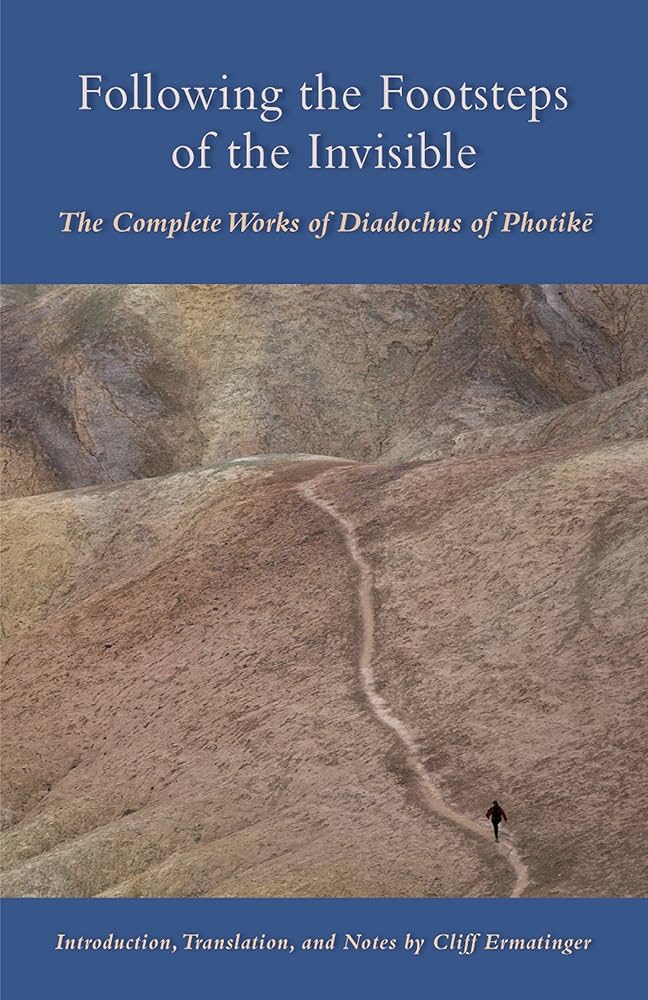
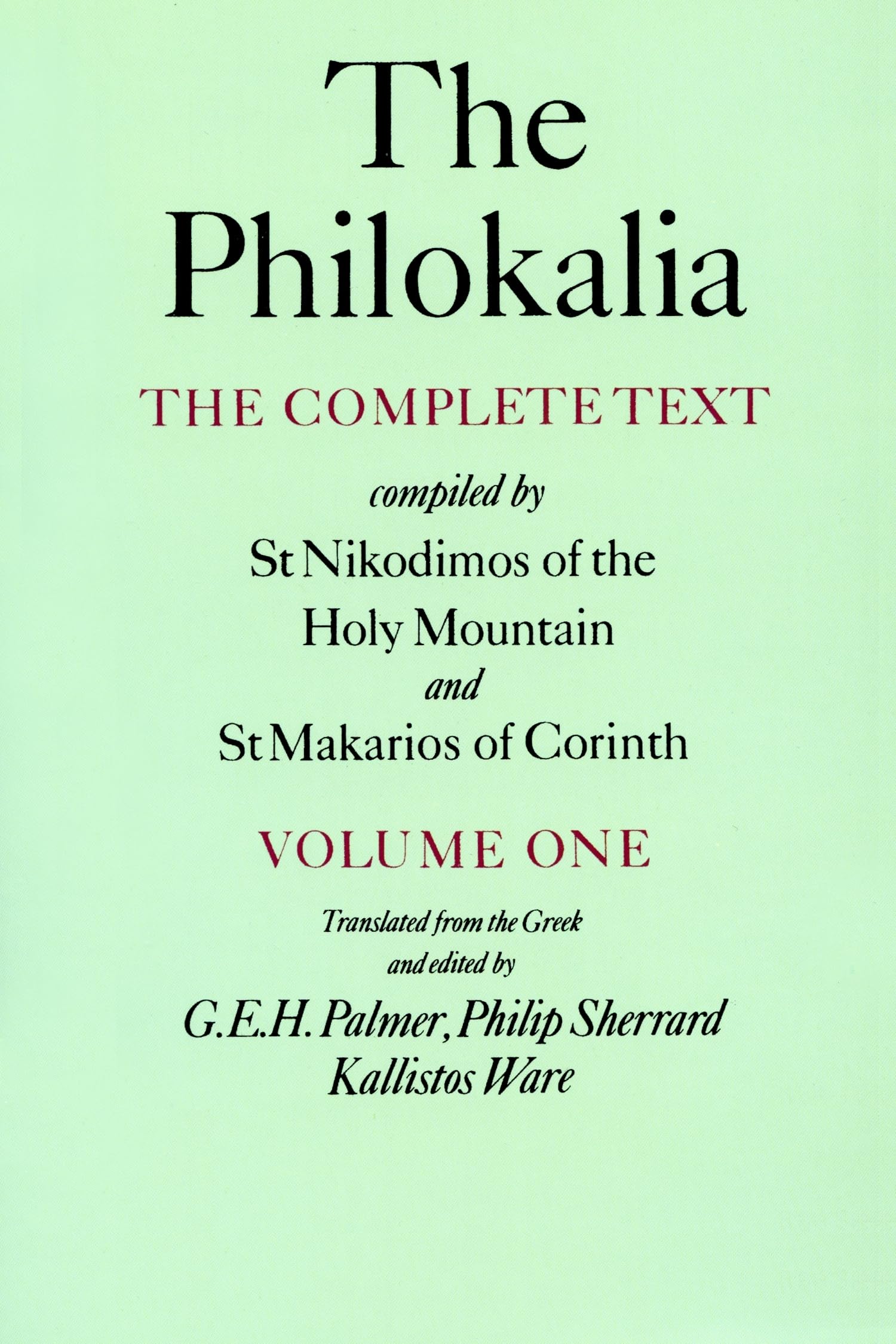
What is certain is that he left a small number of mystical works, one of which – his century of texts on spiritual knowledge and discrimination, or the Gnostic Chapters – found its way into the Philokalia where it is easily to be found in English translation in the first volume of that compilation. The complete works are also available in a later English translation by Fr Cliff Ermatinger (Cistercian Studies 239). It is this text that I want to explore over the coming weeks and I’ll try to post as regularly as I can, as it is clear to me that this short work is very rich indeed.

Diadochos writes elegantly, with some memorable images to illustrate his points, though the langauge can be technical, sometimes using the terminology of Evagrius of Pontus. His approach is a wonderful via media between head and heart, offering a positive but realistic anthropology and teaching a very practical way of prayer. Indeed, it is that last area in which Diadochos may have had the most lasting influence, as he is the first known proponent of what became known as the Jesus Prayer.

As a wee taster, the first ‘chapter’ reads as follows:

All spirital contemplation should be goverened by faith, hope and love, but most of all by love. The first two teach us to be detached from physical delights, but love unites the soul with the excellence of God, searching out the invisible by means of intellectual perception.

The word translated ‘searching out’ is, in fact, the verb ‘to track’, as a hunter would his prey! The human search for God should have the same focus and stedfast motivation as that hunter. And the governing principle of love reminds us that, in Greek thought, love is also a kind of knowing, an ‘intellectual perception’ as much as an emotional instinct. At times, Diadochos also uses the language of erotic desire to indicate our passionate search for God. So, right at the beginning of the text, we invited to join in the hunt, to commit ourselves to the pursuit of God who is love and life, and who calls us into union with him.

Saint Porphyrios – A Saint for Creationtide

In truth, any saint could be a saint for creationtide, as when people draw close to God in Christ, they draw close to the fulfillment of their humanity and, therefore, to the communion we share with all Creation in its Godwardness. So many of the saints express something of that intended harmony with creation, often through their relationship with animals, and there’s a wonderful collection of these stories in Helen Waddell’s book, Beast and Saints.

But since I’m enjoying reading the wonderful autobiographical account of the life of St Porphyrios (1906-1991), Wounded by Love, which also contains some of his teachings, I thought I would share some of his insights. St Porphyrios was a monk of Mount Athos, who began and ended his monastic journey at the Skete of Kavsokalyvia, but spent most of his adult life as a hospital chaplain in Athens. In spite of many trials, his life was one of deep simplicity and joy, as is typified in his description of how much he was enchanted by the song of a nightingale: ‘How marvellously you unceasingly carry on your duty, your prayer to God!’ The little bird sang with no one but its creator to hear it and the saint was moved to holy tears, a gift of grace as his heart ws opened by the ‘sweet, intoxicating voice singing and praising the Creator.’

He described nature as the ‘secret Gospel’ to which we are called to give our loving attention:

All things are holy – the sea, swimming and eating. Take delight in them all. All things enrich us, all lead us to the great Love, all lead us to Christ.

This sense of attention is key to Prophyrios. Spiritual peopole notice all things beacuse they ‘wish to be together with all things’. So the attentiveness they exercise is not so much a practised skill as a gift of grace, a spiritual way of being.

The theological vision of St Porphyrios is beautifully summarised in this paragraph:

When you find Christ, you are satisfied, you desire nothing else, you find peace. You become a different person. You live everywhere, wherever Christ is. You live stars, in infinity, in heaven with the angels, with the saints, on earth with people, with plants, with animals, with everyone and everything. When there is love for Christ, loneliness disappears. You are peaceable, joyous, full. Neither melancholy, nor illness, nor pressure, nor anxiety, nor depression, nor hell.

So I Long…

After a sermon recently, a parishioner confidently told me that I was wrong in suggesting that human beings can do anything to draw near to God – the traffic is only one-way and God comes to us when we don’t expect it. Whether wittingly or not, he had wandered into one of the perennial conundrums of the spiritual life, and one which I’ve explored before on this blog: is the human-divine traffic only one-way or is there room for human effort in the mystery whereby we encounter the living God?

Sometimes the conundrum is phrased in terms of a human ascent in stages towards the God who has already, in descending, opened the path towards that transformative encounter. Sometimes it’s framed as a debate about God’s grace, given to us who do not merit it and who can do nothing to attain it, though no orthodox Christian teachers would deny divine initiative in this life-giving meeting. Some have taught that the spiritual life is mostly one of struggle against the passions, with the experience of loving union with God only coming towards the end of our lives, and some deny that it is possible to experience anything at all of divine light in this world.

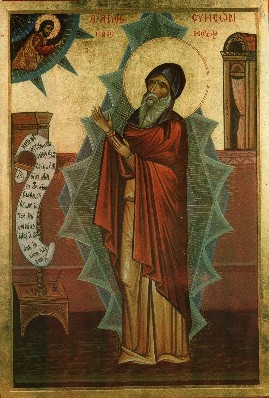
One distincitive voice in this discussion is that of S. Symeon the New Theologian (949-1022), an unconventional monk who was a subtle inheritor of the traditions of Origen, Evagrius and Pseudo-Dionysius, who had his own fair share of controversy over this matter. He taught that anyone could be the recipient of an experience of divine light in this world, not only those who had striven for it through ascetical struggle. Indeed, it is the will of God that all his children should experience the transfiguring light of his mercy. The human being is not, however, without agency in this matter. Indeed, he was clear that we will not experience this divine illumining unless we desire it and unless we undergo a metanoia, a repentance. So, although Symeon may seem like one who undermines the notion of a pattern of staged progress towards being united with God in love, a path of ascent towards our theosis, there is ‘work’ to be done by the human person, and that is the ‘work’ of desiring God and turning towards him, the one who is already there for us.

Fr John McGuckin’s excellent article on Symeon’s Hymns of Divine Eros summarises his spiritual teaching in this way:

Symeon’s great contribution to Christian spirituality, therefore, is how the incomprehensibility of God is defended not by insisting on God’s inscrutable absence from the earthly creation, but by celebrating the manner in which an incomprehsibly deep mercy reaches into the heart of alienation and returns the human soul to its correct purposes: the vision of the Creator. [in the 3rd volume of his collected essays, Illumined by the Spirit, SVS Press, 2017]

Symeon writes from the perspective of one who has experienced the divine light and who wishes others to feel that presence for themselves. It requires only readiness. I guess that, for some of us, that state of readiness entails a little more work than for others, as there may be all kinds of barriers in the way of that desire. But God is not out of reach!

When we try to speak of how it is that we enter into a life-giving encounter with God, we draw on our own experiences, as Symeon did, but also on the collective and accumulative experiences of our ancestors in the faith and on the paradigmatic words of Scripture. It is a process we can describe only haltingly, as we are speaking of things we are not able fully to voice. In these accounts, there are many repeated patterns and common threads, but there are also singular examples that don’t fit any mould. This should not surprise us, as we are all different, but there are two general truths we can affirm: God takes the initiative; God usually works with us. With Symeon, I would affirm a third: God desires that we experience his transfiguring light in this life.

Happy New Year!

Yesterday, Sunday 1st September, was the beginning of the church year for Orthodox Christians. In a happy coincidence*, today’s Gospel reading in the Roman and Anglican daily Eucharistic lectionaries was the same one as heard by our Orthodox fellow Christians yesterday:

So He came to Nazareth, where He had been brought up. And as His custom was, He went into the synagogue on the Sabbath day, and stood up to read. And He was handed the book of the prophet Isaiah. And when He had opened the book, He found the place where it was written:

“The Spirit of the Lord is upon Me,
Because He has anointed Me
To preach the gospel to the poor;
He has sent Me to heal the brokenhearted,
To proclaim liberty to the captives
And recovery of sight to the blind,
To set at liberty those who are oppressed;
To proclaim the acceptable year of the Lord.”

Then He closed the book, and gave it back to the attendant and sat down. And the eyes of all who were in the synagogue were fixed on Him. And He began to say to them, “Today this Scripture is fulfilled in your hearing.” So all bore witness to Him, and marveled at the gracious words which proceeded out of His mouth. [S. Luke 4:16-22, NKJV]

What a perfect passage to begin the church year! Christ’s preaching of a gospel to the poor; his announcement of the fulfillment of prophecy in him; the proclamation of ‘the acceptable year of the Lord’.

This last phrase took me back to a book I’ve treasured ever since I got it (October 1990! Sadly, I’ve got out of the habit of dating books when I get them…). It’s Fr Lev Gillet’s ‘The Year of Grace of the Lord’, which is a scriptural and liturgical commentary on the church year in the Eastern Rite. In his introduction, he makes the point – in typically direct Gillet style – that, whether we are considering the paschal cycle or the calendar of saints, ‘The liturgical year has but one and the same object, Jesus Christ; whether we contemplate him directly, or whether we contemplate him through the members of his body.’ He also reminds us that, throughout history, solitaries and ascetics have often either cut down or done without this rich liturgical resource, preferring instead the direct contemplation of Christ. This is a useful reminder of the secondary things on which we can often risk focussing instead of the One to whom they point.

But, using the calendar in the way it is intended allows to say something important at the start of this month:

Jesus, himself, is the embodiment of all deliverance and of all forgiveness. If at this moment I accept his word, his salvation, everything can become new for me. Today: on the first day of the year this offer is made new for me.

*I suspect it’s not really a coincidence – the Gospel reading will always fall close to 1 Sept, but it’s nice that it’s the very next day this year. Next year, the reading will actually be on Monday 1st Sept.

Having Another Sunday Off?

*This is not a rant*

I was standing, in my cassock, next to the vestry while the sacred ministers vested for Mass and a parishioner quipped, ‘Oh, are you having another Sunday off?’ I was a little perplexed at this comment, given that I was in church and not in bed, but then realised that the parishioner assumed I was not taking part ‘up front’ that morning, as sometimes happens in a parish which is blessed with a healthy team of priests. In fact, I was preaching that day and just hadn’t quite got round to donning the rest of my vestments, but this exchange got me thinking.

I responded, as cheerfully as I could, ‘Oh this stuff doesn’t feel like work – it’s the icing on the cake!’ I truly meant that: celebrating Mass or otherwise pariticpting in the Liturgy and/or preaching, does not feel like work to me, by which I mean that is not burdensome but is an enjoyable privilege. I include pastoral work alongside liturgical work – it can be demanding, but doesn’t feel burdensome because it, too, is a privilege and is so often life-giving. The stuff that feels like ‘work’ happens whether or not I am taking a prominent role in the Liturgy that day. It’s the stuff that happens seven days a week and always manages to sneak into days off…

Another reflection I had after this brief exchange is that, for some of those who are not used to the range of activities that make up a normal working week for a priest, the thought of standing up in front of 120 people and saying (let alone singing!) anything at all seems utterly terrifying. It might look like hard work. The truth is, if I was being selfish, I would love to do more, not less of that ‘up front’ stuff but I realise how valuable it is to have a range of voices and perspectives and how fortunate we are to have this option. When I have worked in parishes that require me to prepare a homily every Sunday, I have enjoyed that privilege too. It’s a different kind of discipline and, in some respects, easier because there is less of a temptation to feel that you have say everything every time. Indeed, I find the whole process of reflection, meditation and preparation for preaching very stimulating and spiritually nourishing.

I suspect that I am not alone in finding that the most demanding aspects of priestly ministry are the relatively minor practicalities that can cause anxiety or low-level conflict: administrative tasks that cause little friction in larger organisations; any changes that affect the fabric of the church building; inter-personal tensions that arise from the very human tendency to protect one’s own ‘patch’; misunderstandings that occur when the peculiarities of the church’s institutional culture come up against the expectations of work in other sectors; the projections and expectations that can form when the priestly role is so laden with unexamined assumptions, and so on. I am not naive – all these things go with the territory and need to be attended to with care and seriousness. However, the reason we value the liturgical and pastoral dimensions of ministry is that these things take us to the heart of what it means to live a Christian life. They give us the strength we need to manage the more burdensome things.

So much of priestly ministry is unseen – the quiet daily times of prayer that are the life-blood of any spiritual discipline; those profound, grace-filled encounters with people as you accompany them and bear witness to the precious details of their life; the careful study of scripture and spiritual reading without which nourishment you have little to offer; the daily tasks of administration – that phone call to the fire alarm company, that meeting with the pest-control man; the conversation with a local third sector organisation about unmet need in the community; the fourth committee meeting that week; the formatting of a liturgy booklet; the word of encouragement to a colleague; the gift token sent to celebrate an anniversary. The ministry that is much more visible – Sunday Mass, weddings, funerals – depends on the quiet daily disciplines but also feeds the invisible work. This is most particularly true of the Sunday Liturgy in every one of its many facets. The assembling of God’s people to offer the sacrifice of praise and to be nourished by the Word of Life and the Bread of Life, the Body of Christ fed by the Body of Christ, is a wonderful mystery and an immense privilege. It doesn’t feel like a job to me!

An interrupted life?

Etty Hillesum kept a diary of her experiences in the early 1940s in the Netherlands as a young Jewish woman caught up in the events of the Holocaust. That introductory sentence tells you almost nothing important about the remarkable testimony contained in these diaries, because Etty’s account is not simply that of a victim, but is the narrative of a conversion experience, the reflections of a deeply thoughtful and philosophically sophisticated woman, the insights of a mystic, the testimony of a unique chronicler of her times.

Etty’s inner journey over the short period covered by her published diaries was a remarkable one because of its scope: she begins her reflections as a somewhat self-absorbed and chaotic individual and ends them as a truthful, compassionate witness to the horrors around her who, nonetheless, refuses to hate any of the perpetrators of that horror. Her descriptions of contemplative prayer and language abot God are luminous and memorable, revealing a highly refined mystical sensitivity formed by a potent mixture of scripture, Rilke, Jung and Dostoevsky. It was phsychotherapy, not religion that led her in this direction, though her interactions with her therapist, friend and love, Julius Spier, are more than a little irregular! Here is one passage that spoke to me:

‘It’s not so simple, that sort of ‘quiet hour’. It has to be learnt. A lot of unimportant inner litter and bits and pieces have to be swept out first. Even a small head can be piled high inside with irrelevant distractions. True, there may be edifying emotions and thoughts, too, but the clutter is ever present. So let this be the aim of the meditation: to turn one’s innermost being into a vast empty plain, with none of that treacherous undergrowth to impede the view. So that something of ‘God’ can enter you, and something of ‘Love’. Not the kind of love-de-luxe that you revel in deliciously for half an hour, taking pride in how sublime you feel, but the love you can apply to small, everyday things.’

I will have much more to write about these diaries in the coming weeks, but I wanted to comment on the title given to the edited version, published in English in 1983, which also includes a selection of Ettty’s letters. It’s title is ‘An Interrupted Life’ and there is certainly the sense that the life of a woman of such talent and insight dying in such appalling circumstances at the age of 29 was tragically interrupted. Etty is well aware of her likely fate, though she does express the hope that she will survive in order to give a full account of the events through which she lived. However, there is also a sense in which her life was not ‘interrupted’ because she had such a powerful awareness of the necessity of living each new day as fully as possible: ‘Let me use and spend every minute and turn this into a fruitful day, one stone more in the foundations on which to build our so-uncertain future.’ She was fond of Jesus’ teaching about the lilies of the field and the birds of the air from the Sermon on the Mount. And she could speak of how one simple life can contain the whole of life: ‘I am with the hungry, with the ill-treated and the dying, every day, but I am also with the jasmine and with that piece of sky beyond my window; there is room for everything in a single life.’

Etty Hillesum’s life embraced such fullness that it is only partially true to describe it as having been ‘interrupted’. The witness she bears to the events around her and, more importantly, to the possibility of living a good and loving life in the face of such chaos and destruction, are full and complete. She is an inspiring example of the enduring and eternal quality of love and truth.

I can resist all things…

…except temptation, as the old saying goes. And this rather feeds into the narrow sense that temptations are little more than appealing titbits dangled before our hungry eyes – a tasty morsel, a bit of slightly naughty fun, a micro-transgression in which we permit ourselves to indulge in order not to appear too holier-than-thou. This reduces fasting to modest denials of small pleasures – a spiritual training regime for armchair athletes.

Of course, the words of the Our Father must have something a little more serious in mind – ‘lead us not into temptation’ or, maybe better, ‘do not bring us to the time of trial’ is surely the prayer of one facing something more troubling than the offer of a second chocolate biscuit. David Bentley Hart, in his refreshing and astonishing translation of the New Testament, invites us to think of the petitions of the Our Father in starkly immediate terms: daily bread for someone for whom hunger is a real risk; forgiveness of debts for someone under threat frrom a merciless creditor; rescue from the ‘wicked man’ rather than some abstract and metaphysical ‘evil’. And the ‘temptation’ in this understanding would be an actual trial before a court with every advantage pre-loaded in favour of the rich man out to fleece you. This is the prayer of one who lives on edge of peril each day.

But for those of us who live in relative comfort, the words still carry immediate meaning when we consider the trials that might come our way – illness, loss, anxiety, personal conflict. A ‘temptation’ is, in this sense, an unwlecome and probably unexpected set of circumstances that strain our inner resources.

Members of our parish have been reading the Sayings of the Desert Fathers and Mothers during Lent, one for each day. Tuesday’s reading was a saying by Amma Theodora:

Amma Theodora said, ‘Let us strive to enter by the narrow gate. Just as the trees, if they have not stood before the winter’s storms cannot bear fruit, so it is with us; this present age is a storm and it is only through many trials and temptations that we can obtain an inheritance from heaven.’

Sayings of the Desert Fathers, Benedicta Ward (trans), Cistercian Publications 1975, p. 83

Theodora urges us to think of temptations as being like the stresses put on a plant which prepare and strengthen it for bearing fruit when the winter is past. Those stresses are simply ‘weather’ – the climatic context of the plant’s environment which comes and goes, sometimes brief and violent, sometimes sustained and predictable. The farmer prays that the weather will not be destructive (do not bring us to the time of trial).

Theodora asks us likewise to see our temptations and trials as ‘weather’, and this is not to diminish them, for we all know the immense power of wind and rain. And, just as weather can be ‘weathered’ with the right clothes, our trials and temptations can be faced if we clothe ourselves with a clear understanding of them and with some protective measures. The clear understanding is that we see temptations as ‘weather’ – environmental contexts that are common to our human condition. The protective measures include prayer and ascetical disciplines that help sharpen our awareness. One such prayer is a daily examen which trains us in the better knowledge of our trials and of our habitual responses to them. Thus equipped, we will be prepared to go about our business even as the storm rages and we will be better able to meet the next one, which might be very much stronger. We do not need to seek out trials and temptations – they will come our way – but we can practice, each day, the stance we can take to brace ourselves against the gusts of wind that need not knock us off our feet.

Abba Anthony

The 17th of January is the feast day of S. Anthony the Great, Father of Monks, and I wanted to offer one of my favourite of his sayings in recognition of his wisdom. It’s from the Apophthegmata Patrum:

One day some old men came to see Abba Anthony. In the midst of them was Abba Joseph. Wanting to test them, the old man suggested a text from the Scriptures, and, beginning with the youngest, he asked them what it meant. Each gave his opinion as he was able. But to each one the old man said, ‘You have not understood it.’ Last of all he said to Abba Joseph, ‘How would you explain this saying?’ and he replied, ‘I do not know.’ Then Abba Anthony said, ‘Indeed, Abba Joseph has found the way, for he has said: “I do not know,”‘

p.4, Sayings of the Desert Fathers, tr. Benedicta Ward, Cistercian Publications 1975

image from Wikipedia. See page for author, Public domain, via Wikimedia Commons

There are many reasons why this apparently simple story speaks so eloquently. First, it’s as much a story about Abba Joseph as Abba Anthony, and this reflects Anthony’s vital principle that ‘our life and death is with our neighbour’. The attention is not on him, but on his brother. Second, it underlines another ascectic principle which is that humility is more to be prized than knowledge. Humility, in this case, is that state of constant openness to learning and to growth and is contrasted with the closed mind that is quick with ready answers. It is notable that neither the biblical text nor its interpretation are revealed in the story. Third, and expanding on this last point, Abba Joseph is commended not for finding the meaning, but for finding a way. It is his fundamental disposition that matters, not his ability to provide a ‘correct’ answer. The interpretation of the Scripture is revealed when one knows how to hear, and this is less likely to be a fixed meaning than a word of insight that will speak to a particular set of circumstances. One hears when one is open to receiving a vital and life-giving word for now rather than a theoretical answer to a quesiton that is merely ‘interesting’.

Elsewhere in the Sayings, Abba Joseph said that, ‘If you want to find rest here below, and hereafter, in all circumstances say, Who am I? and do not judge anyone.’ (ibid. p. 102) This beautifully encapsulates the humility praised by Abba Anthony in response to Joseph’s answer. We do not judge because we do not know. We know nothing of what lies behind another’s words or actions – we find it hard enough to fathom our own motivations! – and to live with the question, Who am I?, is to live not seeking a position in this world, but rather a condition of complete simplicity and openness. May the prayers of the Venerable and God-bearing Father Anthony assist us in this great calling!