Saint Porphyrios – A Saint for Creationtide

In truth, any saint could be a saint for creationtide, as when people draw close to God in Christ, they draw close to the fulfillment of their humanity and, therefore, to the communion we share with all Creation in its Godwardness. So many of the saints express something of that intended harmony with creation, often through their relationship with animals, and there’s a wonderful collection of these stories in Helen Waddell’s book, Beast and Saints.

But since I’m enjoying reading the wonderful autobiographical account of the life of St Porphyrios (1906-1991), Wounded by Love, which also contains some of his teachings, I thought I would share some of his insights. St Porphyrios was a monk of Mount Athos, who began and ended his monastic journey at the Skete of Kavsokalyvia, but spent most of his adult life as a hospital chaplain in Athens. In spite of many trials, his life was one of deep simplicity and joy, as is typified in his description of how much he was enchanted by the song of a nightingale: ‘How marvellously you unceasingly carry on your duty, your prayer to God!’ The little bird sang with no one but its creator to hear it and the saint was moved to holy tears, a gift of grace as his heart ws opened by the ‘sweet, intoxicating voice singing and praising the Creator.’

He described nature as the ‘secret Gospel’ to which we are called to give our loving attention:

All things are holy – the sea, swimming and eating. Take delight in them all. All things enrich us, all lead us to the great Love, all lead us to Christ.

This sense of attention is key to Prophyrios. Spiritual peopole notice all things beacuse they ‘wish to be together with all things’. So the attentiveness they exercise is not so much a practised skill as a gift of grace, a spiritual way of being.

The theological vision of St Porphyrios is beautifully summarised in this paragraph:

When you find Christ, you are satisfied, you desire nothing else, you find peace. You become a different person. You live everywhere, wherever Christ is. You live stars, in infinity, in heaven with the angels, with the saints, on earth with people, with plants, with animals, with everyone and everything. When there is love for Christ, loneliness disappears. You are peaceable, joyous, full. Neither melancholy, nor illness, nor pressure, nor anxiety, nor depression, nor hell.
So I Long…

After a sermon recently, a parishioner confidently told me that I was wrong in suggesting that human beings can do anything to draw near to God – the traffic is only one-way and God comes to us when we don’t expect it. Whether wittingly or not, he had wandered into one of the perennial conundrums of the spiritual life, and one which I’ve explored before on this blog: is the human-divine traffic only one-way or is there room for human effort in the mystery whereby we encounter the living God?

Sometimes the conundrum is phrased in terms of a human ascent in stages towards the God who has already, in descending, opened the path towards that transformative encounter. Sometimes it’s framed as a debate about God’s grace, given to us who do not merit it and who can do nothing to attain it, though no orthodox Christian teachers would deny divine initiative in this life-giving meeting. Some have taught that the spiritual life is mostly one of struggle against the passions, with the experience of loving union with God only coming towards the end of our lives, and some deny that it is possible to experience anything at all of divine light in this world.

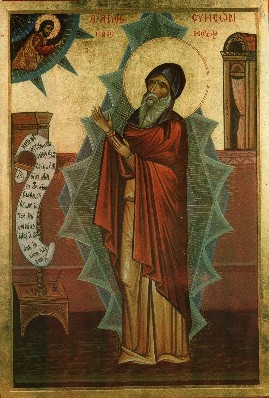
One distincitive voice in this discussion is that of S. Symeon the New Theologian (949-1022), an unconventional monk who was a subtle inheritor of the traditions of Origen, Evagrius and Pseudo-Dionysius, who had his own fair share of controversy over this matter. He taught that anyone could be the recipient of an experience of divine light in this world, not only those who had striven for it through ascetical struggle. Indeed, it is the will of God that all his children should experience the transfiguring light of his mercy. The human being is not, however, without agency in this matter. Indeed, he was clear that we will not experience this divine illumining unless we desire it and unless we undergo a metanoia, a repentance. So, although Symeon may seem like one who undermines the notion of a pattern of staged progress towards being united with God in love, a path of ascent towards our theosis, there is ‘work’ to be done by the human person, and that is the ‘work’ of desiring God and turning towards him, the one who is already there for us.

Fr John McGuckin’s excellent article on Symeon’s Hymns of Divine Eros summarises his spiritual teaching in this way:

Symeon’s great contribution to Christian spirituality, therefore, is how the incomprehensibility of God is defended not by insisting on God’s inscrutable absence from the earthly creation, but by celebrating the manner in which an incomprehsibly deep mercy reaches into the heart of alienation and returns the human soul to its correct purposes: the vision of the Creator. [in the 3rd volume of his collected essays, Illumined by the Spirit, SVS Press, 2017]

Symeon writes from the perspective of one who has experienced the divine light and who wishes others to feel that presence for themselves. It requires only readiness. I guess that, for some of us, that state of readiness entails a little more work than for others, as there may be all kinds of barriers in the way of that desire. But God is not out of reach!

When we try to speak of how it is that we enter into a life-giving encounter with God, we draw on our own experiences, as Symeon did, but also on the collective and accumulative experiences of our ancestors in the faith and on the paradigmatic words of Scripture. It is a process we can describe only haltingly, as we are speaking of things we are not able fully to voice. In these accounts, there are many repeated patterns and common threads, but there are also singular examples that don’t fit any mould. This should not surprise us, as we are all different, but there are two general truths we can affirm: God takes the initiative; God usually works with us. With Symeon, I would affirm a third: God desires that we experience his transfiguring light in this life.

Happy New Year!

Yesterday, Sunday 1st September, was the beginning of the church year for Orthodox Christians. In a happy coincidence*, today’s Gospel reading in the Roman and Anglican daily Eucharistic lectionaries was the same one as heard by our Orthodox fellow Christians yesterday:

So He came to Nazareth, where He had been brought up. And as His custom was, He went into the synagogue on the Sabbath day, and stood up to read. And He was handed the book of the prophet Isaiah. And when He had opened the book, He found the place where it was written:

“The Spirit of the Lord is upon Me,
Because He has anointed Me
To preach the gospel to the poor;
He has sent Me to heal the brokenhearted,
To proclaim liberty to the captives
And recovery of sight to the blind,
To set at liberty those who are oppressed;
To proclaim the acceptable year of the Lord.”

Then He closed the book, and gave it back to the attendant and sat down. And the eyes of all who were in the synagogue were fixed on Him. And He began to say to them, “Today this Scripture is fulfilled in your hearing.” So all bore witness to Him, and marveled at the gracious words which proceeded out of His mouth. [S. Luke 4:16-22, NKJV]

What a perfect passage to begin the church year! Christ’s preaching of a gospel to the poor; his announcement of the fulfillment of prophecy in him; the proclamation of ‘the acceptable year of the Lord’.

This last phrase took me back to a book I’ve treasured ever since I got it (October 1990! Sadly, I’ve got out of the habit of dating books when I get them…). It’s Fr Lev Gillet’s ‘The Year of Grace of the Lord’, which is a scriptural and liturgical commentary on the church year in the Eastern Rite. In his introduction, he makes the point – in typically direct Gillet style – that, whether we are considering the paschal cycle or the calendar of saints, ‘The liturgical year has but one and the same object, Jesus Christ; whether we contemplate him directly, or whether we contemplate him through the members of his body.’ He also reminds us that, throughout history, solitaries and ascetics have often either cut down or done without this rich liturgical resource, preferring instead the direct contemplation of Christ. This is a useful reminder of the secondary things on which we can often risk focussing instead of the One to whom they point.

But, using the calendar in the way it is intended allows to say something important at the start of this month:

Jesus, himself, is the embodiment of all deliverance and of all forgiveness. If at this moment I accept his word, his salvation, everything can become new for me. Today: on the first day of the year this offer is made new for me.

*I suspect it’s not really a coincidence – the Gospel reading will always fall close to 1 Sept, but it’s nice that it’s the very next day this year. Next year, the reading will actually be on Monday 1st Sept.