
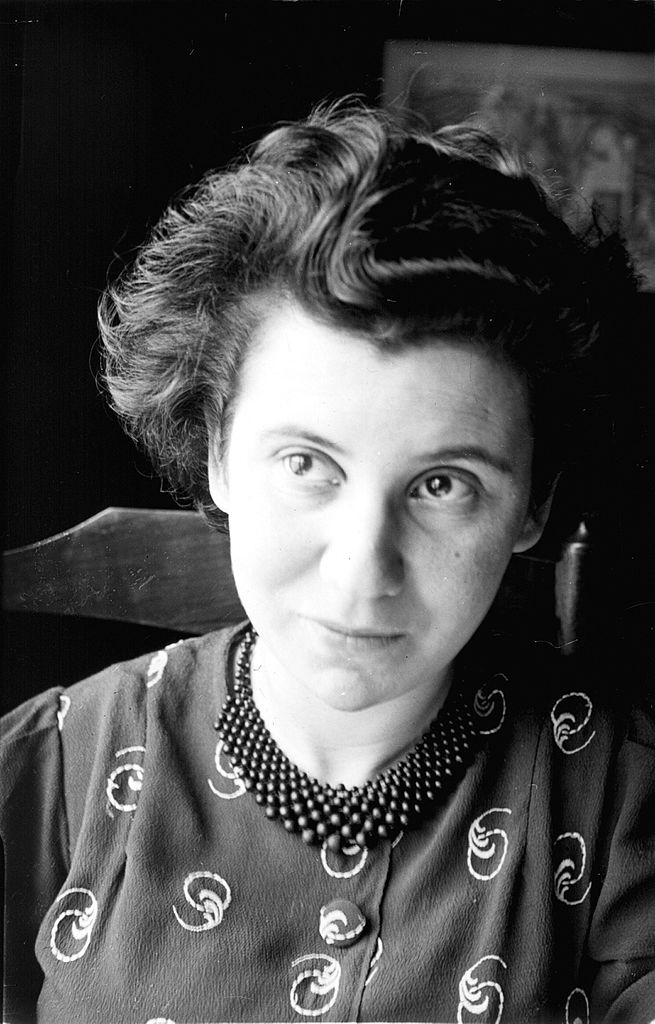
Etty Hillesum kept a diary of her experiences in the early 1940s in the Netherlands as a young Jewish woman caught up in the events of the Holocaust. That introductory sentence tells you almost nothing important about the remarkable testimony contained in these diaries, because Etty’s account is not simply that of a victim, but is the narrative of a conversion experience, the reflections of a deeply thoughtful and philosophically sophisticated woman, the insights of a mystic, the testimony of a unique chronicler of her times.
Etty’s inner journey over the short period covered by her published diaries was a remarkable one because of its scope: she begins her reflections as a somewhat self-absorbed and chaotic individual and ends them as a truthful, compassionate witness to the horrors around her who, nonetheless, refuses to hate any of the perpetrators of that horror. Her descriptions of contemplative prayer and language abot God are luminous and memorable, revealing a highly refined mystical sensitivity formed by a potent mixture of scripture, Rilke, Jung and Dostoevsky. It was phsychotherapy, not religion that led her in this direction, though her interactions with her therapist, friend and love, Julius Spier, are more than a little irregular! Here is one passage that spoke to me:
‘It’s not so simple, that sort of ‘quiet hour’. It has to be learnt. A lot of unimportant inner litter and bits and pieces have to be swept out first. Even a small head can be piled high inside with irrelevant distractions. True, there may be edifying emotions and thoughts, too, but the clutter is ever present. So let this be the aim of the meditation: to turn one’s innermost being into a vast empty plain, with none of that treacherous undergrowth to impede the view. So that something of ‘God’ can enter you, and something of ‘Love’. Not the kind of love-de-luxe that you revel in deliciously for half an hour, taking pride in how sublime you feel, but the love you can apply to small, everyday things.’
I will have much more to write about these diaries in the coming weeks, but I wanted to comment on the title given to the edited version, published in English in 1983, which also includes a selection of Ettty’s letters. It’s title is ‘An Interrupted Life’ and there is certainly the sense that the life of a woman of such talent and insight dying in such appalling circumstances at the age of 29 was tragically interrupted. Etty is well aware of her likely fate, though she does express the hope that she will survive in order to give a full account of the events through which she lived. However, there is also a sense in which her life was not ‘interrupted’ because she had such a powerful awareness of the necessity of living each new day as fully as possible: ‘Let me use and spend every minute and turn this into a fruitful day, one stone more in the foundations on which to build our so-uncertain future.’ She was fond of Jesus’ teaching about the lilies of the field and the birds of the air from the Sermon on the Mount. And she could speak of how one simple life can contain the whole of life: ‘I am with the hungry, with the ill-treated and the dying, every day, but I am also with the jasmine and with that piece of sky beyond my window; there is room for everything in a single life.’
Etty Hillesum’s life embraced such fullness that it is only partially true to describe it as having been ‘interrupted’. The witness she bears to the events around her and, more importantly, to the possibility of living a good and loving life in the face of such chaos and destruction, are full and complete. She is an inspiring example of the enduring and eternal quality of love and truth.
 Point Vierge